• Skip to primary navigation
  • Skip to main content

My Life After Prison

Resources for the incarcerated and their families.

  • Home
  • About
  • Contact Us
  • BREAKING NEWS !!
  • Florida
  • Louisiana
  • Show Search
Hide Search

Florida

A Trip To The Planetarium For Kayle

William Kissinger · August 17, 2025 · Leave a Comment

Carrying Our Veterans On Our Shoulders

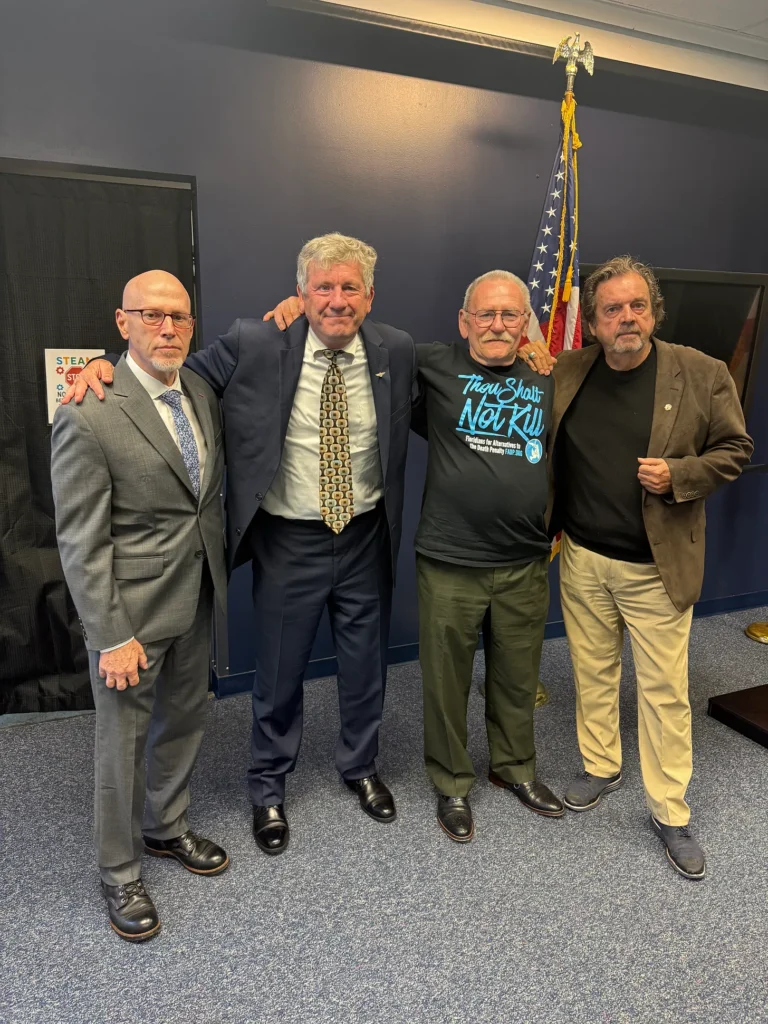
Today I had the honor of being the final speaker at an event/press conference sponsored by Floridians For Alternatives To The Death Penalty and Death Penalty Action. I was joined by 3 other Veterans who are active in representing Veterans and, honestly? I felt a good bit out of my depth. Man, EVERYBODY outranked me! There was a retired Navy Captain, a retired Army Major, a retired Army Sergeant and finally, me, a lowly Airman 1st Class, USAF.

Everybody was smarter than me. Everybody dressed better than me. They were charismatic like you just wouldn’t believe! They all had 20, 30, even 40 years invested in their careers doing exactly what they were doing. And I was the last speaker, so I really faced an uphill battle going into the fight. But I had a clearly distinct advantage in one regard and outranked them all in one aspect – I was the ONLY one in the room who had served 47 years in one of the worst prisons in America. I’m pretty certain that I was the only convicted murderer present (though I cannot be entirely certain of that detail !). LoL!

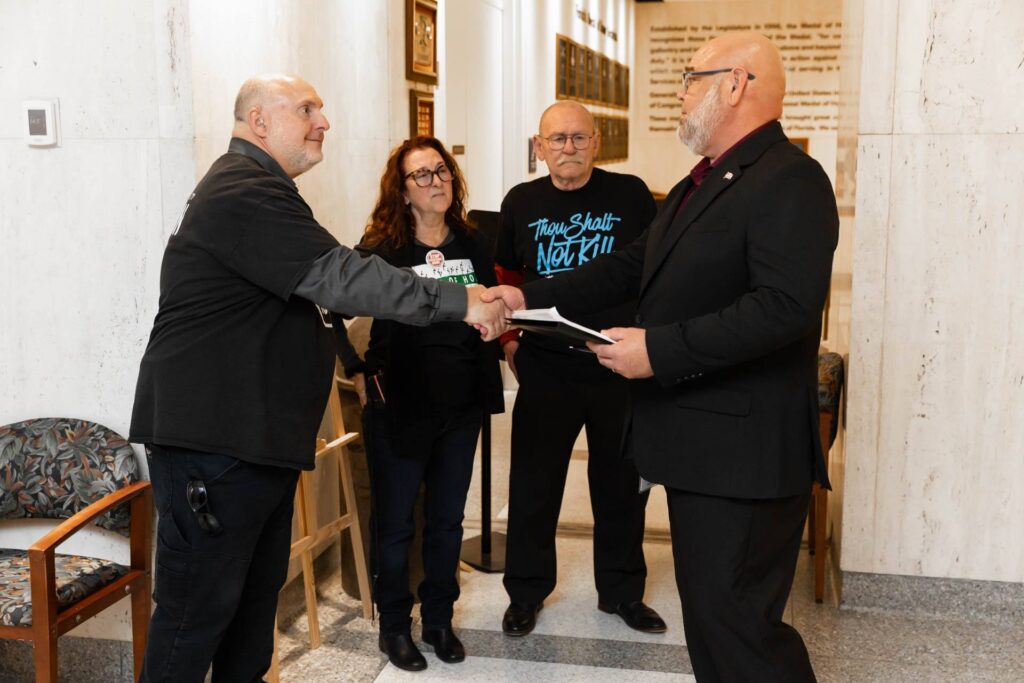
(L-R) Tom Dunn, Esq. (USA) [Kayle Bates’ Trial Attorney] , Art Cody, Esq., (USN), Director Center for Veteran Criminal Advocacy, Bill Kissinger, A1st, (USAF), Justice Advocate, David Ferrier, retired Sergeant (USA) Mitigation Investigator

We were all gathered together in a room at the Challenger Learning Center in Tallahassee, Florida, a beautiful complex with scale models of the Challenger spacecraft, an IMAX theater, and a planetarium that will dazzle you.

TOP – The Planetarium BOTTOM – The Event Room

It was a beautiful setting for a serious discussion on a gruesome event – the pending execution of Kayle Bates, whose execution at time of this writing is scheduled for 6:00pm, August 19, 2025.

The four of us had only met the night before at a dinner organized by the bubbly and energetic Grace Ellen Hanna, the Board Secretary of FADP. I cannot stress enough how calming of a presence Grace carries with her effortlessly, and in all of my moments of vulnerability (frequent!) was there to push me forward. She also served as my personal taxi service for which I am forever grateful.

Grace Ellen Hanna, Board Secretary, FADP

Art Cody was the last to arrive to the dinner due to travel complications, so Dave Ferrier, Tom Dunn and his wife, Millie, (Litigation Attorney, Federal Public Defender Program), Grace and I proceeded to enjoy each other’s company and a great meal. In the process, we discovered that we actually knew other people in each other’s orbit. See, the capital punishment circle is actually very small and it’s like the old adage that “Everybody knows somebody and somebody knows everybody.” Millie knew Federal Public Defenders in Louisiana that I’ve worked with and Dave knew ex-convicts that I had known and seen go home many years before that Dave had worked to prove his innocence.

The reason the circle is small is actually multifold: the job of representing and defending or appealing a death-sentenced prisoner demands a dedication, passion and commitment that very few attorneys possess. The passion comes from believing that every human life is sacred and to put it all very simply

Killing people who kill people to show people that killing people is wrong just doesn’t work. It only kills more people.

The job also requires that a person be able to set aside all of their own biases and prejudices and fight to save this life – this hated and reviled and contemptible life, and that’s a pretty apt descriptor for virtually every single death-eligible prisoner ever to stand trial. But, it’s also the descriptor used by those who wholeheartedly support and actually energize the push for more and faster executions.

I have talked with and interviewed many wardens and high-ranking security officials and they are almost unanimous in their belief that capital punishment does not serve the purpose of deterrence and does much more harm than good. It only creates more victims. The executioners, also, become victims as they are forced to kill another human being with whom they have near-daily contact and become familiar with over time.

And then, there are those who simply take a “clinical” or “sanitized” viewpoint: “It’s a part of the job and I may not like it, but I have to do it so I’ll be humane and kind to him while I do it.” Like shooting him with a bullet made of sugar? Suffocating him with a fragrant and aromatic, flower-scented gas? Hanging him with a rope made of the finest silk? Or, there’s this:

“When Warden Burl Cain came that afternoon to my office, I poured him coffee. He’d hosted a new coroner’s technician for dinner the night before and told me how he’d described the execution to him, to calm his worries: “Four officers will escort Dobie from his cell. The strapdown team is well trained, each officer has an arm or a leg. If he resists, they’ll carry him. They’ll strap him to the gurney and it’ll be over quickly—then you’ll pronounce him dead.” He spoke as matter-of-factly as discussing the weather. I was appalled; Cain was serene. Before leaving, he slipped off to deliver a brand-new “Stone Cold” Steve Austin T-shirt to Dobie—an awkward farewell gift.”

Bill Kissinger, from “The Last Breakfast”, in the Harvard Inquest Magazine.

How do we distance ourselves from this mindset, from this policy-directed death, from this sanitized version of pre-meditated murder? By opposing it, fighting against it and demanding by every possible measure that we abolish it. Here is where the passion and commitment comes in. This is the passion that Tom Dunn carries with him to trial, that Art Cody defends his clients with and that David Ferrier investigates and searches for mitigating evidence with.

Kayle Bates was Tom’s first capital case after leaving the Army. It turned into a decades-long journey with Kayle that continues today.

Kayle Bates – Scheduled for execution August 19, 2025

After graduating from high school, Kyle Bates followed his lifetime dream and he enlisted in the military with the Florida National Guard. He served for six years. He participated in the unit’s activation to quell the race riots in Liberty City in Miami in 1980. He also attended and completed the Army’s rigorous jungle training in Panama. Essentially, his wife said after those two incidences, Kyle was different. He had nightmares. He’d wake up screaming loudly, acting crazy, and not recognizing or remembering where he was.

As Art explained, every veteran on death row has service connected, post-traumatic stress disorder, traumatic brain injury, or other service related disabilities. It is a service connected disability because were it not for the fact he served, had he not raised his hand and volunteered for duty, he would not have this mental health problem and would not have committed this crime and never found himself on death row.

Every veteran who served – especially in combat or combat zones – brings home scars that are sometimes plainly visible, and sometimes invisible and unseen, and sometimes don’t manifest themselves for months, years, or even decades later. Such close and frequent association with violent death does not leave one unscathed. Of the general population of the United States, only about 5% are veterans. Yet the segment of veterans on death row is 10%, or twice the rate of normal population. That rate is growing – the United States has been in more wars in the past 30 years than any other period in history. More veterans are exposed to the horrors of war and ever more powerful and destructive weapons.

Sgt. David Ferrier, U.S. Army, a Vietnam veteran and longtime capital defense investigator, talked about how little the system accounts for veterans’ trauma. He said, “In criminal cases, it’s very common that the only person in the courtroom familiar with the veterans’ experience, with the veterans’ military experience, are the veterans themselves.”

He reminded the audience that PTSD is not a new thing, and neither is the state’s neglect of it.

“Although it’s been referred to by many different names over the centuries — soldier’s heart, shell shock, battle fatigue, Vietnam syndrome, post-traumatic stress disorder — it has been part of warfare since ancient times,” Dave said. “It’s written about in The Odyssey, it’s written about in All Quiet on the Western Front. It’s written about in a variety of Vietnam oriented books. Such close and frequent association with violent death in combat does not leave one unscathed.”

And then, it was my turn. I spoke not only as a former Airman First Class, U.S. Air Force, Vietnam veteran and criminal justice reform advocate, but also as an ex-offender who spent 47 years in prison. During much of my time in prison I served as an Inmate Counsel Substitute (paralegal) and much of it working on death row.

When I began, I recalled the lessons of military service from the first day of basic training through tech school and on to the combat zone:

“When a brother is hurting, when a brother is wounded, you run to him, you put him on your shoulders and you carry him as far as you can towards safety.”

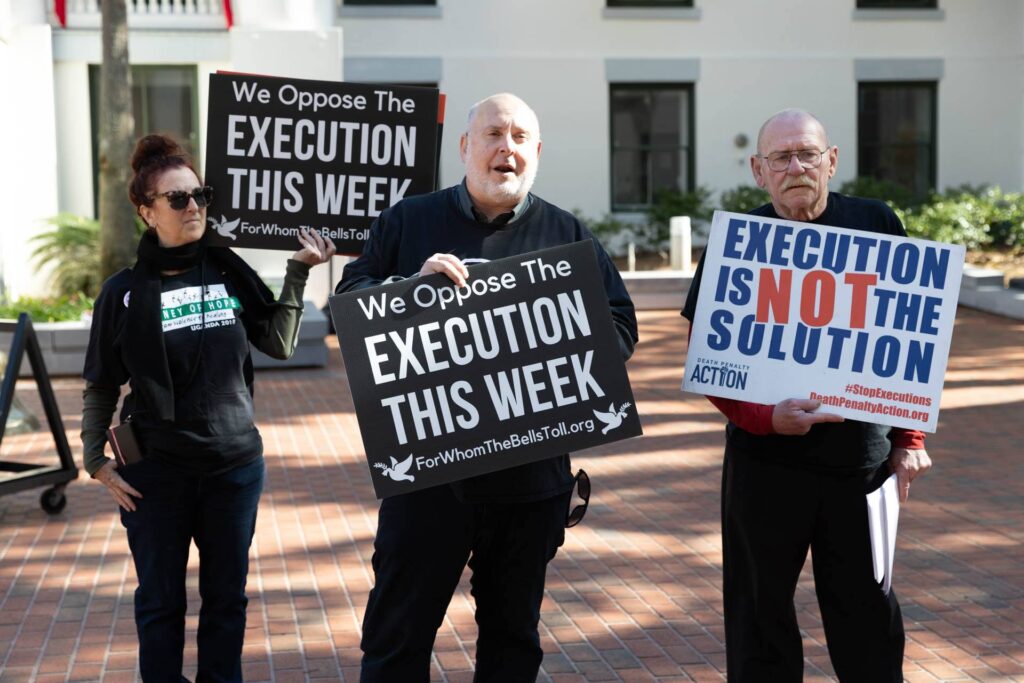
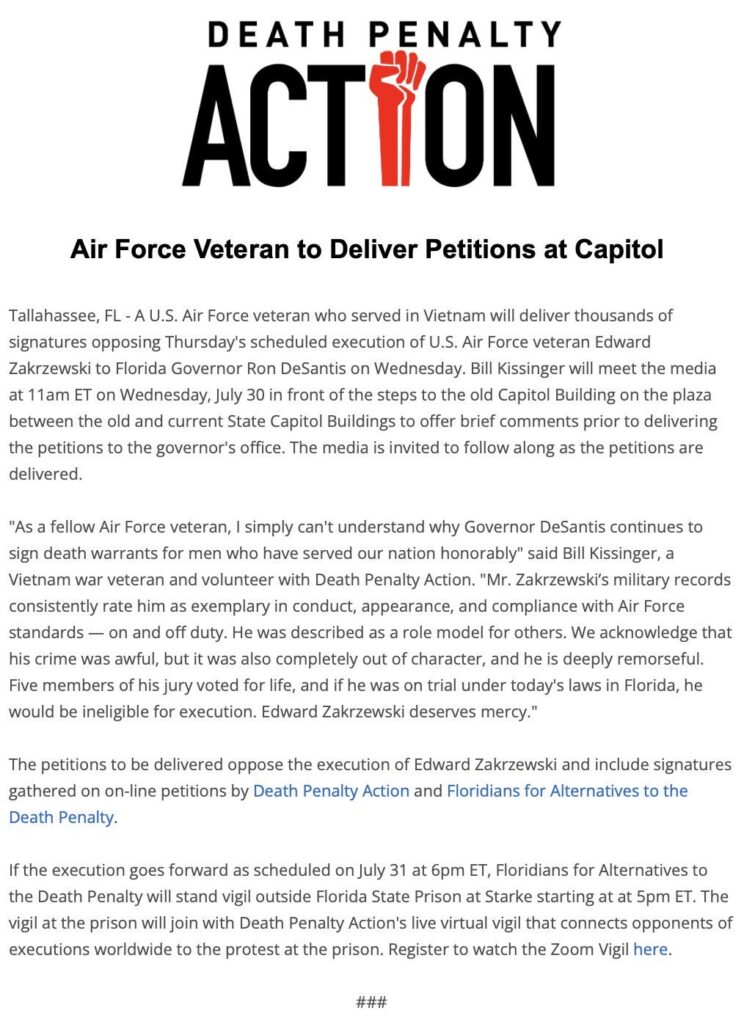
I described the day I brought a petition with 4,000 signatures to Governor DeSantis’ office pleading to halt the execution of Edward “Zak” Zakzwreski only 2 weeks before this day on behalf of FADP and Death Penalty Action.

“When I did this, it reawakened something in me and it was hard for me to deal with, but it reminded me that when I went down that hall, I was carrying every veteran on death row with me.”

I also spoke about sitting with a condemned man on death row during his final hours.

I was given permission by the warden to spend the last 24 hours of his life with Dobie Gillis Williams. Dobie, at the time of his execution, was a 39-year-old black man that was tried and convicted by an all white jury with a white prosecutor, a white judge, a white defense attorney, white sheriffs in the courtroom, and he was terrified. The night before his execution, I stood at the bars with him talking to him, and we had his lawyer on the phone and she was just crying and screaming, “Dobie, there’s nothing else I can do! I can’t do anything else.”

I tell that whole story here on Substack in “The Last Breakfast.”

Our veterans are in the same shape. We send them to war. They face the horrors of war. They come home and we ignore them. Governor DeSantis has had the opportunity four times this year to pick a veteran up and put him on his shoulder and carry him to safety. He’s not doing it. Instead, he’s choosing to rush them to the chamber of death and it’s wrong. It is time to stop executions for everyone, but most especially for our most vulnerable, and our most vulnerable are our veterans. They’re the most deserving of our care, our empathy, and they’re deserving of us picking them up and putting them on our shoulders and carrying them to safety.

I sincerely hope that I am able to continue carrying this weight towards safety for at least a bit farther. My appreciation extends to everyone who helps to shoulder the burden and help me carry it. My thanks to Grace, Bridget, Art, Dave, Tom and Millie, and to all the unseen hands that help to make it a little bit lighter.

The Collision Course of Ron DeSantis and Edward Zakrzewski

William Kissinger · August 17, 2025 · Leave a Comment

It Ends In The Death House

My trip to see the Governor – or the Floridian, His Excellency of Death – was eventful in that I met a wonderful Episcopal priest by the name of Reverend Susan Gage. Just as everything seemed as if it were going to go all the way off the rails, she showed up staring intently at my T-Shirt and Vietnam Veteran cap, as if God Himself had sent her to rescue me from my shortcomings. Made me wonder if God was either partial to Episcopalians or showing a bit of mercy to a blundering sinner.

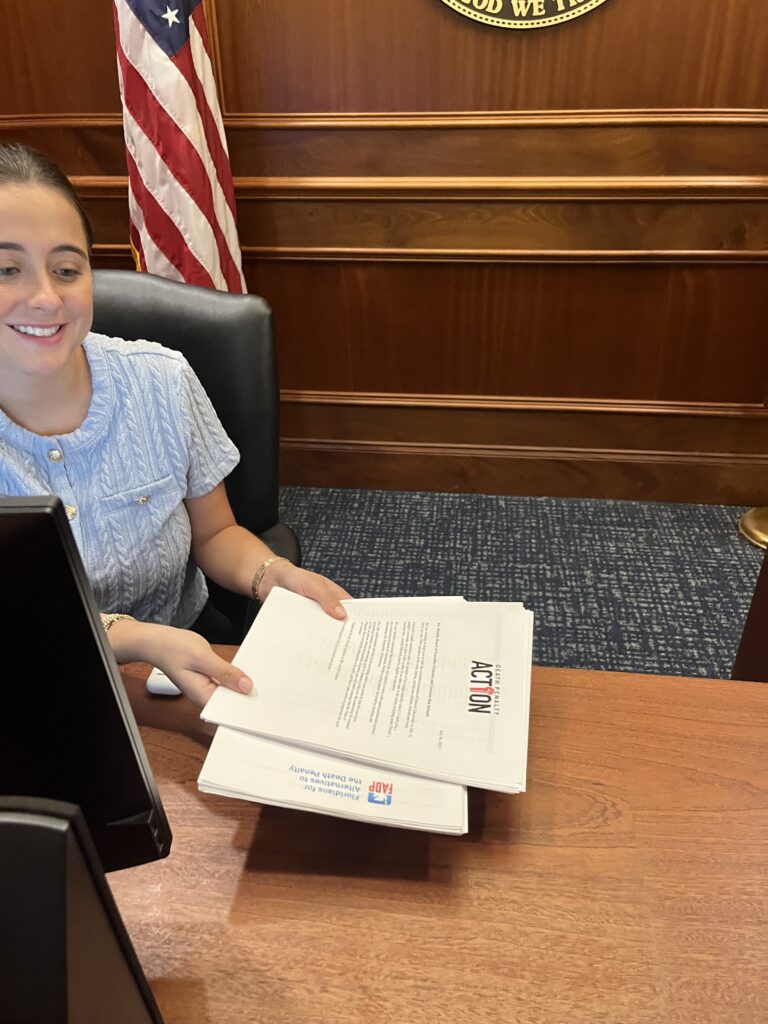
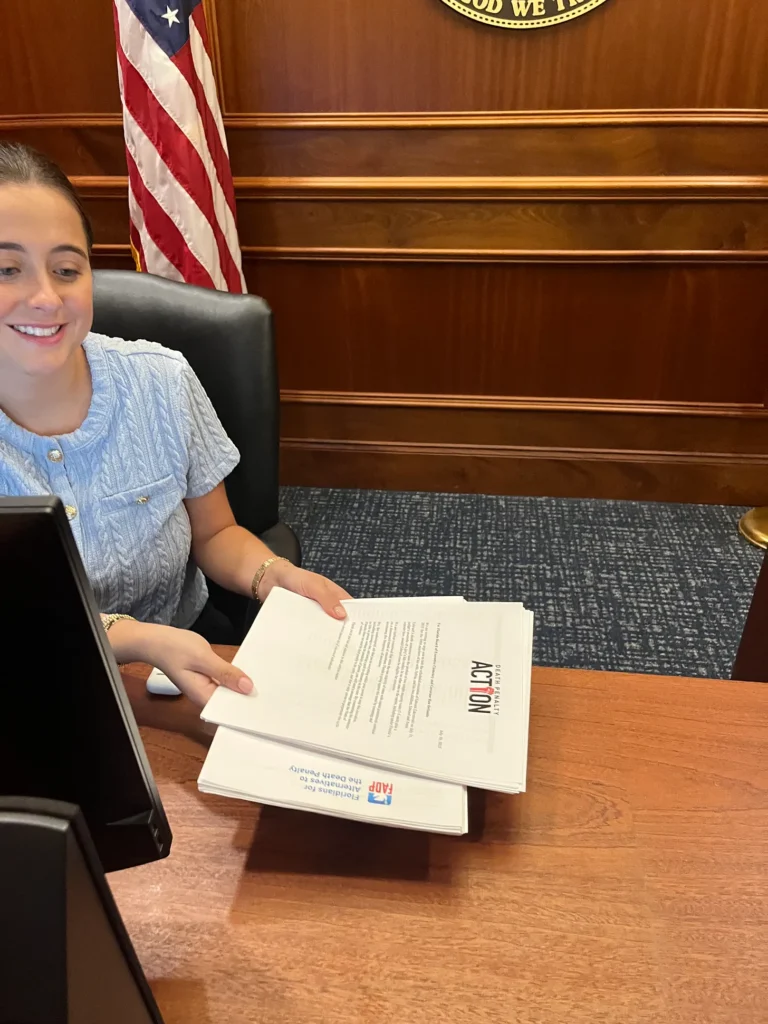
In my very first solo mission for Floridians for Alternatives to the Death Penalty and Death Penalty Action, I made a tremendous boo-boo. I made a miscalculation timewise and presented the dual Petitions for Clemency for Edward Zakrzewski 30 minutes early.

The only saving grace for me was twofold – no media timely made an appearance and I did have the foresight to take photos of my presentation to the beaming young lady sitting behind the imposing barrier of Reception. It appears that – as Susan patiently explained to me – it is very difficult to catch the attention of the media in Tallahassee. It seems as though executions have become so commonplace in Florida that they don’t even bother to show up any more unless, of course, there might possibly be an “illegal alien” lurking in the crowd for FHP and ICE to grab..

First though, before making my way haltingly to Reception. I had to traverse the Security barricades manned at the moment by no less than five big and burly armed officers, X-ray machines, bowls for metallic odds and ends and wands which they use to scan your person. Now, to be quite honest with you, this was an intimidating process; however, not one I am completely unfamiliar with. You see, I was in prison for 47 calendar years in Louisiana, so I am well-versed in intrusive – and abusive – searches.

This was neither intrusive or abusive, yet I knew the drill perfectly: empty your pockets, open the backpack, deposit phone(s) in the bowl, set laptop to the side, lift arms and follow directions, turning when told, and when approved gather everything back up. Ask for and receive directions. Simple, right? Absolutely. Traumatic and triggering? Absolutely!

It brought to mind all of the many, many times I had been shaken down in Angola by angry officers or scared officers or rookie guards who felt they had to make an impression. Though, honestly, they never impressed me. After a while you don’t let it affect you, just let them do their thing and hope for the best. Back in the game, we used the old trick of placing a hard-core porno magazine about 1/3 of the way down in our boxes, and it’d get them every time. They’d lock in on that and sit there for an hour slowly paging through the mag, and “forget” to shake us down and their lieutenant would call for them to go somewhere else. Then the new policies went into effect and porn was contraband, so we had to find new ways – and, of course, we did.

I got through this shakedown without incident, and was so relieved I thought I might pass out. Just a few short years before in prison, I had been fortunate to get in to a Shift Supervisor’s office without risking either a serious cursing out or lockdown or at the extreme, an ass-kicking and a stay in extended lockdown. They gave me directions and I gathered my belongings, stuffing pockets and lugging my backpack into place and sat off on this amazing journey. Once the necessary turns and corners were navigated, there it sat before me, this imposing hallway – the Pathway to Power.

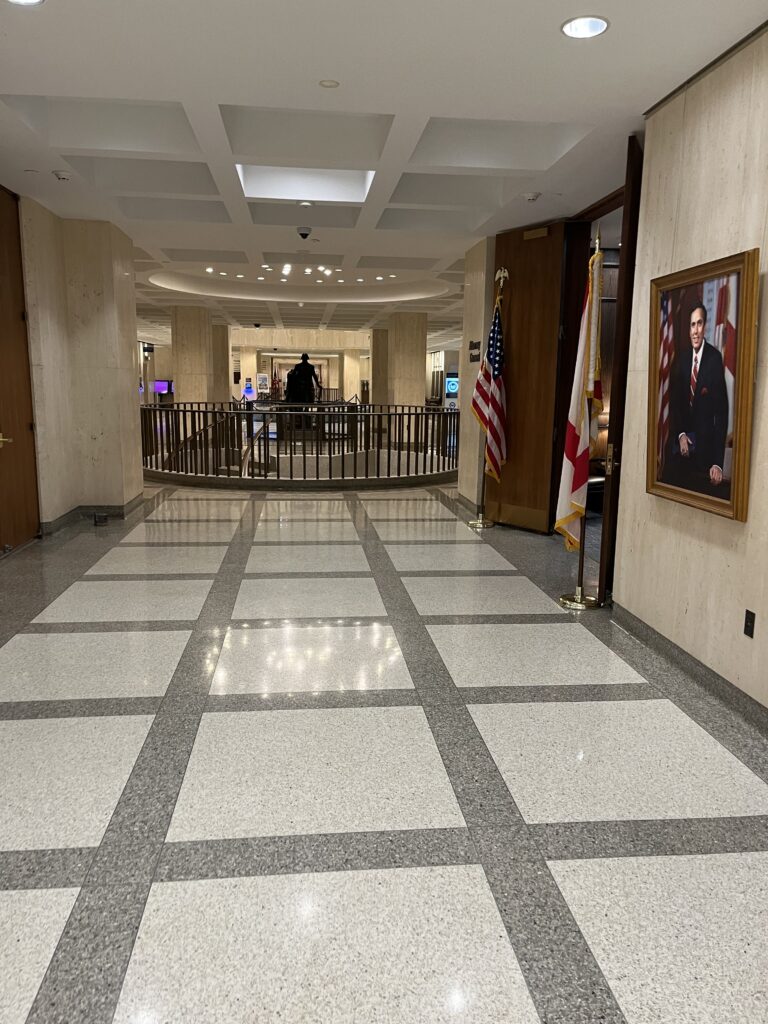
Hallway To The Governor’s Office – Tallahassee, FL

It was an impressive Pathway for sure, a long and wide gleaming corridor of marble lined with gilt-framed oversized oil paintings of former Governors, some of whom went on to become US Congressmen. I am an Air Force Vietnam veteran and had the distinct pleasure of delivering a dispatch to a Brigadier General who was based in Saigon (now Ho Chi Minh City) in much less grand quarters but who had equally impressive powers. The General had the power to summarily kill hundreds or thousands of people via a radioed order with no qualms, no hesitation, no regrets. This man at the end of this corridor had the power to kill only one at a time and solely with the stroke of a pen, but his actions would affect dozens now, and perhaps even future generations.

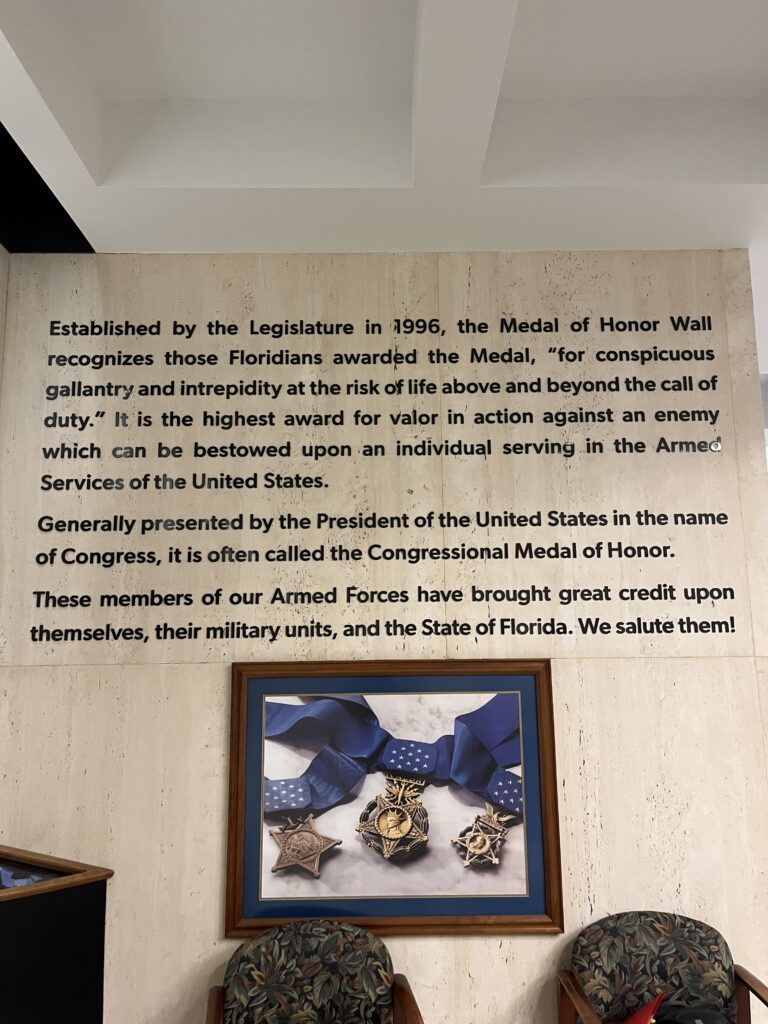
What struck me as I turned to enter this hallway was a section with an elegant display of plaques attached to the wall, marked “Florida’s Medal of Honor Recipients” in bold black lettering. There is an accompanying inscription explaining the Medal and describing in summation, “These members of the Armed Forces have brought great credit upon themselves, their military units, and the State of Florida. We salute them!”

Tribute Wall In The Capitol, Tallahassee, FL

Edward “Zak” Zakrzewski was an Air Force veteran. His military records consistently rated him as exemplary in conduct, appearance, and compliance with Air Force standards — both on and off duty. He was often described as a role model for others. He was no Medal of Honor recipient by far, but he did his job and was prepared to sacrifice himself in service to this country if called upon. His crime was horrific, but it was also completely out of character, and proof that he was plagued with emotional and mental burdens too heavy to bear.

These thoughts would not escape my mind as I crossed the final few feet into the opening to the sanctum. My heart was thundering in my chest as the lovely young lady behind the high desk asked if she could help me. Remembering my mission, I said very clearly and confidently

“I hope so, ma’am. I’m here as a representative of Death Penalty Action – a nationwide organization opposed to the death penalty – and Floridians for Alternatives to the Death Penalty. I have petitions from both groups with thousands of signatures calling upon Governor DeSantis to halt tomorrow’s execution of Edward Zakrzewski. We ask that he honor this man’s military service, and the fact that half of his jury wanted to spare him death. I would like to submit these petitions to him. Would you accept them and may I speak with him?”

Petition Delivery At The Governor’s Office

To make it short, she accepted them with a smile and a few kind words and said that the Governor was not available. I thanked her and left, my heart rate slowing as I did until I came to the Medal of Honor display, and turned to ponder it again. It was tragic that politicians constantly harp on and on about how they “care for our Veterans,” and “honor their service” and “respect their sacrifices.” In reality, Veterans are expendable on the fields of battle and in everyday life. Why else would there be thousands of veterans battling addiction, sleeping on the streets and in whatever shelter they can find? Why else would vital physical and mental health services be cut and benefits denied?

Edward Zakrzewski sought treatment and sought help for his demons. He remained deeply remorseful for many years. Five members of his jury voted for life instead of death. The judge overrode their decision. If he stood trial under today’s laws in Florida, he would be ineligible for execution. Edward Zakrzewski deserved mercy, and hardly merited a moment’s thought as DeSantis’ pen scrawled across the warrant calling for his execution.

Florida this year has carried out more executions than any other state, while Texas and South Carolina are tied for second with four each. A 10th execution is scheduled in Florida on Aug. 19 and an 11th on Aug. 28 under death warrants signed by Republican Gov. Ron DeSantis.

Florida is setting records already – it’s just now August 1 – and not in a good way.

My mission was complete, if not a success. RIP, Zak.

Let’s Talk Trauma & The Death Penalty.

William Kissinger · September 2, 2024 · Leave a Comment

Boy, is there a LOT going on! In the world of state AND federal politics, we have heated arguments and an attempted assassination and questions of whether it was staged or real….we have a former President assembling a group of followers and going to Arlington National Cemetery where he posed for a photo op after aides physically shoved a Park employee aside…do YOU have an opinion on that?

Also, in other areas, civil rights attorney Ben Crump speaks out on Democracy Now! after a judge dismisses counts against 2 officers in the Breonna Taylor case (a Black female EMT who was killed by police IN her home during a raid…a raid based upon a falsified police officer’s affidavit), saying that the victim’s boyfriend was responsible for her death because he produced a legally owned firearm and officers returned fire. Bear in mind that the warrant was falsified, it was in the wee hours of the morning, Breonna and her boyfriend were asleep, and the officers broke the doors down for entry. Hmmmmm….

FORMER President Trump has said that he would offer immunity to police officers if he is elected, when “Qualified Immunity” is one of the largest problems in policing, corrections and virtually every field where someone has power over another. This is another issue that divides us as a nation – those who oppose this are labelled as liberal and weak, and supporters of it are called radical and inhumane. Where does one draw the line? Where do YOU draw the line?


AND, the death penalty is back on the table and liberally in use around the country. The old arguments both for and against it are resurfacing, and the usual voices are raised in defense of their positions.


LAST NIGHT, August 29, 2024, at 6:15 pm, the State of Florida executed Loran Cole.

The Death Penalty in America: A System of Inequality

The Death Penalty is Looming.                                             Photo by Bruno Guerrero on Unsplash

The System’s Inequities

The execution of Loran Cole in Florida highlights the ongoing debate surrounding capital punishment in the United States. While proponents argue that the death penalty serves as a deterrent to crime and provides justice for victims, critics contend that it is a cruel and unusual punishment that disproportionately affects marginalized populations.

The death penalty system in America is often criticized for its systemic biases, particularly against individuals from underprivileged backgrounds. Here are some key factors that contribute to this inequality:

  • Racial Disparity: Studies consistently show that individuals from minority racial groups are more likely to be sentenced to death than their white counterparts, even when controlling for other factors. This racial bias can be attributed to systemic racism within the criminal justice system.
  • Economic Inequality: Individuals from low-income backgrounds often have limited access to quality legal representation, which can significantly impact the outcome of their cases. This can lead to harsher sentences, including the death penalty.
  • Mental Health Issues: Many individuals who are sentenced to death have underlying mental health conditions that may have contributed to their crimes. However, these conditions are often not adequately addressed, which can result in unfair trials and harsh sentences.

The Impact of Trauma and Neglect

The experiences of individuals from underprivileged backgrounds can often be marked by trauma and neglect, which can contribute to criminal behavior. If these individuals had access to mental health services, substance abuse treatment, and other support programs, it is possible that they could have been prevented from committing crimes.

For example, individuals who have experienced childhood abuse or neglect may be more likely to develop mental health problems, such as depression, anxiety, or substance abuse. These conditions can increase the risk of criminal behavior. By providing early intervention and support, it may be possible to address these underlying issues and reduce the likelihood of criminal activity.

The Need for Reform

The death penalty system in America is in need of significant reform to ensure that it is applied fairly and justly. This includes:

  • Addressing systemic biases: The criminal justice system must take steps to address racial and economic disparities in death penalty cases.
  • Improving access to legal representation: Individuals facing the death penalty should have access to high-quality legal representation, regardless of their income level.
  • Addressing mental health issues: Individuals with mental health conditions should have access to adequate treatment and support.
  • Exploring alternatives to the death penalty: Some states are considering alternatives to the death penalty, such as life without parole. The life is saved!

By addressing these issues, it may be possible to create a more just and equitable death penalty system that better serves the needs of all Americans.


BUT, what about Loran Cole, a White male?

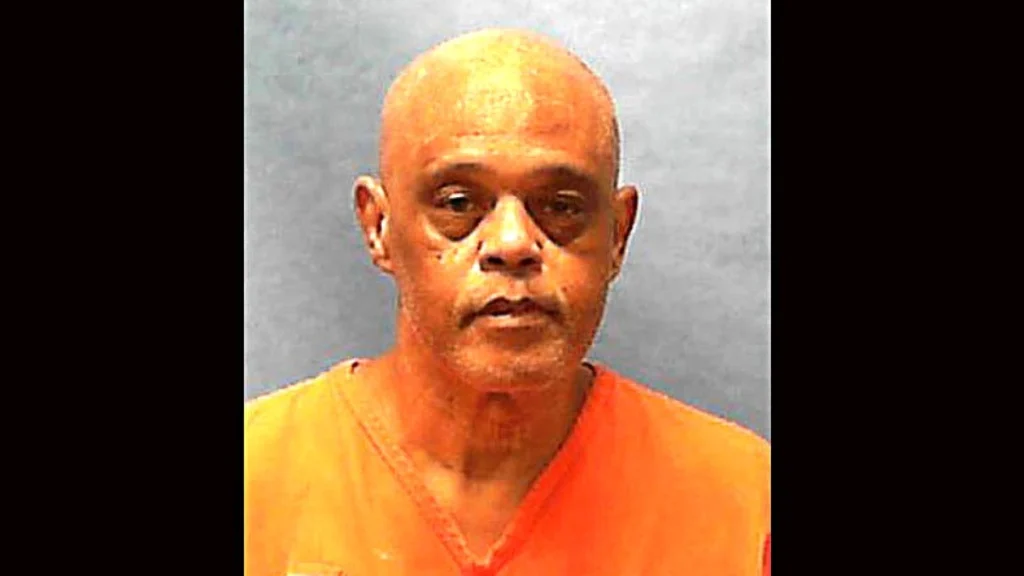
Photo provided by FL Department of Corrections

Loran Cole, 57, received a lethal injection and was pronounced dead at 6:15 p.m. at Florida State Prison for the 1994 killing of an 18-year-old college student. Cole also was serving two life sentences for rape.

Cole did not have a last statement. “No sir,” he said when asked if he had some final words.

After the procedure began about 6 p.m. Cole briefly looked up at a witness in the front row. After three minutes, he began taking deep breaths, his cheeks puffing out. For a brief moment, his entire body trembled. Five minutes into the procedure, the warden shook him and shouted his name. Cole then appeared to stop breathing and then was declared dead.

Cole’s crime was horrific.

Cole and a friend, William Paul, befriended two college students in the Ocala National Forest, court records showed. After talking around a fire, the men offered to take the siblings to see a pond. While away from the campsite, Cole and Paul jumped the victims and robbed them, according to the records.

THUS, another life was taken…and, another life was surrendered.


Although it is widely known that I oppose the death penalty in ALL cases, this particular case is haunting. It is haunting in that the state of Florida was actually complicit in the heinous murder that landed Cole on death row. I say that because he was a surviving victim of the notorious Dozier School for Boys in Marianna, Florida.

Cole was an inmate at a state-run reform school where he and other boys were beaten and raped. The state has since apologized for the abuse and this year passed a law authorizing reparations for inmates at the now-shuttered reform school. The lawyers also argued Cole shouldn’t be executed because he was mentally ill and had brain damage and Parkinson’s disease.


Not that long ago, Florida Governor Ron DeSantis (R), signed legislation setting aside $20-million in compensation for surviving victims of Dozier.

“It’s been too long,” said state Sen. Darryl Rouson, the Democrat who sponsored the bill. “This is but a small token for a vast ocean of hurt, but it’s what we can do now.”

As he spoke, a group of about 20 victims stood in the Senate public gallery, one wiping tears from his eyes.

“Thank you for never giving up. Thank you for continuing to fight. Thank you telling the story and the stories of those who are not here and can’t speak. We salute your presence today,” Rouson continued.


What is striking about this is the fact that Cole survived the Dozier School, and the trauma he was exposed to, later led him to commit the crime for which he was put to death by Florida, the same state that allowed the Dozier facility to operate. Bodies are still being dug up there.

The mass grave that was discovered in 2017 on the grounds of the campus has been thoroughly excavated, and the remains of many of the missing boys have been identified. At least 75 separate remains were mingled in the mass grave. However, it is possible that there may be additional remains to be found. Given the history of the school and the number of boys who disappeared (hundreds), it’s unlikely that all of the missing have been accounted for.

If new evidence emerges or additional remains are discovered, authorities may need to reopen the investigation. But for now, the primary focus of the investigation has shifted to identifying the victims and bringing those responsible for the abuses to justice.

One might say that all of the survivors of Dozier were compensated. Some received a monetary reward. Some were killed by Florida.

Just 2 weeks ago, I did a long post on trauma and where it leads if not treated. It often leads to prison, and sometimes to death. For Loran Cole it led to his death, and the death of a promising young man in a college student. For now, Florida has failed.

My Life After Prison

Copyright © 2025 · Website provided by Boomajoom