• Skip to primary navigation
  • Skip to main content

My Life After Prison

Resources for the incarcerated and their families.

  • Home
  • About
  • Contact Us
  • BREAKING NEWS !!
  • Florida
  • Louisiana
  • Show Search
Hide Search

Death-Penalty

A New Era for Executions in Louisiana

William Kissinger · March 28, 2025 · Leave a Comment

The Advent of Nitrogen Gas Hypoxia
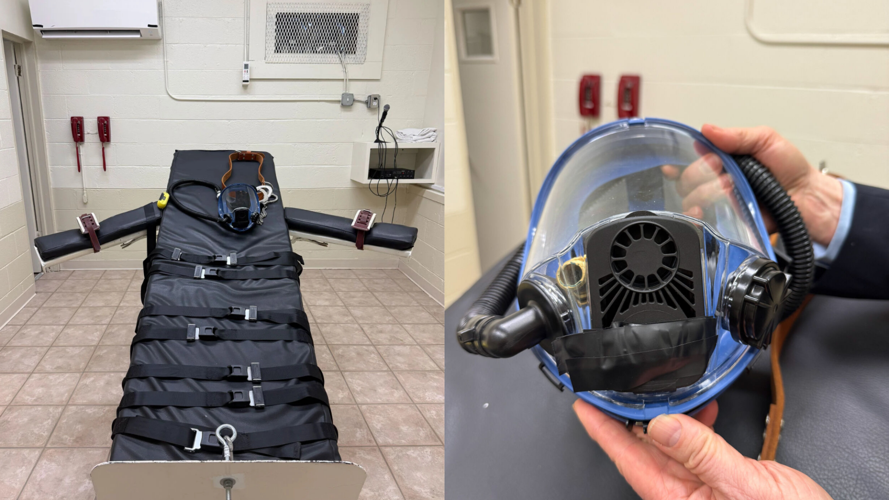
The execution gurney and a mask used for the nitrogen gas

Gerald Bordelon expe­dit­ed his own exe­cu­tion by choos­ing to waive his appeals, includ­ing his direct appeal, which was pre­vi­ous­ly thought to be a manda­to­ry part of the state’s death penal­ty process. Bordelon vol­un­teered for exe­cu­tion after he was found guilty of rap­ing and mur­der­ing his 12-year-old step­daugh­ter. The choice to waive his appeals was met with strong dis­agree­ment from his team of inmate coun­sels (pris­on­ers who serve as attor­ney sub­sti­tutes), who jointly decid­ed that they would not assist him in his decision. Bordelon was rep­re­sent­ed in his desire to be exe­cut­ed by a fairly well-renowned con­sti­tu­tion­al law attor­ney from Baton Rouge, Jill Craft. She suc­ceed­ed in hav­ing the court allow Bordelon to waive his appeals, but lat­er said she “would nev­er do it again. “

Bordelon told media sources why he vol­un­teered for his exe­cu­tion: ​“I’m doing this for [the vic­tim] Courtney. I’m doing it for her fam­i­ly. I’m doing it for me. I’m doing it for my fam­i­ly so they don’t have to wor­ry and deal with it for the next 20 or 30 years. I’m doing it for a lot of reasons.”

On January 7, 2010, Gerald Bordelon was executed via lethal injection at Angola. He was one of three people executed in the United States on that same day. The others were Vernon Lamont Smith in Ohio and Kenneth Mosley in Texas. They were the first three people to be executed in the United States in 2010. The executions of three or more people within a single day is something that has not occurred in the United States since.

In Bordelon’s last statement, he apologized to LeBlanc’s family as well as his own. His last meal was fried sac-a-lait fish, topped with crawfish étouffée, a peanut butter and apple jelly sandwich, and chocolate chip cookies. He was pronounced dead at 6:32 pm.
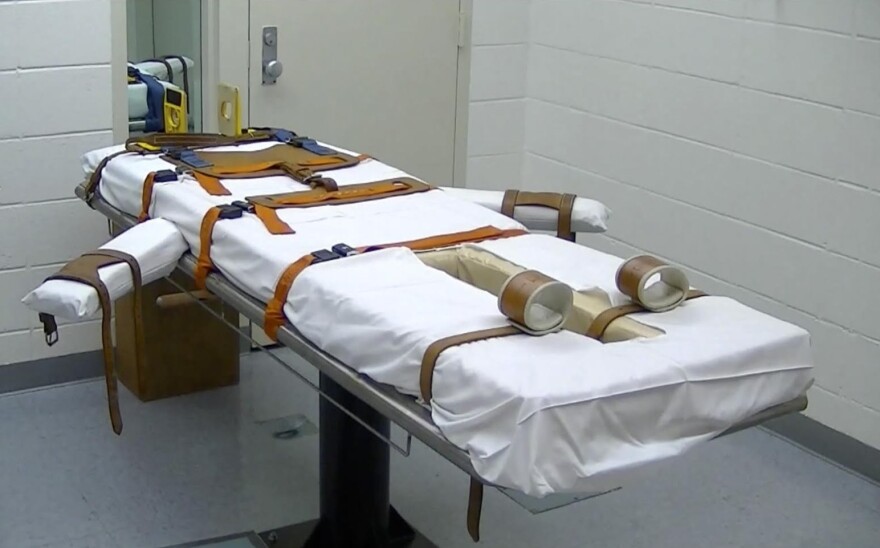
As of this writing, Bordelon remains the last person executed in Louisiana, which has gone over fourteen years without an execution. He is also the only person to have been executed in Louisiana since 2002, when Leslie Dale Martin was executed for murder.

Due to a 2012 lawsuit challenging Louisiana’s lethal injection protocol and drug companies not wanting their products associated with capital punishment, Louisiana has been unable to carry out executions, despite capital punishment still being a legal penalty.

Despite remaining a legal penalty, there have been no executions in Louisiana since 2010, and no involuntary executions since 2002. Execution protocols are tied up in litigation due to a 2012 lawsuit challenging Louisiana’s lethal injection procedures. In addition, certain pharmaceutical companies and manufacturers do not want their products associated with capital punishment, meaning the state has been unable to obtain lethal injection drugs. Despite this, a 2018 survey by the Louisiana State University found that the majority of Louisiana citizens still support capital punishment.

On March 5, 2024, Governor Jeff Landry signed a law allowing executions to be carried out via nitrogen gas and electrocution. The law has opened the door for Louisiana to resume capital punishment after a fourteen-year hiatus.

No more is there a “liberal” decision on what is appropriate punishment or humane. So a new era is beginning in Louisiana, one of anger and hatred and – for lack of a better term – revenge, and simple political expediency. Landry campaigned on a promise to “get tough on crime,” even though crime had been on a steadily declining path for several years. The problem is that New Orleans has a fairly high profile and when anything happens there, it gets highly magnified. People ignored what was actually happening, a lot of people did not vote, and Landry won. Like Trump, Landry claims that a “mandate from the people” propelled him into office, when nothing could be further from the truth.

In the 2023 Louisiana gubernatorial election held on October 14, 2023, Jeff Landry secured the governorship by winning 51.56% of the vote, totaling 547,827 votes. His closest competitor, Democrat Shawn Wilson, received 25.93% of the vote, amounting to 275,525 votes.

Voter turnout for this election was notably low, with only about 36% of registered voters casting ballots—the lowest for a Louisiana gubernatorial primary since 2011. Given the state’s 2,970,167 registered voters, this means that approximately 18% of the total electorate voted for Landry.

While Landry achieved a majority in the primary, allowing him to avoid a runoff, the low voter turnout indicates that a significant portion of the electorate did not participate in the election. Therefore, his victory margin reflects both his support among active voters and the broader context of limited electoral engagement.

So, his election was hardly a “mandate,” but Louisiana’s largely conservative “Bible Belt” reputation strongly supports him. That fact is reflected in him holding a super-majority in both houses of government. He used this to great effect when, within days of taking office, he instituted a complete reversal of all criminal justice reform gains made during the terms of his predecessor, John Bel Edwards.

New methods of execution, legislation authorizing treatment of 17-year-olds as adults, elimination of parole for prisoners, and a vast reshaping of the entire criminal justice system were accomplished within weeks in “Special Sessions” of the legislature. He very publicly announced that he was creating a new State Police Troop to be based in New Orleans that would assist the notoriously corrupt NOPD in fighting crime in the city.

Within weeks, the new Troop was responsible for three separate car chases that resulted in four crashes. These incidents led to multiple arrests and the confiscation of various drugs and firearms. In at least one of those chases, an innocent bystander was injured.“

As far as the promised results, violent crime in New Orleans actually increased in the months ahead. Homicides increased, armed robberies increased, and a horrible homegrown terrorist attack occurred in New Orleans’ famed French Quarter, about a month shy of the city hosting the Super Bowl. Landry created a bit of a stir with his court-challenged uprooting of the city’s homeless population and placing them in an “emergency shelter,” and in the process destroying most of their personal property while promising to implement programs designed to get people off the streets and into residential housing.

So the Super Bowl came and went – and my Chiefs LOST! – and things pretty much returned to normal. Louisiana went right back to figuring out the quickest and best way to efficiently kill someone.

We are now less than a week from Jessie Hoffman’s execution date of March 18th, 2025. Although court challenges are in the works, it remains to be seen whether the date will be met, and what sense of pride Jeff Landry and Attorney General Liz Murrill will exhibit following the intentional killing of a man. Both Landry and Murrill have said that they are “honoring promises made to the victims and their families.” I think they are only creating more victims.

The federal district court in Baton Rouge, Middle District of Louisiana Judge Shelly Dick, has granted an injunction halting (or at the very least, slowing) the execution, and in the ruling, said,

CONCLUSION

Considering the foregoing, Plaintiff’s Motion to Reconsider the Court’s Denial of his RLUIPA Claim (Count VI) shall be DENIED. Plaintiff’s Motion for Preliminary Injunction shall be GRANTED on the Eighth Amendment claim, and Defendants are enjoined from executing Jessie Hoffman on March 18, 2025, using nitrogen hypoxia. Plaintiff’s Motion for Preliminary Injunction is DENIED as to Counts III and IV.

March

Baton Rouge, Louisiana, this 11th ___ day of _______________, 2025.

S

________________________________

SHELLY D. DICK

CHIEF DISTRICT JUDGE

MIDDLE DISTRICT OF LOUISIANA

I pray for Jessie Hoffman, as I hope you do as well. He has asked that he be executed via firing squad, due to the lack of prolonged suffering. He will simply be wiped out of existence, like some terrible substance on the bottom of Jeff Landry’s shoes and Liz Murrill’s heels, and not drowned with fluids filling his lungs and prolonged suffering. After all, isn’t this what you wanted, Louisiana? Oh, I see. You didn’t vote. Well, then you couldn’t care.

Sleep safe tonight, Jessie Hoffman.

NOTE: This post was originally posted on March 14, 2025, prior to Jessie’s execution by nitrogen gas. I just never had the opportunity to update all of the places my writing is available. You can find my writing on my Substack or on my other website at MyLifeAfterPrison.

If you like my work, and appreciate it, please note that donations are greatly appreciated.

Let’s Talk Trauma & The Death Penalty.

William Kissinger · September 2, 2024 · Leave a Comment

Boy, is there a LOT going on! In the world of state AND federal politics, we have heated arguments and an attempted assassination and questions of whether it was staged or real….we have a former President assembling a group of followers and going to Arlington National Cemetery where he posed for a photo op after aides physically shoved a Park employee aside…do YOU have an opinion on that?

Also, in other areas, civil rights attorney Ben Crump speaks out on Democracy Now! after a judge dismisses counts against 2 officers in the Breonna Taylor case (a Black female EMT who was killed by police IN her home during a raid…a raid based upon a falsified police officer’s affidavit), saying that the victim’s boyfriend was responsible for her death because he produced a legally owned firearm and officers returned fire. Bear in mind that the warrant was falsified, it was in the wee hours of the morning, Breonna and her boyfriend were asleep, and the officers broke the doors down for entry. Hmmmmm….

FORMER President Trump has said that he would offer immunity to police officers if he is elected, when “Qualified Immunity” is one of the largest problems in policing, corrections and virtually every field where someone has power over another. This is another issue that divides us as a nation – those who oppose this are labelled as liberal and weak, and supporters of it are called radical and inhumane. Where does one draw the line? Where do YOU draw the line?


AND, the death penalty is back on the table and liberally in use around the country. The old arguments both for and against it are resurfacing, and the usual voices are raised in defense of their positions.


LAST NIGHT, August 29, 2024, at 6:15 pm, the State of Florida executed Loran Cole.

The Death Penalty in America: A System of Inequality

The Death Penalty is Looming.                                             Photo by Bruno Guerrero on Unsplash

The System’s Inequities

The execution of Loran Cole in Florida highlights the ongoing debate surrounding capital punishment in the United States. While proponents argue that the death penalty serves as a deterrent to crime and provides justice for victims, critics contend that it is a cruel and unusual punishment that disproportionately affects marginalized populations.

The death penalty system in America is often criticized for its systemic biases, particularly against individuals from underprivileged backgrounds. Here are some key factors that contribute to this inequality:

  • Racial Disparity: Studies consistently show that individuals from minority racial groups are more likely to be sentenced to death than their white counterparts, even when controlling for other factors. This racial bias can be attributed to systemic racism within the criminal justice system.
  • Economic Inequality: Individuals from low-income backgrounds often have limited access to quality legal representation, which can significantly impact the outcome of their cases. This can lead to harsher sentences, including the death penalty.
  • Mental Health Issues: Many individuals who are sentenced to death have underlying mental health conditions that may have contributed to their crimes. However, these conditions are often not adequately addressed, which can result in unfair trials and harsh sentences.

The Impact of Trauma and Neglect

The experiences of individuals from underprivileged backgrounds can often be marked by trauma and neglect, which can contribute to criminal behavior. If these individuals had access to mental health services, substance abuse treatment, and other support programs, it is possible that they could have been prevented from committing crimes.

For example, individuals who have experienced childhood abuse or neglect may be more likely to develop mental health problems, such as depression, anxiety, or substance abuse. These conditions can increase the risk of criminal behavior. By providing early intervention and support, it may be possible to address these underlying issues and reduce the likelihood of criminal activity.

The Need for Reform

The death penalty system in America is in need of significant reform to ensure that it is applied fairly and justly. This includes:

  • Addressing systemic biases: The criminal justice system must take steps to address racial and economic disparities in death penalty cases.
  • Improving access to legal representation: Individuals facing the death penalty should have access to high-quality legal representation, regardless of their income level.
  • Addressing mental health issues: Individuals with mental health conditions should have access to adequate treatment and support.
  • Exploring alternatives to the death penalty: Some states are considering alternatives to the death penalty, such as life without parole. The life is saved!

By addressing these issues, it may be possible to create a more just and equitable death penalty system that better serves the needs of all Americans.


BUT, what about Loran Cole, a White male?

Photo provided by FL Department of Corrections

Loran Cole, 57, received a lethal injection and was pronounced dead at 6:15 p.m. at Florida State Prison for the 1994 killing of an 18-year-old college student. Cole also was serving two life sentences for rape.

Cole did not have a last statement. “No sir,” he said when asked if he had some final words.

After the procedure began about 6 p.m. Cole briefly looked up at a witness in the front row. After three minutes, he began taking deep breaths, his cheeks puffing out. For a brief moment, his entire body trembled. Five minutes into the procedure, the warden shook him and shouted his name. Cole then appeared to stop breathing and then was declared dead.

Cole’s crime was horrific.

Cole and a friend, William Paul, befriended two college students in the Ocala National Forest, court records showed. After talking around a fire, the men offered to take the siblings to see a pond. While away from the campsite, Cole and Paul jumped the victims and robbed them, according to the records.

THUS, another life was taken…and, another life was surrendered.


Although it is widely known that I oppose the death penalty in ALL cases, this particular case is haunting. It is haunting in that the state of Florida was actually complicit in the heinous murder that landed Cole on death row. I say that because he was a surviving victim of the notorious Dozier School for Boys in Marianna, Florida.

Cole was an inmate at a state-run reform school where he and other boys were beaten and raped. The state has since apologized for the abuse and this year passed a law authorizing reparations for inmates at the now-shuttered reform school. The lawyers also argued Cole shouldn’t be executed because he was mentally ill and had brain damage and Parkinson’s disease.


Not that long ago, Florida Governor Ron DeSantis (R), signed legislation setting aside $20-million in compensation for surviving victims of Dozier.

“It’s been too long,” said state Sen. Darryl Rouson, the Democrat who sponsored the bill. “This is but a small token for a vast ocean of hurt, but it’s what we can do now.”

As he spoke, a group of about 20 victims stood in the Senate public gallery, one wiping tears from his eyes.

“Thank you for never giving up. Thank you for continuing to fight. Thank you telling the story and the stories of those who are not here and can’t speak. We salute your presence today,” Rouson continued.


What is striking about this is the fact that Cole survived the Dozier School, and the trauma he was exposed to, later led him to commit the crime for which he was put to death by Florida, the same state that allowed the Dozier facility to operate. Bodies are still being dug up there.

The mass grave that was discovered in 2017 on the grounds of the campus has been thoroughly excavated, and the remains of many of the missing boys have been identified. At least 75 separate remains were mingled in the mass grave. However, it is possible that there may be additional remains to be found. Given the history of the school and the number of boys who disappeared (hundreds), it’s unlikely that all of the missing have been accounted for.

If new evidence emerges or additional remains are discovered, authorities may need to reopen the investigation. But for now, the primary focus of the investigation has shifted to identifying the victims and bringing those responsible for the abuses to justice.

One might say that all of the survivors of Dozier were compensated. Some received a monetary reward. Some were killed by Florida.

Just 2 weeks ago, I did a long post on trauma and where it leads if not treated. It often leads to prison, and sometimes to death. For Loran Cole it led to his death, and the death of a promising young man in a college student. For now, Florida has failed.

  • « Go to Previous Page
  • Page 1
  • Page 2
  • Page 3

My Life After Prison

Copyright © 2026 · Website provided by Boomajoom