• Skip to primary navigation
  • Skip to main content

My Life After Prison

Resources for the incarcerated and their families.

  • Home
  • About
  • Contact Us
  • BREAKING NEWS !!
  • Florida
  • Louisiana
  • Show Search
Hide Search

Florida

Can’t We Just Get Off Of This Insane Merry-Go-Round?!

William Kissinger · December 12, 2025 · Leave a Comment

The Mis-Adventures Of A Road Warrior In The Fight Against Capital Punishment

AI-Generated Image of A Clownish Merry-Go-Round Trying To Exit A Freeway

I write about the death penalty. Mostly in two states – Louisiana and Florida. But on the whole, everywhere in America. I also write a lot about prison as I have a whole lot of experience with being a prisoner there, and I like to write from the POV of experience and authority. 47 years of experience, I believe, qualifies me in that regard.

I happen to take executions personally, as I have been personally impacted by the deliberate and premeditated killing of a human being by an impersonal entity commonly referred to as a “state.” See my earlier story, published by HARVARD Inquest, “The Last Breakfast.” It is a coldly, well-planned and deeply impactful process that severely impacts families and turns them all into more victims. In fact, victims are used by this “state” as a promotional gimmick to justify their actions and actually promote their use as an example of “justice.” Florida goes a step further and has laws to shield everything about the process.

Execution of a criminal offender does NOT provide closure to a family member of a murdered victim. And, one of my personal heroes, who has an incredibly touching story, SuzAnn Bosler, used her forgiveness of the killer of her father to advocate for his clemency, even though he tried to kill her as well.

SuzAnn Bosler, Whose Father Was Murdered In Front Of Her, And Who Was Left For Dead By The Killer Holds His Photo While Explaining Why She Forgave Him And Tried To Save Him From Execution

My personal interviews with SueZann left me heartbroken and weeping as she shared her story. Left for dead, she survived and eventually forgave the killer. She even hired her own attorney in an effort to save his life. Executions take a horrible toll on those who actually oversee and perform the executions themselves. The interviews with Allen Ault, the former Commissioner of Corrections for the State of Georgia, clearly tell us of this.

The lowly prison guards who participated in executions, underpaid and often underqualified to perform even the most menial of jobs, have been driven to desperate lengths. Because of a lack of support and trauma, they have often felt “less than,” and became “a murderer.” Some have resorted to suicide. Almost every single one of them changed their politics and their minds about executions after participating in one.

America has a wide variety of methods of killing people. The most common are (1) Lethal injection, (2) firing squad, (3) Electric chair and (4) nitrogen hypoxia suffocation. Nitrogen hypoxia is definitely an abomination, first used in Alabama, and later adopted in 3 other states: Alabama, Arkansas, Louisiana, Mississippi, and Oklahoma. Ohio and Nebraska have bills introduced as well to authorize the use of nitrogen to kill prisoners. All “Bible belt” states, all have MAGA “Christian” governors. Everyone is entitled to have their own view of Christianity; mine is that it is impossible for one to be both “pro-Life” AND a supporter of capital punishment.
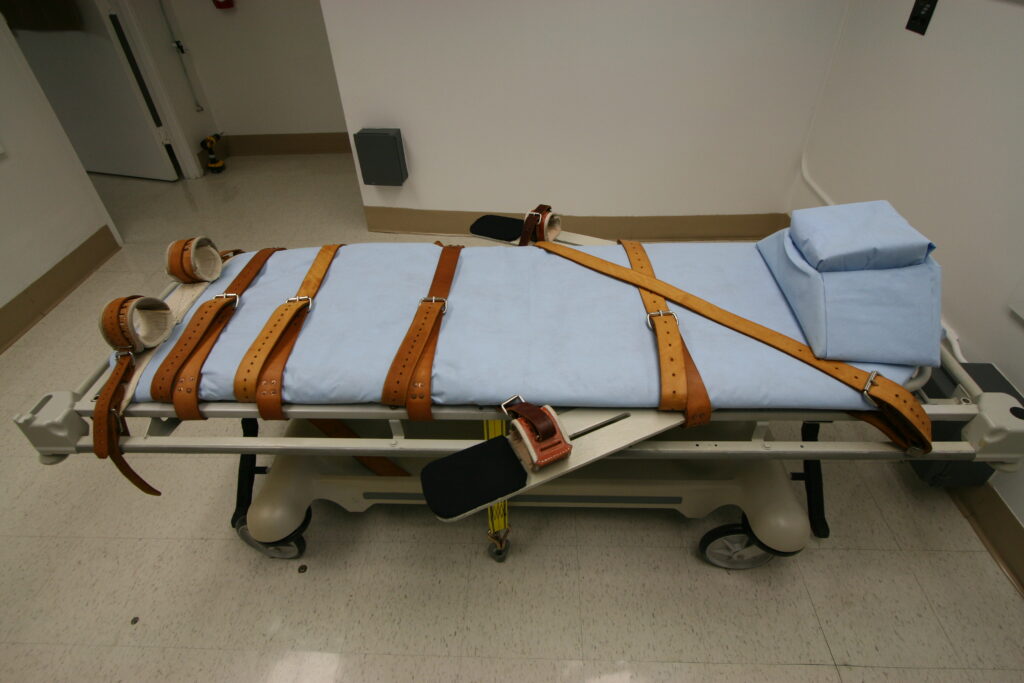
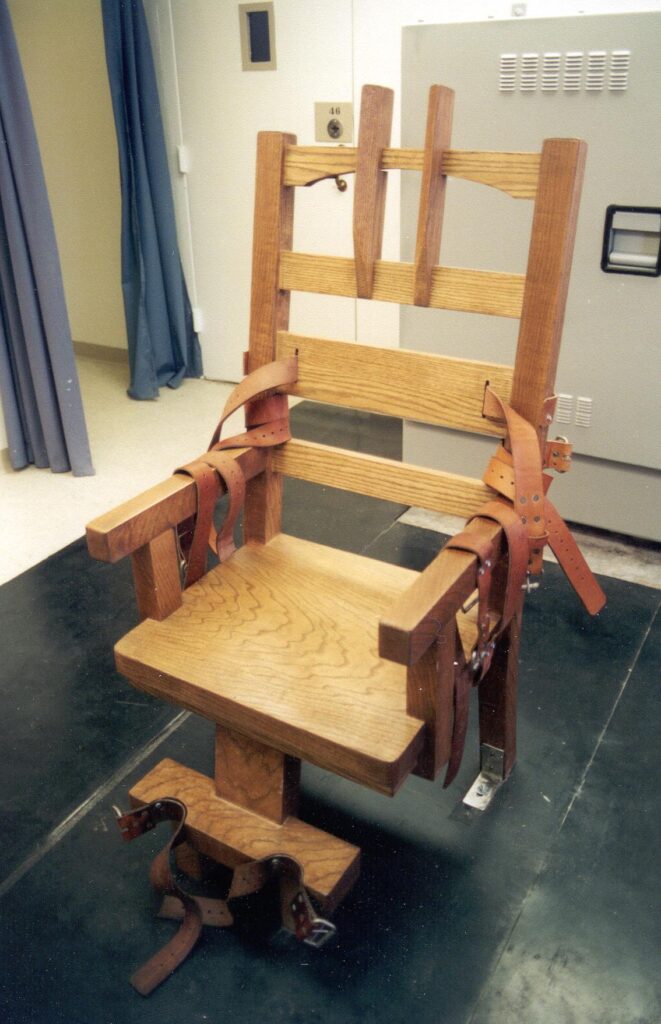
Florida’s Execution Gurney
Florida’s Electric Chair
Firing Squad Chair
Nitrogen Gas Cylinfer Tank
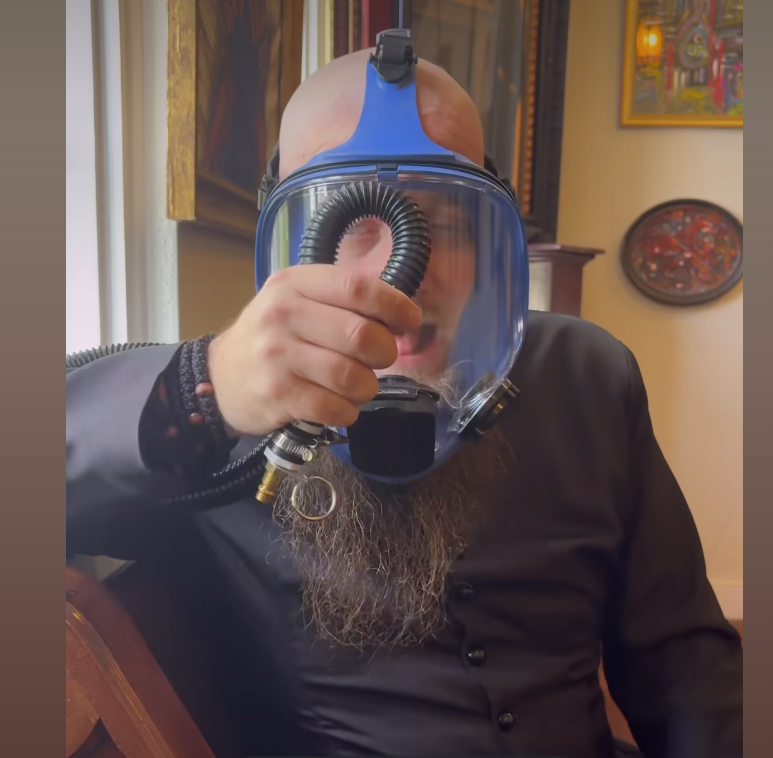
Rev. Dr. Jeff Hood Demonstrating Nitrogen Gas Hypoxia Mask Placed On Condemned Inmate

All of the methods are horrific.

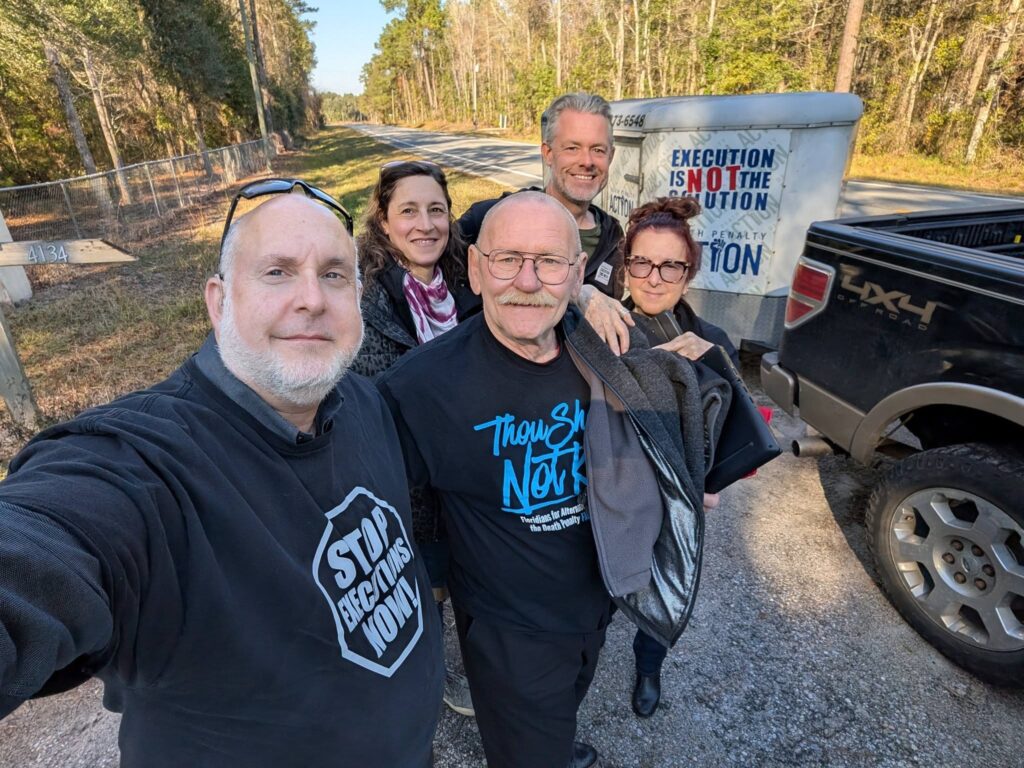
Let me tell you about my adventure with DeathPenaltyAction and Floridians for Alternatives to the Death Penalty yesterday, Tuesday, December 9, 2025. It was an exhausting day, beginning with a calm awakening at 4:00am. I hastily drank coffee, answered a flurry of overnight emails, fed and walked the dogs, took a shower and shaved, went outside and smoked a cigarette, and came back in to prepare for the trip.

I went to Tallahassee with my friend, Robert, and was picked up at 9:30 by the wonderful Grace Ellen, Executive Director of Floridians for Alternatives to the Death Penalty. We went to the Good Shepherd Church, where we attended a prayer service for the soon-to-be-executed Mark Allen Geralds, the victim (Tressa Pettibone) and her family, and everyone in the chain-of-command involved in the execution. Grace, Abraham – one of the original founders of FADP – and SuzAnn spoke about forgiveness and the urgency of stopping executions and why they are so wrong.

We finished loading the trailer with shirts and signs, and then set off on our excursion to the office of Governor Ron DeSantis, the most prolific of all of Florida’s executing governors.
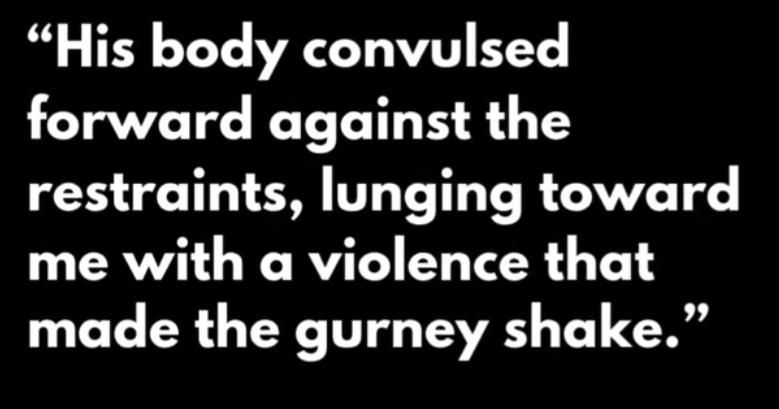
Quote from Rev. Dr. Jeff Hood After Witnessing The Nitrogen Hypoxia Execution Of Anthony Bell
Ringing Of The Bell
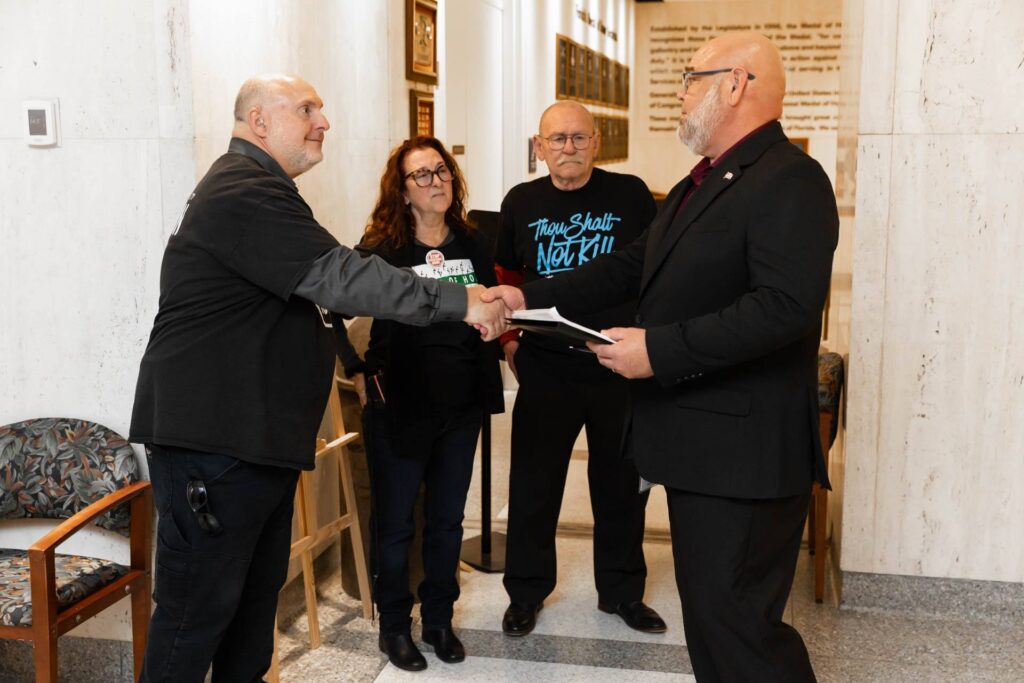
Presenting Our Petitions
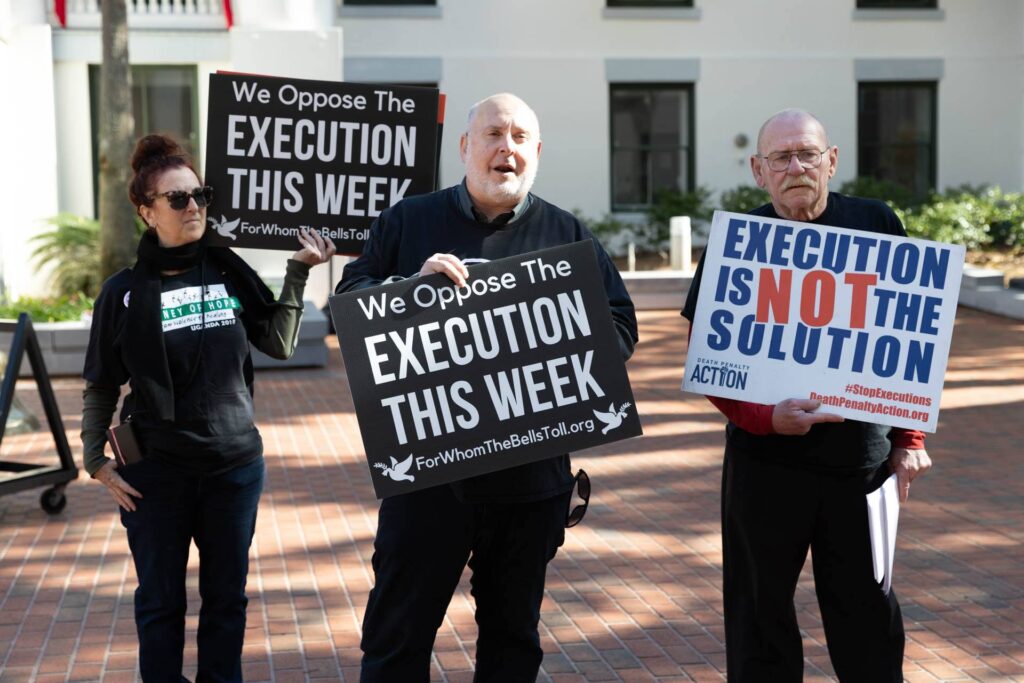
Videoing Our Protests At The Governor’s Office

The media was waiting for us and we were videod, and gave our interviews, and proceeded to the Governor’s Office. Following a security search and wanding, we made our way to the reception desk where we interacted with her and she summoned someone to meet with us. The Governor, obviously, would not come out to meet and talk with us. This is the 18th execution he has ordered to be carried out this year. He cannot be proud of what he is doing, after all, but he did send a couple of very nice Constituent Services Representatives to meet with us, and again we pleaded our case and presented petitions from both groups.
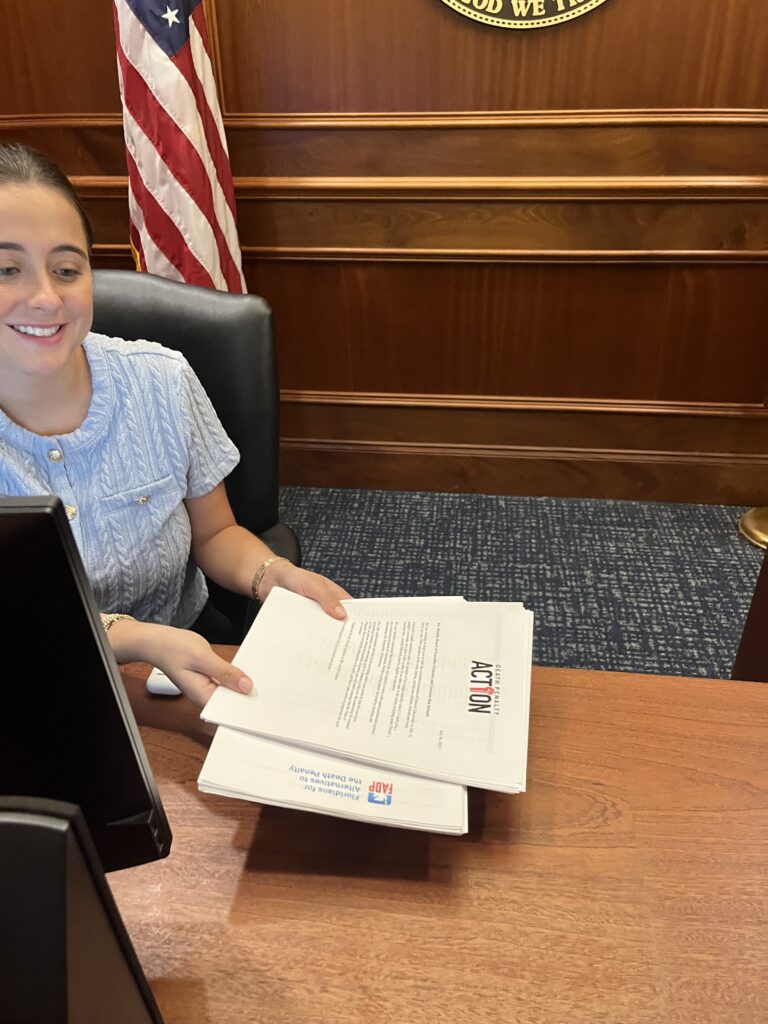
Our Petitions

Abe conducted the majority of the presentation explaining why we protest every execution and all of what is wrong with capital punishment. SueZann told her incredibly powerful story, and I touched on the wrongful conviction aspects and explained how Florida leads the entire nation in exonerations from their death row. Virtually every single exoneration from Louisiana involved one common factor – prosecutorial or official misconduct and illegal police conduct – torture, witness coercion or intimidation, and/or placing of informants in defendant’s cells who then gave false testimony to obtain convictions.

Later that evening, many who opposed the execution gathered at the state prison and held their service with Father Phil and the congregants from Our Lady of Lourdes (Daytona Beach). There were prayers and there was song and there was homily, followed by the ringing of the same bell – the same heavy cast bell that Abe totes with him everywhere he goes, to every execution, to every vigil.
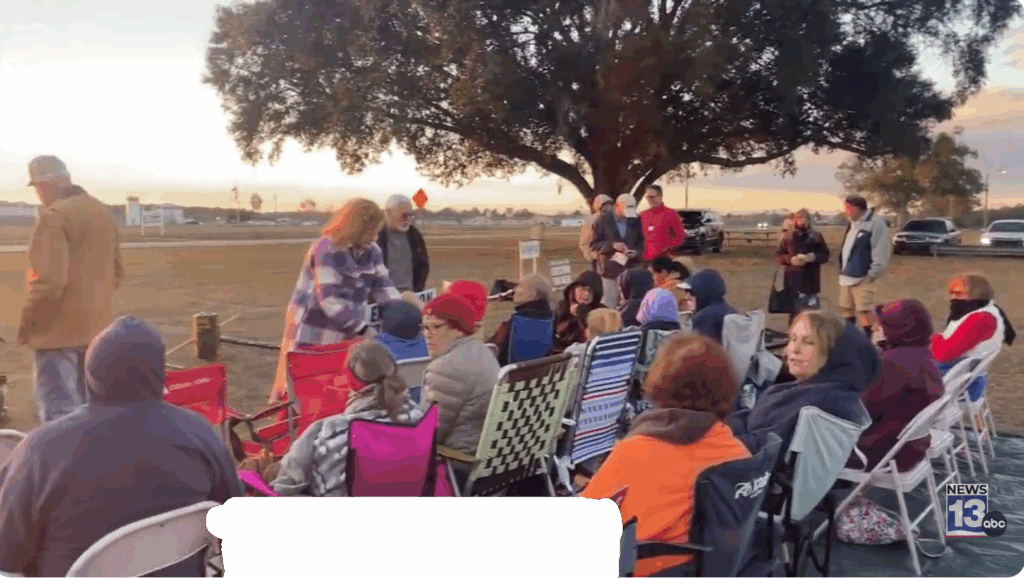
Parishioners of Our Lady of Lourdes Church (Daytona Beach) Outside The State Prison

The witnesses and the lawyers who attend the executions have told Grace that the ringing of the bell can definitely be heard inside the execution chamber.

Think about that. The solemn peal of the church bell, rung by protesters and the devout gathered beyond the prison walls, seeps through concrete and steel like a funeral hymn, impossible to ignore.

For the condemned, each toll of the bell and its’ echo becomes a sacred reminder of humanity reaching through the void, a gesture that they are seen in their final hour. For the executioners, it strikes deeper than their strict and formal protocols – an unwanted rhythm tapping at their conscience, breaking the sterile silence and the solemnity they rely on. Even the guards and warden feel the weight of it, the bell making the air heavier, as if time itself pauses to listen.

Finally, Abe and the others returned me to my home, my safe space, and rest from my journeys through the killing fields of Florida. There is another execution scheduled for just 8 days from today. Yet, we will not, we cannot be silenced. They must hear us.
Mark Geralds (Mark Allen Geralds), who was executed by lethal injection for the 1989 murder of Tressa Pettibone, was pronounced dead at 6:15 p.m. on Tuesday, December 9, 2025. 

The execution took place at the Florida State Prison in Starke, Florida.


So, I need help now. This publication and sight is entirely reader-supported, and I can only continue doing it with your help. You can either buy me a coffee by clicking here:

donate to my GoFundMe, or you can SUBSCRIBE. I’ll be happy either way you choose – but, I really like the subscriptions because it means you’ll be around a lot longer. I’m dropping a button where you can do it very easily, or you can click any of the links above to help.

Let’s Talk Trauma & The Death Penalty.

William Kissinger · September 2, 2024 · Leave a Comment

Boy, is there a LOT going on! In the world of state AND federal politics, we have heated arguments and an attempted assassination and questions of whether it was staged or real….we have a former President assembling a group of followers and going to Arlington National Cemetery where he posed for a photo op after aides physically shoved a Park employee aside…do YOU have an opinion on that?

Also, in other areas, civil rights attorney Ben Crump speaks out on Democracy Now! after a judge dismisses counts against 2 officers in the Breonna Taylor case (a Black female EMT who was killed by police IN her home during a raid…a raid based upon a falsified police officer’s affidavit), saying that the victim’s boyfriend was responsible for her death because he produced a legally owned firearm and officers returned fire. Bear in mind that the warrant was falsified, it was in the wee hours of the morning, Breonna and her boyfriend were asleep, and the officers broke the doors down for entry. Hmmmmm….

FORMER President Trump has said that he would offer immunity to police officers if he is elected, when “Qualified Immunity” is one of the largest problems in policing, corrections and virtually every field where someone has power over another. This is another issue that divides us as a nation – those who oppose this are labelled as liberal and weak, and supporters of it are called radical and inhumane. Where does one draw the line? Where do YOU draw the line?


AND, the death penalty is back on the table and liberally in use around the country. The old arguments both for and against it are resurfacing, and the usual voices are raised in defense of their positions.


LAST NIGHT, August 29, 2024, at 6:15 pm, the State of Florida executed Loran Cole.

The Death Penalty in America: A System of Inequality

The Death Penalty is Looming.                                             Photo by Bruno Guerrero on Unsplash

The System’s Inequities

The execution of Loran Cole in Florida highlights the ongoing debate surrounding capital punishment in the United States. While proponents argue that the death penalty serves as a deterrent to crime and provides justice for victims, critics contend that it is a cruel and unusual punishment that disproportionately affects marginalized populations.

The death penalty system in America is often criticized for its systemic biases, particularly against individuals from underprivileged backgrounds. Here are some key factors that contribute to this inequality:

  • Racial Disparity: Studies consistently show that individuals from minority racial groups are more likely to be sentenced to death than their white counterparts, even when controlling for other factors. This racial bias can be attributed to systemic racism within the criminal justice system.
  • Economic Inequality: Individuals from low-income backgrounds often have limited access to quality legal representation, which can significantly impact the outcome of their cases. This can lead to harsher sentences, including the death penalty.
  • Mental Health Issues: Many individuals who are sentenced to death have underlying mental health conditions that may have contributed to their crimes. However, these conditions are often not adequately addressed, which can result in unfair trials and harsh sentences.

The Impact of Trauma and Neglect

The experiences of individuals from underprivileged backgrounds can often be marked by trauma and neglect, which can contribute to criminal behavior. If these individuals had access to mental health services, substance abuse treatment, and other support programs, it is possible that they could have been prevented from committing crimes.

For example, individuals who have experienced childhood abuse or neglect may be more likely to develop mental health problems, such as depression, anxiety, or substance abuse. These conditions can increase the risk of criminal behavior. By providing early intervention and support, it may be possible to address these underlying issues and reduce the likelihood of criminal activity.

The Need for Reform

The death penalty system in America is in need of significant reform to ensure that it is applied fairly and justly. This includes:

  • Addressing systemic biases: The criminal justice system must take steps to address racial and economic disparities in death penalty cases.
  • Improving access to legal representation: Individuals facing the death penalty should have access to high-quality legal representation, regardless of their income level.
  • Addressing mental health issues: Individuals with mental health conditions should have access to adequate treatment and support.
  • Exploring alternatives to the death penalty: Some states are considering alternatives to the death penalty, such as life without parole. The life is saved!

By addressing these issues, it may be possible to create a more just and equitable death penalty system that better serves the needs of all Americans.


BUT, what about Loran Cole, a White male?

Photo provided by FL Department of Corrections

Loran Cole, 57, received a lethal injection and was pronounced dead at 6:15 p.m. at Florida State Prison for the 1994 killing of an 18-year-old college student. Cole also was serving two life sentences for rape.

Cole did not have a last statement. “No sir,” he said when asked if he had some final words.

After the procedure began about 6 p.m. Cole briefly looked up at a witness in the front row. After three minutes, he began taking deep breaths, his cheeks puffing out. For a brief moment, his entire body trembled. Five minutes into the procedure, the warden shook him and shouted his name. Cole then appeared to stop breathing and then was declared dead.

Cole’s crime was horrific.

Cole and a friend, William Paul, befriended two college students in the Ocala National Forest, court records showed. After talking around a fire, the men offered to take the siblings to see a pond. While away from the campsite, Cole and Paul jumped the victims and robbed them, according to the records.

THUS, another life was taken…and, another life was surrendered.


Although it is widely known that I oppose the death penalty in ALL cases, this particular case is haunting. It is haunting in that the state of Florida was actually complicit in the heinous murder that landed Cole on death row. I say that because he was a surviving victim of the notorious Dozier School for Boys in Marianna, Florida.

Cole was an inmate at a state-run reform school where he and other boys were beaten and raped. The state has since apologized for the abuse and this year passed a law authorizing reparations for inmates at the now-shuttered reform school. The lawyers also argued Cole shouldn’t be executed because he was mentally ill and had brain damage and Parkinson’s disease.


Not that long ago, Florida Governor Ron DeSantis (R), signed legislation setting aside $20-million in compensation for surviving victims of Dozier.

“It’s been too long,” said state Sen. Darryl Rouson, the Democrat who sponsored the bill. “This is but a small token for a vast ocean of hurt, but it’s what we can do now.”

As he spoke, a group of about 20 victims stood in the Senate public gallery, one wiping tears from his eyes.

“Thank you for never giving up. Thank you for continuing to fight. Thank you telling the story and the stories of those who are not here and can’t speak. We salute your presence today,” Rouson continued.


What is striking about this is the fact that Cole survived the Dozier School, and the trauma he was exposed to, later led him to commit the crime for which he was put to death by Florida, the same state that allowed the Dozier facility to operate. Bodies are still being dug up there.

The mass grave that was discovered in 2017 on the grounds of the campus has been thoroughly excavated, and the remains of many of the missing boys have been identified. At least 75 separate remains were mingled in the mass grave. However, it is possible that there may be additional remains to be found. Given the history of the school and the number of boys who disappeared (hundreds), it’s unlikely that all of the missing have been accounted for.

If new evidence emerges or additional remains are discovered, authorities may need to reopen the investigation. But for now, the primary focus of the investigation has shifted to identifying the victims and bringing those responsible for the abuses to justice.

One might say that all of the survivors of Dozier were compensated. Some received a monetary reward. Some were killed by Florida.

Just 2 weeks ago, I did a long post on trauma and where it leads if not treated. It often leads to prison, and sometimes to death. For Loran Cole it led to his death, and the death of a promising young man in a college student. For now, Florida has failed.

My Life After Prison

Copyright © 2026 · Website provided by Boomajoom