• Skip to primary navigation
  • Skip to main content

My Life After Prison

Resources for the incarcerated and their families.

  • Home
  • About
  • Contact Us
  • BREAKING NEWS !!
  • Florida
  • Louisiana
  • Show Search
Hide Search

justice

Can’t We Just Get Off Of This Insane Merry-Go-Round?!

William Kissinger · December 12, 2025 · Leave a Comment

The Mis-Adventures Of A Road Warrior In The Fight Against Capital Punishment

AI-Generated Image of A Clownish Merry-Go-Round Trying To Exit A Freeway

I write about the death penalty. Mostly in two states – Louisiana and Florida. But on the whole, everywhere in America. I also write a lot about prison as I have a whole lot of experience with being a prisoner there, and I like to write from the POV of experience and authority. 47 years of experience, I believe, qualifies me in that regard.

I happen to take executions personally, as I have been personally impacted by the deliberate and premeditated killing of a human being by an impersonal entity commonly referred to as a “state.” See my earlier story, published by HARVARD Inquest, “The Last Breakfast.” It is a coldly, well-planned and deeply impactful process that severely impacts families and turns them all into more victims. In fact, victims are used by this “state” as a promotional gimmick to justify their actions and actually promote their use as an example of “justice.” Florida goes a step further and has laws to shield everything about the process.

Execution of a criminal offender does NOT provide closure to a family member of a murdered victim. And, one of my personal heroes, who has an incredibly touching story, SuzAnn Bosler, used her forgiveness of the killer of her father to advocate for his clemency, even though he tried to kill her as well.

SuzAnn Bosler, Whose Father Was Murdered In Front Of Her, And Who Was Left For Dead By The Killer Holds His Photo While Explaining Why She Forgave Him And Tried To Save Him From Execution

My personal interviews with SueZann left me heartbroken and weeping as she shared her story. Left for dead, she survived and eventually forgave the killer. She even hired her own attorney in an effort to save his life. Executions take a horrible toll on those who actually oversee and perform the executions themselves. The interviews with Allen Ault, the former Commissioner of Corrections for the State of Georgia, clearly tell us of this.

The lowly prison guards who participated in executions, underpaid and often underqualified to perform even the most menial of jobs, have been driven to desperate lengths. Because of a lack of support and trauma, they have often felt “less than,” and became “a murderer.” Some have resorted to suicide. Almost every single one of them changed their politics and their minds about executions after participating in one.

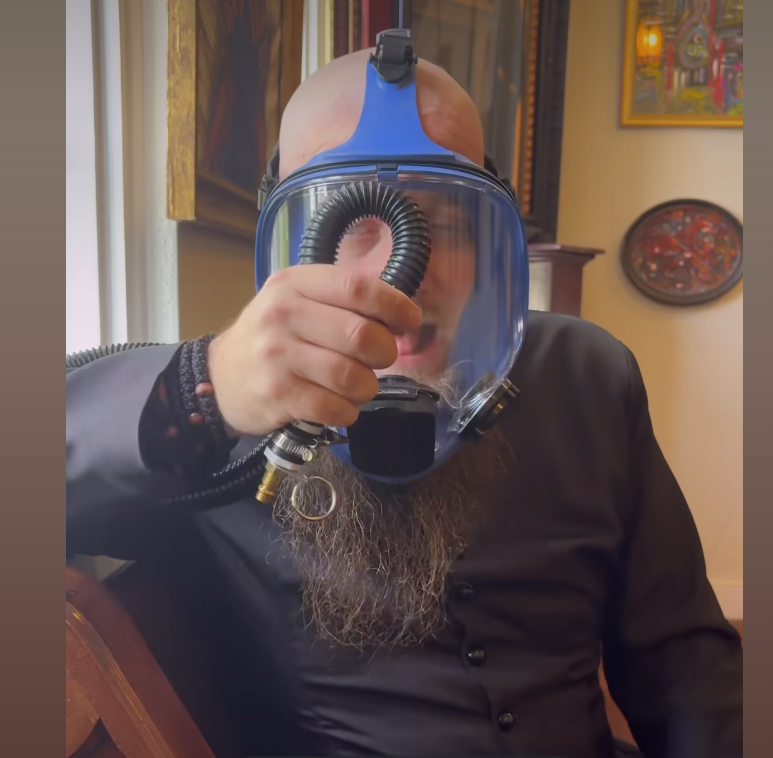
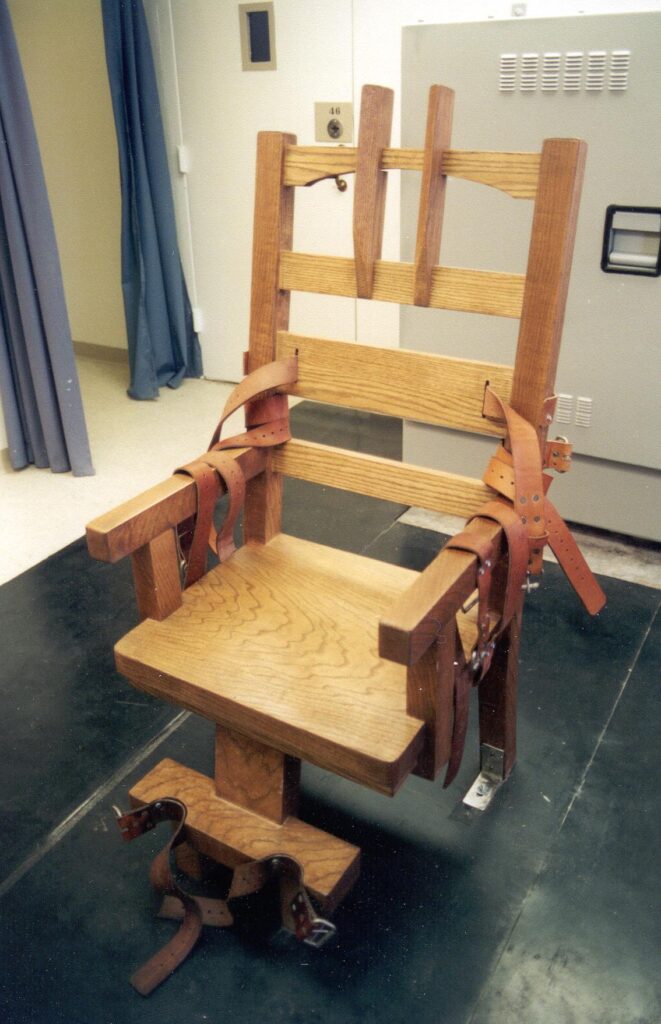
America has a wide variety of methods of killing people. The most common are (1) Lethal injection, (2) firing squad, (3) Electric chair and (4) nitrogen hypoxia suffocation. Nitrogen hypoxia is definitely an abomination, first used in Alabama, and later adopted in 3 other states: Alabama, Arkansas, Louisiana, Mississippi, and Oklahoma. Ohio and Nebraska have bills introduced as well to authorize the use of nitrogen to kill prisoners. All “Bible belt” states, all have MAGA “Christian” governors. Everyone is entitled to have their own view of Christianity; mine is that it is impossible for one to be both “pro-Life” AND a supporter of capital punishment.
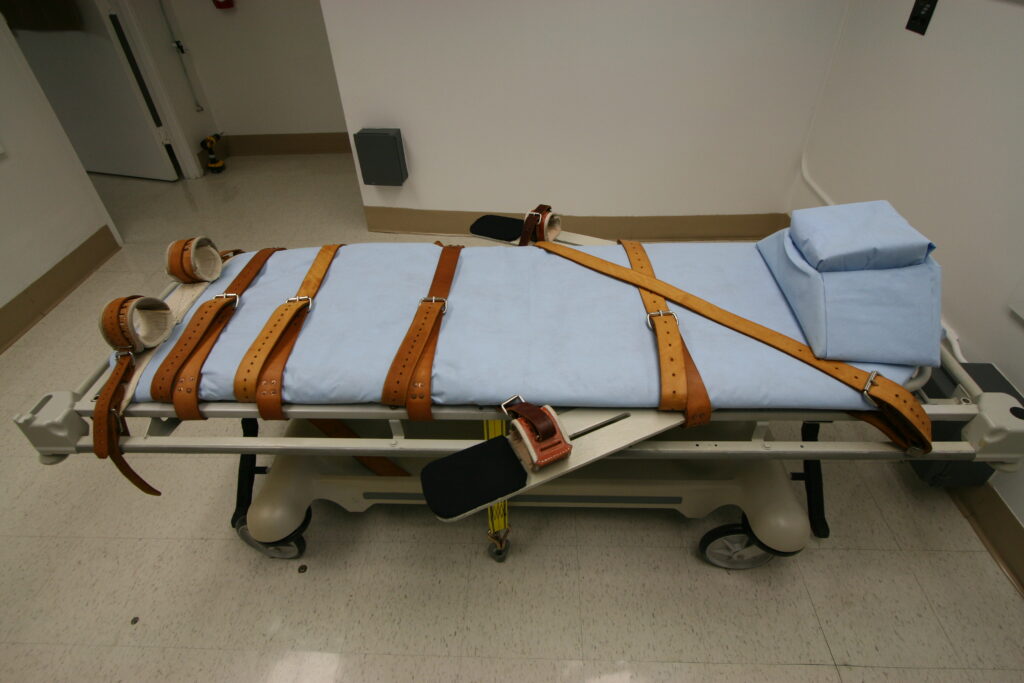
Florida’s Execution Gurney
Florida’s Electric Chair
Firing Squad Chair
Nitrogen Gas Cylinfer Tank
Rev. Dr. Jeff Hood Demonstrating Nitrogen Gas Hypoxia Mask Placed On Condemned Inmate

All of the methods are horrific.

Let me tell you about my adventure with DeathPenaltyAction and Floridians for Alternatives to the Death Penalty yesterday, Tuesday, December 9, 2025. It was an exhausting day, beginning with a calm awakening at 4:00am. I hastily drank coffee, answered a flurry of overnight emails, fed and walked the dogs, took a shower and shaved, went outside and smoked a cigarette, and came back in to prepare for the trip.

I went to Tallahassee with my friend, Robert, and was picked up at 9:30 by the wonderful Grace Ellen, Executive Director of Floridians for Alternatives to the Death Penalty. We went to the Good Shepherd Church, where we attended a prayer service for the soon-to-be-executed Mark Allen Geralds, the victim (Tressa Pettibone) and her family, and everyone in the chain-of-command involved in the execution. Grace, Abraham – one of the original founders of FADP – and SuzAnn spoke about forgiveness and the urgency of stopping executions and why they are so wrong.

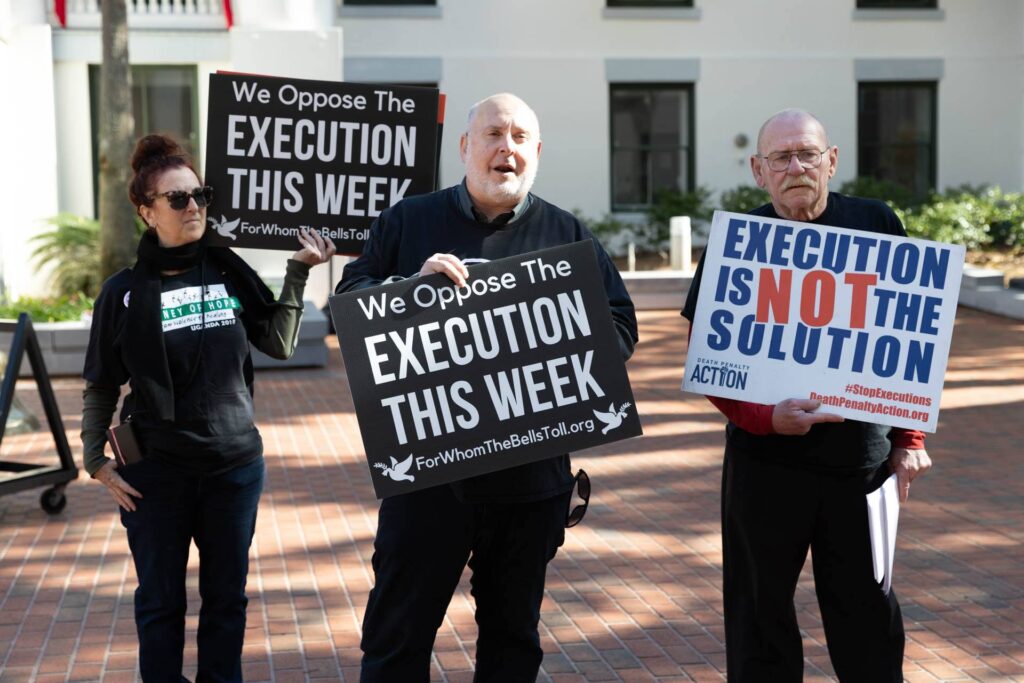
We finished loading the trailer with shirts and signs, and then set off on our excursion to the office of Governor Ron DeSantis, the most prolific of all of Florida’s executing governors.
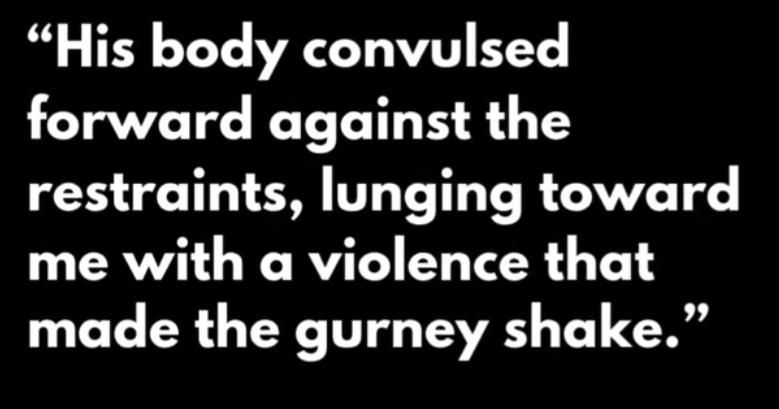
Quote from Rev. Dr. Jeff Hood After Witnessing The Nitrogen Hypoxia Execution Of Anthony Bell
Ringing Of The Bell
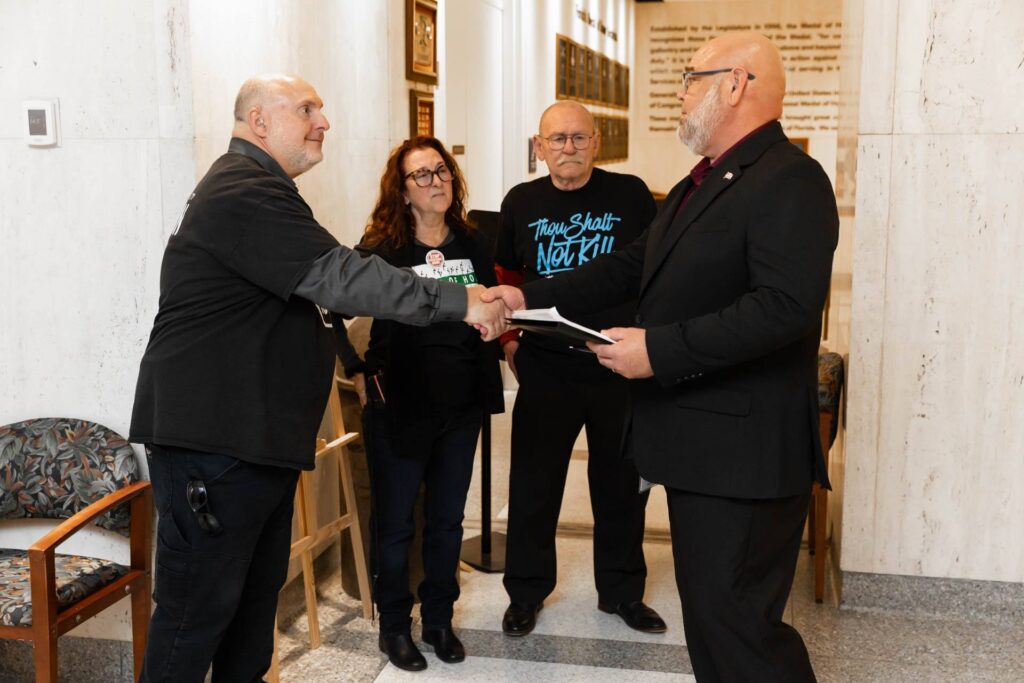
Presenting Our Petitions
Videoing Our Protests At The Governor’s Office

The media was waiting for us and we were videod, and gave our interviews, and proceeded to the Governor’s Office. Following a security search and wanding, we made our way to the reception desk where we interacted with her and she summoned someone to meet with us. The Governor, obviously, would not come out to meet and talk with us. This is the 18th execution he has ordered to be carried out this year. He cannot be proud of what he is doing, after all, but he did send a couple of very nice Constituent Services Representatives to meet with us, and again we pleaded our case and presented petitions from both groups.
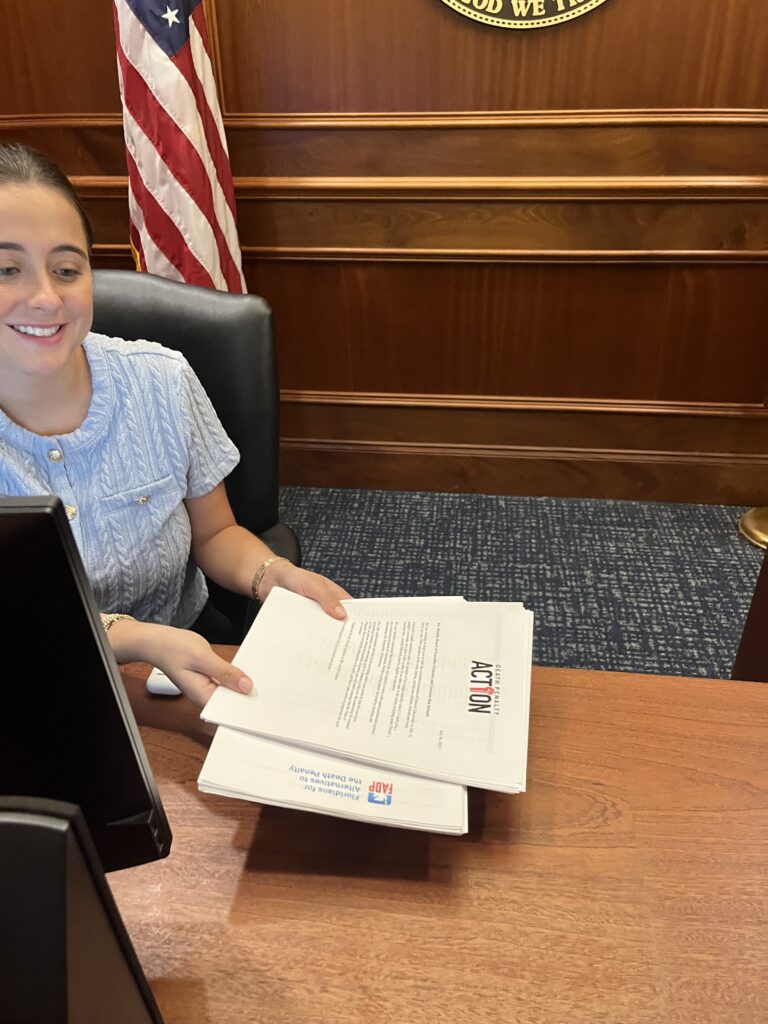
Our Petitions

Abe conducted the majority of the presentation explaining why we protest every execution and all of what is wrong with capital punishment. SueZann told her incredibly powerful story, and I touched on the wrongful conviction aspects and explained how Florida leads the entire nation in exonerations from their death row. Virtually every single exoneration from Louisiana involved one common factor – prosecutorial or official misconduct and illegal police conduct – torture, witness coercion or intimidation, and/or placing of informants in defendant’s cells who then gave false testimony to obtain convictions.

Later that evening, many who opposed the execution gathered at the state prison and held their service with Father Phil and the congregants from Our Lady of Lourdes (Daytona Beach). There were prayers and there was song and there was homily, followed by the ringing of the same bell – the same heavy cast bell that Abe totes with him everywhere he goes, to every execution, to every vigil.
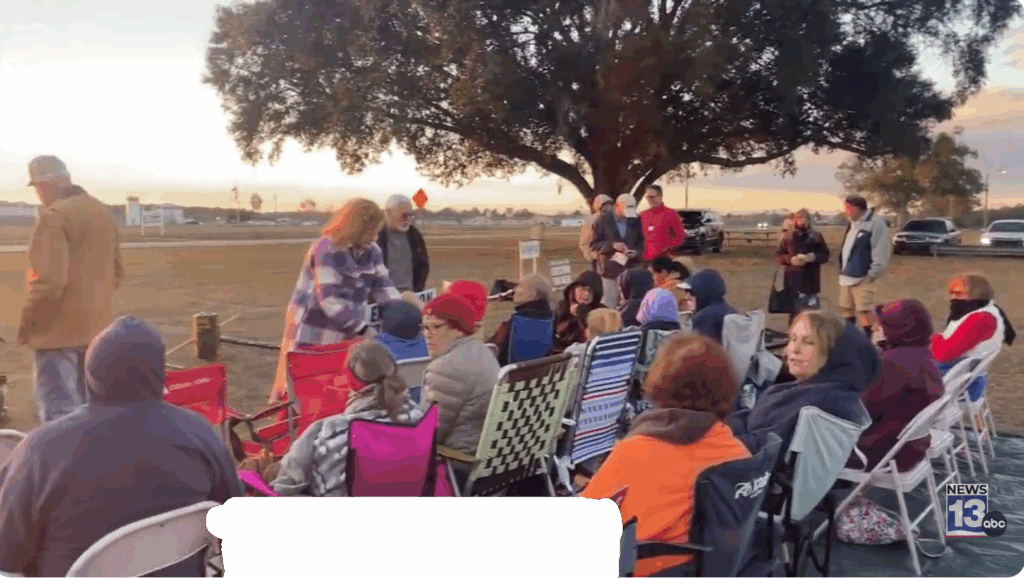
Parishioners of Our Lady of Lourdes Church (Daytona Beach) Outside The State Prison

The witnesses and the lawyers who attend the executions have told Grace that the ringing of the bell can definitely be heard inside the execution chamber.

Think about that. The solemn peal of the church bell, rung by protesters and the devout gathered beyond the prison walls, seeps through concrete and steel like a funeral hymn, impossible to ignore.

For the condemned, each toll of the bell and its’ echo becomes a sacred reminder of humanity reaching through the void, a gesture that they are seen in their final hour. For the executioners, it strikes deeper than their strict and formal protocols – an unwanted rhythm tapping at their conscience, breaking the sterile silence and the solemnity they rely on. Even the guards and warden feel the weight of it, the bell making the air heavier, as if time itself pauses to listen.

Finally, Abe and the others returned me to my home, my safe space, and rest from my journeys through the killing fields of Florida. There is another execution scheduled for just 8 days from today. Yet, we will not, we cannot be silenced. They must hear us.
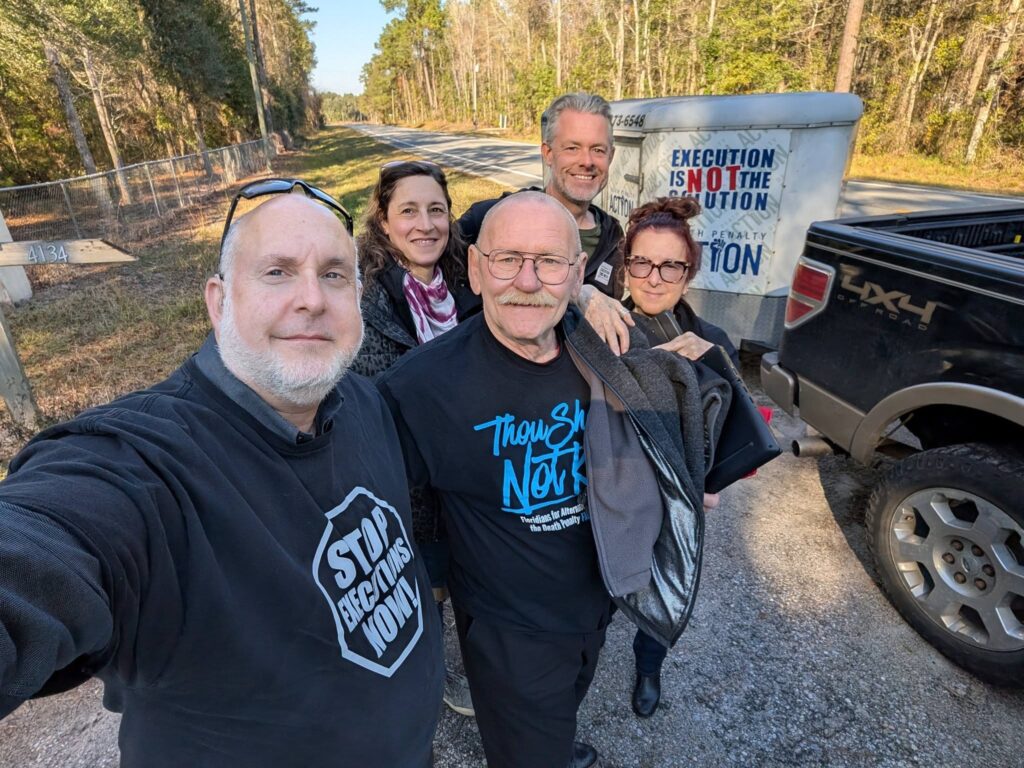
Mark Geralds (Mark Allen Geralds), who was executed by lethal injection for the 1989 murder of Tressa Pettibone, was pronounced dead at 6:15 p.m. on Tuesday, December 9, 2025. 

The execution took place at the Florida State Prison in Starke, Florida.


So, I need help now. This publication and sight is entirely reader-supported, and I can only continue doing it with your help. You can either buy me a coffee by clicking here:

donate to my GoFundMe, or you can SUBSCRIBE. I’ll be happy either way you choose – but, I really like the subscriptions because it means you’ll be around a lot longer. I’m dropping a button where you can do it very easily, or you can click any of the links above to help.


TRAUMA – Where It Leads

William Kissinger · November 26, 2025 · Leave a Comment

And where it comes from…

What IS trauma?

Trauma is defined as an emotional, psychological, or physical response to an event or series of events that are distressing or harmful, often overwhelming a person’s ability to cope.

This can include experiences such as violence, sexual abuse or physical abuse, accidents, or natural disasters that lead to feelings of intense fear, helplessness, or horror.

Trauma can manifest in various ways, including anxiety, depression, and post-traumatic stress disorder (PTSD), affecting an individual’s daily life, relationships, and overall mental health.

Understanding trauma is essential, especially in contexts like prisons, where individuals may face unique and compounding challenges that amplify their experiences of distress.

Here’s another question:

Does prison lead to trauma, or does trauma lead to prison? I think that in the majority of cases, trauma leads to prison…but prison ALWAYS leads to more trauma.

Trauma significantly influences why some people end up in prison. It often leads to harmful behaviors and poor coping skills. Experiencing violence, abuse, or serious neglect can warp a person’s self-view and how they see the world, leading to increased anxiety, aggression, or impulsive actions.

These traumatic events may push some to commit crimes for survival or to regain a sense of control. Furthermore, the lack of mental health resources and support can leave traumatized individuals without the means to heal, making them more susceptible to the justice system. In essence, unresolved trauma can create a tough cycle to break, contributing to the high number of traumatized people in prisons.

Trauma often leads to harmful behaviors and poor coping skills.

Trauma often has its origins in adverse childhood experiences, such as abuse within the home, unstable family structures like single-parent households, exposure to substance abuse, and community crime.

A young child growing up in such an environment may first feel unsafe and neglected, leading to emotional and behavioral issues. As they transition into adolescence, feelings of abandonment or rage may take hold, oftentimes impairing their ability to form healthy relationships and cope with stress.

Non-violent Gathering of Youth – Courtesy Shutterstock

If these individuals begin seeking “unhealthy” outlets—such as engaging in drug use or alcohol or associating with delinquent peers—they may further spiral into risky behaviors. This cycle of trauma can escalate, leading them into criminal activities as a means of survival or providing an escape. The compounded effects of untreated trauma can create a firmly entrenched path, ultimately steering them toward the criminal justice system and incarceration.

Home to School to Prison…and the Pipeline There

The “home to school” path for a child experiencing trauma is critical in understanding how environments influence their emotional and psychological well-being. For many children, home life can be a source of significant distress due to factors such as domestic violence, neglect, substance abuse, or instability. In the beginning, school may represent a refuge from these challenges, offering a comforting structure, a form of social interaction, and offering the potential for academic success.

Upon arriving at school, however, the child’s experience may be very complex. Some children find school to be a safe haven, as it allows them to escape the traumatic conditions at home, even if temporarily. In these instances, the structure provided by a school environment can facilitate healing in that it gives children a space where they can engage with peers and, as importantly, caring adults, which is essential for their emotional development.

Conversely, for some children, school can present a new set of challenges that may reinforce existing trauma. Factors such as bullying, academic pressure, social isolation, or rigid disciplinary practices can turn school, at first a refuge, into a traumatic environment. This contradiction can lead to heightened anxiety and distress, making the journey from home to school fraught with tension rather than relief.

School Classroom – courtesy Shutterstock

Additionally, trauma can deeply affect a child’s ability to engage with their environment. Symptoms such as hyper-vigilance, emotional dysfunction, or difficulties in forming relationships can affect how a child interacts with teachers and fellow students. These challenges can create a cycle of trauma, where the child feels unsafe both at home and in school, reinforcing that sense of vulnerability and isolation.

So, the “home to school” path is not a straightforward and clear transition. It often involves a complex interplay of escaping one form of trauma only to potentially face another. In some cases, the traumatized child will find comfort in structured learning. Understanding these dynamics is crucial for educators and advocates in creating supportive school environments that recognize and address the broader impacts of trauma on children.

Is School a Refuge – Or a Place of More Trauma?

And, School To Prison…The “school to prison pipeline” is a complex phenomenon where students, particularly those from marginalized communities, face disciplinary actions in schools that often lead to law enforcement involvement. For a child already experiencing trauma—whether from economic instability, domestic violence, or community violence, or abuse—the pressures of this pipeline are magnified.

A Mind In Trauma

Traumatized children may exhibit behaviors such as aggression, withdrawal, or defiance, which are often misinterpreted by educators. Instead of receiving support, they may face harsh disciplinary measures, such as suspensions or expulsions. This pushes them further away from education. Factors such as lack of access to mental health resources, negative school climates, and socio-economic disparities can lead these children to feel alienated and disengaged. This only increases their chances of indulging in criminal activity as a way to cope or seek validation. Understanding these connections is crucial for developing interventions that address the root causes of behavior rather than simply reacting to the symptoms.

How does this progression work in real life? Let’s meet Marcus.

A young boy named Marcus grew up in a home filled with domestic violence, often witnessing his parents fight, his father often beating his mother. This led to him feeling emotionally neglected and very alone. The unstable home life caused him to struggle in school, making it hard to focus on his classes and to connect with fellow students. Failing to make this connection led to bullying. Frustrated and helpless, Marcus acted out by skipping classes and hanging out with older “friends” who seemed to understand his pain. He was soon engaging in petty theft. His rebellious behavior escalated, and he was eventually caught vandalizing school property, resulting in a troubling encounter with police.

Instead of receiving the support he needed, he was labeled a delinquent. Each time he came into contact with the authorities, his trauma deepened. This led to an arrest that put him on a path toward prison, continuing the cycle of trauma that started at home.

JUVENILE COURT PROCEEDINGS

Traumatized children may exhibit behaviors such as aggression, withdrawal, or defiance, which are often misinterpreted by educators. Instead of receiving support, they may face harsh disciplinary measures, such as suspensions or expulsions. This pushes them further away from education. Factors such as lack of access to mental health resources, negative school climates, and socio-economic disparities can lead these children to feel alienated and disengaged. This only increases their chances of indulging in criminal activity as a way to cope or seek validation. Understanding these connections is crucial for developing interventions that address the root causes of behavior rather than simply reacting to the symptoms.


JUVENILE COURT PROCEEDINGS

PRISON…And More Trauma

Juvenile Courtroom

What would have been the right time to intervene? What type of intervention would have been successful? Whose intervention would have been most valuable?

We will never be able to know. Marcus’ life continued to spiral out of control after he went to prison. By the time someone took the time and made the effort to intervene in his life, to attempt to get him to confront and defeat his trauma, it was too late. Marcus died of an overdose of fentanyl, alone, in a cell, in prison.

THIS is what “trauma” is, and what it does.

Below, you will find links to resources that may be of help. If trauma begins at home, that’s where it should be treated. Thank you for reading this!

TRAUMA RESOURCES FOR CHILDREN

TRAUMA RESOURCES FOR FAMILIES

RESOURCES WHEN THERE IS AN INCARCERATED PARENT

This post is dedicated to an unnamed Assistant Warden at Angola, who asked me to write about trauma, because they understand what trauma does, and where it leads.


Donate

DONATE TO MY LIFE AFTER PRISON

OR YOU CAN BUY ME A COFFEE ! (Or a pot of coffee!)

Please be sure to check out my Substack for more articles and commentary on efforts to end the death penalty. If you don’t already, please hit that SUBSCRIBE button, and share!

CLICK THE PICTURE TO GO TO MY SUBSTACK!

Seen Through The Fog of Dementia

William Kissinger · August 24, 2025 · Leave a Comment

Ralph Menzies – Scheduled for Execution Sept. 5, 2025 (AP)

This is an exhausting journey to be on, this fight against the death penalty. Exhausting, but – yes, interesting. Interesting in that every case is similar yet different. Interesting in that we’re presented with so many different personalities as we trudge along this path, sometimes forward and sometimes walking backwards, sometimes being pushed backwards and off the path. The one consolation is that we never walk alone. The anti-death penalty community is a small but committed and tightly knit one, with friends and allies in the sometimes unlikeliest of places and at unlikely times.

He walked the cracked asphalt roads outside the state prison, his battered shoes softened by the hours of pacing with a placard in hand. The words, scrawled in uneven marker paint—”Mercy Is Justice” — alternating with — “Stop Gas Executions”, or “Execution Is NOT The Solution” — had long since grown heavy to him, acting more as a shield than a message. His voice was hoarse from chanting into the indifferent and non-hearing wind, yet he persisted, tracing the same worn path past chain-link fences, concrete walls, and rows of armed guards whose eyes followed him with cold amusement. Every step was a ritual, a prayer against the inevitability of a clock ticking toward midnight executions or stopping short at 6:00, praying for a stay, a reprieve, a gift from God.

Yet along this lonely march, allies emerged from unexpected shadows. A prison nurse, weary from tending to men who would not live to grow old, stopped to press a bottle of water into his hand, whispering, “I wish I could say this for myself, and say it out loud – but I must consider my retirement and my future.” A grizzled ex-guard—once his adversary across the fence—fell into step beside him one evening, muttering that the killing had rotted away at his soul until he could no longer bear it. Even a mother in mourning, her son murdered years ago, came not to condemn but to stand silently near him, carrying her grief as testimony that justice need not be sharpened to a blade.

The path wound longer than the road itself, each footfall carrying him deeper into a strange fellowship stitched from fragments of guilt, sorrow, and defiance, all pieces to a puzzle. He realized he no longer walked alone but at the head of a procession of unlikely companions, all tethered by the same invisible weight. Though the state’s machinery ground on, implacable and deaf, the protester found that his path was no longer only protest—it was pilgrimage. And on that path, every voice beside his own turned the solitary chant into something approaching a chorus.

These are the ghosts that join us. These are the voices that urge us on forward, to not give up the fight. To fight and protest for every death carried out by the State, for every murder committed by the State. We will not give up this fight.

UTAH’S FIRING SQUAD CHAIR (AP Photo)

Condemned killer Ralph Leroy Menzies, arguably has one last chance to avoid a firing squad execution by appealing to the Utah Supreme Court.

Repetitive application? By far. Chances of evading execution? You pick the numbers…

On Thursday, the state’s top court heard arguments over whether Menzies’ upcoming execution should have been halted pending appeal, and whether a lower court judge should have ordered a new competency evaluation once his attorneys disclosed his dementia had gotten worse.

That same judge previously found Menzies competent to be executed for the 1986 murder of Maurine Hunsaker, who was taken from her job at a Kearns gas station, tied to a tree and her throat was slit.

“Mr. Menzies has a progressive disease. He is always getting worse,” his attorney, Lindsey Layer, argued to the justices.

He sat in the narrow cell, its walls painted the color of old bone, staring at the blank steel door as though it might one day speak to him. His hair had thinned to wisps, his body frail beneath the coarse prison uniform, but his eyes—clouded, drifting—held no recognition of the years or the sentence hanging over him. Once, he had argued with lawyers, shouted at guards, clung to scraps of appeals and promises. Now he no longer remembered those battles. He asked instead when his mother might visit, though she had been buried for half a century, or whether he could go home soon, confused why they kept him here at all.

The warden visited, speaking carefully, slowly, about the scheduled execution. The condemned man nodded politely, then asked whether dinner would come on time. He did not know what a firing squad was, nor why so many solemn faces gathered to watch him shuffle down the corridor during rehearsals of protocol. To him, the preparations were rituals without meaning, the men with rifles perhaps soldiers in some far-off war that never touched his understanding. When guards whispered “he doesn’t even know anymore,” he only smiled faintly, humming a song half-remembered from boyhood, the words lost to the ravages of time.

“If this particular illness is progressive, it changes all the time, how do we not end up in this situation repeatedly?” asked Justice Paige Petersen.

“With this particular illness? That is true,” Layer replied.

Justice Diana Hagen questioned where the line is for a defendant to understand the nature of their crime and the punishment being handed down and what qualifies as a substantial change. Layer told the Court that Menzies’ circumstances have substantially changed.

Chief Justice Matthew Durrant raised the issue of some prison phone calls that Menzies had made that prosecutors submitted as evidence that he is competent.

“He does seem to understand who he’s speaking with, he’s giving appropriate responses,” Chief Justice Durrant said, later adding: “How does that level of understanding, let’s say, figure into the legal standard for competency to be executed?”

But Layer argued it did not show the whole picture, where Menzies struggled to even make some phone calls to his lawyers and others.

Decades of waiting had stripped him of context, leaving only a fragile shell of routine. Each day was measured by trays of food slid through a slot, by the rattle of keys at dawn and dusk. Death, as the state decreed it, was no longer real to him; he could not grasp it, could not fear it, could not prepare for it. And yet the machinery of law continued grinding forward, as indifferent to his forgetfulness as the concrete floor beneath his feet. For him, there was no looming end—only another morning, another question, another fragment of memory slipping into silence.

“He’s clearly struggling, he’s not able to complete those calls,” she told the Court.

Assistant Utah Attorney General Daniel Boyer argued that not enough has changed to justify a new competency evaluation.

“The defendant must specifically allege a substantial change in circumstances, the petition must be sufficient to raise a question about the inmate’s competency,” he said.

Utah last executed prisoners by firing squad in 2010, and South Carolina used the method on two men this year. Only three other states — Idaho, Mississippi and Oklahoma — allow firing squad executions.

Ralph Leroy Menzies, 67, is set to be executed Sept. 5 for abducting and killing a Utah mother of three, Maurine Hunsaker, in 1986. When given a choice decades ago, Menzies selected a firing squad as his method of execution. He would become only the sixth U.S. prisoner executed by firing squad since 1977.

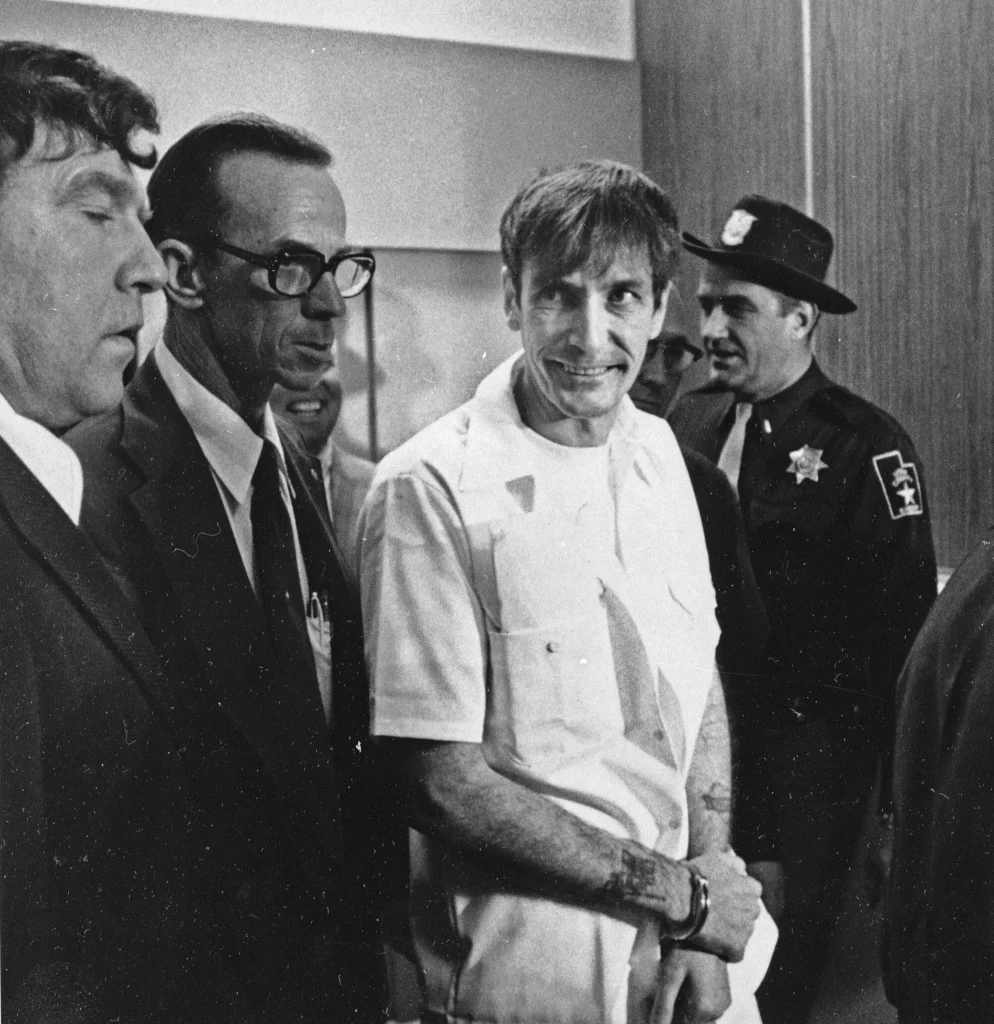
The most notable, perhaps, was Gary Gilmore about whom the book, “The Executioner’s Song” was written by bestselling author, Norman Mailer.

GARY GILMORE – Utahan Executed By Firing Squad (AP Photo)

Utah has a particularly long and bloody history with firing squad executions. Utah’s history with firing squad executions dates back to its original statutes, which allowed it as a method of punishment alongside beheading and hanging. The state has historically been a leader in its use, especially in the modern era following the reinstatement of capital punishment in the 1970s.

Utah was the first state to resume executions after the national moratorium with Gary Gilmore’s execution in 1977, and remained the only state to carry out a firing squad execution in the modern era until the 2010 execution of Ronnie Lee Gardner.

Executing someone with dementia is problematic because competency laws require a prisoner to fully understand the punishment they face (to be executed), which dementia impairs. The primary concern is that a person with dementia cannot rationally comprehend their execution or the reasons for it, rendering the execution unconstitutional under the Eighth Amendment. The firing squad execution itself adds to the concern, as it potentially increases the risk of suffering and error.

Legal and Constitutional Issues

  • Incompetency:Federal and state laws mandate that a death row inmate must be competent, meaning they understand they are facing execution and the reasons for it, according to the Death Penalty Information Center.
  • Ford v. Wainwright:The U.S. Supreme Court ruled that executing someone who doesn’t understand the reasons for their punishment violates the Eighth Amendment’s prohibition against cruel and unusual punishment.
  • 2003  The Utah Legislature unan­i­mous­ly approves a bill that prohibits the execution of those with intellectual disabilities.
  • Attorneys for Mr. Menzies called the state’s deci­sion to move ahead with Mr. Menzies’ scheduled exe­cu­tion ​“deeply troubling,” noting “[Mr.] Menzies is a severely brain-damaged, wheelchair-bound, 67-year-old man with dementia and significant memory problems. His dementia is progressive and he is not going to get better.” They have appealed the ruling to the Utah Supreme Court.

  • “It is deeply troubling that Utah plans to remove Mr. Menzies from his wheelchair and oxygen tank to strap him into an exe­cu­tion chair and shoot him to death.”
    Lindsey Layer, Attorney for Ralph

  • Navigating through a thick fog is difficult, and people can easily lose their bearings. This reflects how dementia can disrupt a person’s sense of direction and familiarity.

  • Disorientation: A person with dementia may feel lost even in familiar places or have trouble navigating familiar surroundings.

  • Social withdrawal: Like someone isolated in a fog, a person with dementia may withdraw from social situations due to communication difficulties and confusion.

  • This whole situation is frightening. It’s not frightening to Menzies, though, as he has no idea what’s happening to him. It’s only frightening to those who know and love him, to those working tirelessly to save his life, and to those who have a sense of responsibility and respect the rule of law.

  • Justice Diana Hagen questioned where the line is for a defendant to understand the nature of their crime and the punishment being handed down…

  • Your honor, there is no pill that one can take to force the defendant to understand the nature of their crime and the punishment being handed down, or meted out. There is no “alarm” that would alert the authorities that Mr. Menzies woke up one morning and was cognizant of all the factors involved here – his crime and the punishment, and how many years he spent wandering through the fog.

  • For now, he continues, still lost, still wandering….will he wander on September 6th, or will his journey end on September 5th, as ordered by the people who want to kill him?

Donate

DONATE TO MY LIFE AFTER PRISON

OR YOU CAN BUY ME A COFFEE ! (Or a pot of coffee!)

Please be sure to check out my Substack for more articles and commentary on efforts to end the death penalty. If you don’t already, please hit that SUBSCRIBE button, and share!

CLICK THE PICTURE TO GO TO MY SUBSTACK!

The Desperate Client

William Kissinger · June 5, 2025 · Leave a Comment

Left At The Altar

The interview meeting was not my first. It was to my knowledge, however, the first of its’ kind. I had been an Inmate Counsel (“lawyer” in the jailhouse sense) for a fair number of years and had encountered many entirely new and different – some might go so far as to say “unique” – situations. The guy sitting across from my desk I had talked to a number of times when I made my morning rounds of the tiers on Death Row. Just never at length, never without bars separating us, and never in such a tense moment.

His wrists were wrapped with solid stainless steel handcuffs threaded through the notorious ‘black box’ and his feet were shackled to his chair. Two security officers had brought him into the Legal Aid Office and strapped him in and cautioned him; “Do NOT fuck up! Act like you’ve got some sense now.”

At the time, I was kind of a hero, as I had just a few years before beaten the Warden, Burl Cain, in a huge lawsuit wherein I was portrayed as the hero and he the villain. It was not much of a stretch to frame Cain as a villain – he was wildly popular with Louisiana’s legislature – his brother, James David Cain (R) from Pitkin, Louisiana, was a legislator for some 36 years – and was often caught up in mildly scandalous affairs and various goings-on. Burl testified that I “used bad words,” and deserved to be punished for saying them. All I had said (in a letter to the FDA requesting an investigation into a private enterprise on prison grounds) was that it was “shrouded in secrecy and stinks of impropriety”

So he locked me up in solitary, I was threatened with being “shot while attempting to escape,” and various other forms of not-so-pleasurable treatment. However, thanks to a friend who smuggled a letter detailing my experiences to a federal judge, a volunteer lawyer who fought tooth-and-nail on my behalf (Keith Nordyke), and favorable public opinion, I eventually prevailed in a federal lawsuit. Instant fame amongst the convicts, instant landfall monies, and an instant target on my back from several different quarters.

I had fought my assignment to Death Row for some time. Burl Cain had summoned me to the A-Building late one night and asked me to take on the role. He explained why I was the perfect candidate for the job. I demurred with the best initial answer I could come up with at the moment – “Warden, how do you expect me to go in at night and lay my head down on that pillow and sleep, not knowing if I had correctly and effectively done everything possible to save that man’s life knowing that next week or the week after you’ll be the one to kill him?! I can’t do that.”

Well, as Wardens will do, he let me go with that, and then a week later Colonel Sam Smith called me in to an Internal Review Board and basically told me I had better take the assignment or…else. He said (off the taped record, of course) he had received instructions from Burl Cain. I abandoned my clients on the Civil Litigation Team and I accepted the assignment.

I had settled in fairly well and grown to learn most of my clients – all condemned to die by lethal injection – and become familiar with most of them and their needs. I had Shepardized cases for them, fetched and delivered law books to them, drafted motions on their behalf, filed public records requests for them, obtained DNA tests and located “lost” evidence in police files for them, and advocated with everybody on earth I could think of on their behalf.

This, however, was a beast of a different stripe. When I made morning rounds on the Tiers, Kevin S. had stopped me and thrust a piece of paper in my face. Shaking from fear or anger or worry or some emotion, he said, “Man, these mother-fuckers trying to kill me and I ain’t even got a lawyer!” Well, this wasn’t right or…was it? I mean, everybody on Death Row has lawyers, don’t they? Don’t they?

It was very simple – it was an Order from the 19th Judicial District Court in Baton Rouge (the state’s capital) setting his date of execution. The date that the State of Louisiana would calmly, methodically and purposefully kill him had been set.

But, to my way of thinking, it hadn’t been set in stone. And that’s the only thing that counts. You see, when a convict (especially an Inmate Counsel) thinks there’s a way to get past something, he’s going to find it. Now, it might be around it, over it, under it, or through it…but he’s going to find it.

So, after getting past my initial uneasiness at the way the meeting had started out, we got into the details. Kevin S. – a tall, heavily built and very dark Black man – had been convicted of the July 30, 1991, 1st Degree Murder of one Kenny Ray Cooper, a young guy working at a Church’s Fried Chicken. As he continued with the story, my skepticism began to wane. He told me that it was NOT an armed robbery, as the DA had presented it to the jury. It was actually a case of self-defense.

Louisiana defined 1st Degree Murder (Louisiana Revised Statute R.S. 14.30) at the time as:

“The killing of a human being:

(1) When the offender has specific intent to kill or to inflict great bodily harm and is engaged in the perpetration or attempted perpetration of certain listed felonies (e.g., aggravated kidnapping, rape, robbery, arson, burglary, assault, etc.),

OR

(2) When the offender has specific intent to kill or inflict great bodily harm and meets other aggravating factors.”

As Kevin unraveled the story to me, Kenny owed him money from a previous drug deal, and he had gone to collect after several failed attempts. An argument ensued, and Kenny pulled a gun and Kevin pulled his and they exchanged shots. Kenny died – Kevin survived. Now, Kevin was awaiting the horror of being killed by Louisiana for defending himself.

Before I go further into the story and my reliving of the moment, let me tell you a few things about Louisiana’s death penalty and its’ prosecution and application in Louisiana. Louisiana is inherently a racist state, and always has been. It has a rich and vibrant history of horrific racism. Even today, Louisiana’s justice system fights to maintain Jim Crow-era laws that are responsible for the mass incarceration crisis in the state, and which even now, threatens to dominate the nation in the numbers of prisoners stuck behind bars for the remainder of their natural lives.

When I was in Angola prison (where I served 47 flat calendar years), at one point I was fortunate enough to meet the artist Debra Luster, while she was working on her beautiful exhibit One Big Self: Prisoners of Louisiana. As a wooden bowl maker and erstwhile craftsman, I participated in her project. This was only one of the myriad of experiences where I began to realize that Louisiana had a serious problem with racism and mass incarceration.

However, as I sat across the desk from Kevin on that day, these were all thoughts far from my mind. I was focused on one thing and one thing only: saving his life from being murdered by the State of Louisiana. It really made no difference to me whether Kevin was truly guilty or truly innocent – at moments such as this, innocence is never the point – the point is taking the next in a series of breaths.

Now, I believe I had told you that Kevin said to me, “…trying to kill me and I ain’t even got a lawyer!” Well, that wasn’t entirely correct, Turns out that he did indeed have attorneys appearing on his behalf. They just weren’t there. Turns out there was a big fancy wedding taking place in England, and his attorney was doing the most vitally important task of attending the wedding. Hmmm…balancing the scales between attending a wedding and getting a stay on Kevin’s case….I believe I would have chosen the latter. But, I digress….

I called Ms. Dora Rabalais, (Director of Legal Programs at Angola for 26 years) and explained the situation to her. At that point in time, we had a pretty good relationship because (secretly) she had admired my first battle with Warden Burl Cain, (wherein I wrote the now-famous “shrouded in secrecy” letter). At the conclusion of my case in Federal District Court, she had told me that I had brought credibility and strength back to the program. So, today, she was willing to help in this seemingly urgent matter.

She called the Death Row Warden who was in charge of both CCR (Close Cell Restriction) and Death Row, and I have no clue as to how the conversation went. I do know that it was only about an hour later that one of the post officers came to my office and told me that they would be bringing Kevin to the office in about thirty minutes. So, that’s how we came to be sitting across from each other, how I heard his story, and how the first-of-its-kind meeting was arranged, and how the next events took place.

Kevin and I talked for at least an hour or two and I told him what we would do. I would file for a Stay of Execution and go from there. I prepared it (my first one in such a critical matter!) using a Louisiana Formulary, and had it carried to Ms. Dora’s office where she faxed it to the court. As expected, a few hours later it was DENIED. I had already prepared an appeal of the denial and sent that back to Ms. Dora, where it was faxed to the Louisiana State Supreme Court. Baby stuff, right?

Maybe ‘baby stuff’, but for me, for Kevin, for everybody, it was huge. In times of clear pressure, Legal Programs was thriving and delivering on the promise of effective assistance of counsel substitutes to all inmates.

Under her leadership, Angola’s legal programs became a model for other states. States like Florida, Mississippi, and Texas adopted similar programs to enhance legal assistance for inmates without the need to hire additional attorneys.

Kevin eventually received his stay order. That night, if no other, I could lay my head down and rest knowing that I had done everything I could to help Kevin, and that it would not be the next week that Louisiana would kill him.

We had several more interactions over the next year or so, and I continued my work for Death Row, Treatment Center, and Infirmary Center inmate clients. Years later, I looked up one day in the chow line and Kevin was standing there – free from the promise of death. He had been re-sentenced and now had a LWOP (life without parole) sentence.

Sadly, though, my battles with Burl would resume some time later. We would get into a war over my accusations of financial impropriety and he would again send me to another institution. It was a harrowing experience to endure for what I felt was – again -doing the right thing. Ultimately, I prevailed again,

I have now been free for 781 days. I just turned 72. I’m living my best life. I hope you are too!

The Author – Bill Kissinger

Donate NOW To My Life After Prison – FREEDOM CHANNEL

OR

BUY ME A COFFEE !!

Thank you! Be sure to check my Substack column at

Unraveling (IN)Justice – Part II

William Kissinger · May 5, 2025 · Leave a Comment

Willing Ears – And A Wide Divide

Jimmie Duncan On The Row At A Visit

Recall the two “experts,” Michael West and Steven Hayne. As I explained before, Jimmie’s case has become a hot gathering spot for wrongful conviction advocates primarily because of its connection to two of the most well-known names in forensic misconduct.

These discredited forensic figures have been linked to many wrongful convictions, many of which have been overturned, and of the overturned, 4 are death row veterans. Yet, in spite of mounting evidence that Duncan was convicted based on junk science, Louisiana continued to push onward with the tortuous path towards his execution.

Michael West first: the evidence analysis provided by Dr. Michael West, a so-called “bite mark expert,” has led to the wrongful conviction of almost a dozen people.

I chose one particular case of Dr. West’s to highlight out of the myriad of cases where he sold his soul and honed his craft. He operated his own little cottage industry where he delivered on demand the testimony most desired by prosecutors: something to tie the case together and point the finger directly at the defendant However, his aim was often way off target.

Dr. West’s bite mark testimony directly contributed to the murder convictions of Levon Brooks and Kennedy Brewer. Brooks and Brewer were accused of killing two young girls in the early 1990’s, and while there wasn’t much evidence tying either man to the crime, West concluded that the bite marks seen on the two girls came from Brooks and Brewer, respectively.

As Oxygen reports, West even went so far as to say that the marks seen on one of the victims were “indeed and without a doubt inflected [sic] by Kennedy Brewer.”

….

He had even been discredited before Brewer’s trial, the first member ever to be suspended from the American Board of Forensic Odontology.


Levon Brooks: Levon Brooks spent 16 years in prison for the rape and murder of a three-year-old girl that he did not commit. Forensic dentist Dr. Michael West claimed that the marks on the victim’s body were human bite marks and he testified at Brooks’ trial that, of 13 suspects whose dentitions he had compared to the wounds on the victim’s body, Brooks’ teeth “matched” the marks on the victim. As he explained, “it could be no one but Levon Brooks that bit this girl’s arm.“

Based on this testimony, Brooks was convicted of capital murder and sentenced to life in prison. In 2001, DNA testing and a subsequent confession revealed that Justin Albert Johnson committed the murder. Johnson had been one of the 12 other suspects whose dental impressions Dr. West had determined did not match the bite marks on the victim’s body. Following Johnson’s confession, Brooks was freed on February 15, 2008.

Their exonerations in 2008 marked the first high-profile cases in which the testimonies of Hayne and West were found by the courts to be riddled with errors and, in some instances, completely fabricated.


Remember that In Jimmie’s case, he has ALWAYS proclaimed his innocence – from arrest to arraignment to trial to conviction and on through appeals to post-conviction relief applications – he has never wavered, and his story has never wavered. In the face of death, he has remained steadfast in declaring his innocence. It seems that the only way that the prosecutors could come up with a theory of the case that they could then sell to a jury, was to do a little buying of their own. So they bought three separate things that jurors would eat up: the physical “evidence” testimony of Dr. West, pathologist Dr. Steven Hayne, whose longtime partnership as state experts fell under legal scrutiny after questions emerged about the validity of their techniques.and the testimony of Michael Cluse (whom we’ll see in greater detail in Part 3), a rewarded jailhouse informant (snitch).

Now, Michael Hayne: At the time of Haley’s death, Hayne and West dominated the autopsy business in Mississippi and were making inroads into Louisiana’s “industry of courtroom experts.” Hayne could flip an autopsy around quickly, and unsurprisingly his findings nearly always supported whatever the working theory of law enforcement was, implicating their primary suspect in whatever crime they were investigating.

Hayne had found an ideal and perfectly willing partner in West, one of the leading “experts” in forensic bite mark analysis, a relatively newcomer science whose main claim to fame was to be able to match bite marks on a victim with the teeth of the suspected biter.

On multiple occasions, Hayne claimed to be performing up to 90% of all autopsies completed in Mississippi and bragged that he completed around 1,500 procedures in a single year. If true, that would far exceed what the annual maximum of 250 set by the National Association of Medical Examiners would equal. When pathologists surpass that number, they risk engaging in shortcuts and making mistakes, according to the organization.

Evidently, he also performed the impossible: in one case, he testified that he removed a victim’s spleen when it had, in fact, already been removed long before the man’s death. In another, he testified that he found in a female child a fully formed prostate gland, an organ that does not even exist in young girls.

Hayne, who died in 2020, had a long and well-documented history of errors and straight-out lies. There have been numerous news reports, court records and even books written about this partnership in the years after Duncan’s conviction.

So, as I said above, they had formed the perfect little cottage industry – reliable and seemingly credible testimony that would favor the state and deliver the desired result – a conviction and sentence.

Years after Haley’s death, Duncan’s post-conviction attorneys uncovered evidence that was not presented at trial that tends to prove his innocence. This includes:

  • a jailhouse informant who wrote to prosecutors offering to share Duncan’s confession to the crime in what the defense claims was an exchange for leniency (the informant later recanted his trial testimony); (covered in detail in the next part of this series)
  • past head injuries Haley (who had experienced seizures) suffered that might explain her death;
  • and a video in which West can be seen grinding a cast of Duncan’s teeth into Haley’s body.

“Cottage industry.” The term make you envision a cozy little gleaming kitchen with red-and-white plaid tablecloths, shiny ovens and the smell of artisan bread baking? No, this is a cold, not-quite sterile room with slide-out drawers, stainless steel tables and windowless walls – and the potential for raking in tens of thousands from willing and eager cops, top cops and frantic prosecutors searching for willing partners in stirring up a pot of criminal (in)justice stew.

They (West and Hayne) were essentially “hired guns,” willing and quite capable of putting on a very convincing show routine in any courtroom and sell any jury.

The amazing thing is that Haley’s autopsy occurred years after there were significant questions raised about West’s and Hayne’s methods and qualifications., as well as results. The wide divide here is the gap between West and Hayne growing and crumbling.

Hayne’s reputation had also been unraveling over the years. A Louisiana judge on the 5th U.S. Circuit Court of Appeals described Hayne as the “now discredited Mississippi coroner” who “lied about his qualifications as an expert and thus gave unreliable testimony about the cause of death” in a 2014 opinion about a different murder case.

“West has routinely collaborated with Steven Hayne, a medical examiner for hire who conducts nearly every autopsy for prosecutors in Mississippi – even though he flunked his board certification. He nets nearly $1 million a year from conducting autopsies across the state, and West helped set up the system that allows Hayne to handle so many autopsies (each year, Haynes conducts six times more autopsies than the recommended standard). Hayne conducted the autopsies on the victims in the Brewer and Brooks cases – and called West in for both autopsies. At Brewer’s trial, full video footage of the victim’s autopsy was deemed inadmissible in court because it was so offensive and inappropriate; throughout the autopsy of the raped and murdered three-year-old girl, Haynes listened to loud music, so the trial judge ruled that the sound from the video could not be played in court. West held the video camera during that autopsy.” The Innocence Project

Just a booming business, right? And a business that Louisiana is heavily invested in. It is NOT the business of truth – rather, the business of fabrication, corruption and eager ears…


Follow along for the next part of this series, and we’ll take a look at how a jailhouse informant helped place Jimmie Duncan in a 6’x9’ death row cell for over three decades.

  • Page 1
  • Page 2
  • Go to Next Page »

My Life After Prison

Copyright © 2026 · Website provided by Boomajoom