• Skip to primary navigation
  • Skip to main content

My Life After Prison

Resources for the incarcerated and their families.

  • Home
  • About
  • Contact Us
  • BREAKING NEWS !!
  • Florida
  • Louisiana
  • Show Search
Hide Search

Prison

TRAUMA – Where It Leads

William Kissinger · November 26, 2025 · Leave a Comment

And where it comes from…

What IS trauma?

Trauma is defined as an emotional, psychological, or physical response to an event or series of events that are distressing or harmful, often overwhelming a person’s ability to cope.

This can include experiences such as violence, sexual abuse or physical abuse, accidents, or natural disasters that lead to feelings of intense fear, helplessness, or horror.

Trauma can manifest in various ways, including anxiety, depression, and post-traumatic stress disorder (PTSD), affecting an individual’s daily life, relationships, and overall mental health.

Understanding trauma is essential, especially in contexts like prisons, where individuals may face unique and compounding challenges that amplify their experiences of distress.

Here’s another question:

Does prison lead to trauma, or does trauma lead to prison? I think that in the majority of cases, trauma leads to prison…but prison ALWAYS leads to more trauma.

Trauma significantly influences why some people end up in prison. It often leads to harmful behaviors and poor coping skills. Experiencing violence, abuse, or serious neglect can warp a person’s self-view and how they see the world, leading to increased anxiety, aggression, or impulsive actions.

These traumatic events may push some to commit crimes for survival or to regain a sense of control. Furthermore, the lack of mental health resources and support can leave traumatized individuals without the means to heal, making them more susceptible to the justice system. In essence, unresolved trauma can create a tough cycle to break, contributing to the high number of traumatized people in prisons.

Trauma often leads to harmful behaviors and poor coping skills.

Trauma often has its origins in adverse childhood experiences, such as abuse within the home, unstable family structures like single-parent households, exposure to substance abuse, and community crime.

A young child growing up in such an environment may first feel unsafe and neglected, leading to emotional and behavioral issues. As they transition into adolescence, feelings of abandonment or rage may take hold, oftentimes impairing their ability to form healthy relationships and cope with stress.

Non-violent Gathering of Youth – Courtesy Shutterstock

If these individuals begin seeking “unhealthy” outlets—such as engaging in drug use or alcohol or associating with delinquent peers—they may further spiral into risky behaviors. This cycle of trauma can escalate, leading them into criminal activities as a means of survival or providing an escape. The compounded effects of untreated trauma can create a firmly entrenched path, ultimately steering them toward the criminal justice system and incarceration.

Home to School to Prison…and the Pipeline There

The “home to school” path for a child experiencing trauma is critical in understanding how environments influence their emotional and psychological well-being. For many children, home life can be a source of significant distress due to factors such as domestic violence, neglect, substance abuse, or instability. In the beginning, school may represent a refuge from these challenges, offering a comforting structure, a form of social interaction, and offering the potential for academic success.

Upon arriving at school, however, the child’s experience may be very complex. Some children find school to be a safe haven, as it allows them to escape the traumatic conditions at home, even if temporarily. In these instances, the structure provided by a school environment can facilitate healing in that it gives children a space where they can engage with peers and, as importantly, caring adults, which is essential for their emotional development.

Conversely, for some children, school can present a new set of challenges that may reinforce existing trauma. Factors such as bullying, academic pressure, social isolation, or rigid disciplinary practices can turn school, at first a refuge, into a traumatic environment. This contradiction can lead to heightened anxiety and distress, making the journey from home to school fraught with tension rather than relief.

School Classroom – courtesy Shutterstock

Additionally, trauma can deeply affect a child’s ability to engage with their environment. Symptoms such as hyper-vigilance, emotional dysfunction, or difficulties in forming relationships can affect how a child interacts with teachers and fellow students. These challenges can create a cycle of trauma, where the child feels unsafe both at home and in school, reinforcing that sense of vulnerability and isolation.

So, the “home to school” path is not a straightforward and clear transition. It often involves a complex interplay of escaping one form of trauma only to potentially face another. In some cases, the traumatized child will find comfort in structured learning. Understanding these dynamics is crucial for educators and advocates in creating supportive school environments that recognize and address the broader impacts of trauma on children.

Is School a Refuge – Or a Place of More Trauma?

And, School To Prison…The “school to prison pipeline” is a complex phenomenon where students, particularly those from marginalized communities, face disciplinary actions in schools that often lead to law enforcement involvement. For a child already experiencing trauma—whether from economic instability, domestic violence, or community violence, or abuse—the pressures of this pipeline are magnified.

A Mind In Trauma

Traumatized children may exhibit behaviors such as aggression, withdrawal, or defiance, which are often misinterpreted by educators. Instead of receiving support, they may face harsh disciplinary measures, such as suspensions or expulsions. This pushes them further away from education. Factors such as lack of access to mental health resources, negative school climates, and socio-economic disparities can lead these children to feel alienated and disengaged. This only increases their chances of indulging in criminal activity as a way to cope or seek validation. Understanding these connections is crucial for developing interventions that address the root causes of behavior rather than simply reacting to the symptoms.

How does this progression work in real life? Let’s meet Marcus.

A young boy named Marcus grew up in a home filled with domestic violence, often witnessing his parents fight, his father often beating his mother. This led to him feeling emotionally neglected and very alone. The unstable home life caused him to struggle in school, making it hard to focus on his classes and to connect with fellow students. Failing to make this connection led to bullying. Frustrated and helpless, Marcus acted out by skipping classes and hanging out with older “friends” who seemed to understand his pain. He was soon engaging in petty theft. His rebellious behavior escalated, and he was eventually caught vandalizing school property, resulting in a troubling encounter with police.

Instead of receiving the support he needed, he was labeled a delinquent. Each time he came into contact with the authorities, his trauma deepened. This led to an arrest that put him on a path toward prison, continuing the cycle of trauma that started at home.

JUVENILE COURT PROCEEDINGS

Traumatized children may exhibit behaviors such as aggression, withdrawal, or defiance, which are often misinterpreted by educators. Instead of receiving support, they may face harsh disciplinary measures, such as suspensions or expulsions. This pushes them further away from education. Factors such as lack of access to mental health resources, negative school climates, and socio-economic disparities can lead these children to feel alienated and disengaged. This only increases their chances of indulging in criminal activity as a way to cope or seek validation. Understanding these connections is crucial for developing interventions that address the root causes of behavior rather than simply reacting to the symptoms.


JUVENILE COURT PROCEEDINGS

PRISON…And More Trauma

Juvenile Courtroom

What would have been the right time to intervene? What type of intervention would have been successful? Whose intervention would have been most valuable?

We will never be able to know. Marcus’ life continued to spiral out of control after he went to prison. By the time someone took the time and made the effort to intervene in his life, to attempt to get him to confront and defeat his trauma, it was too late. Marcus died of an overdose of fentanyl, alone, in a cell, in prison.

THIS is what “trauma” is, and what it does.

Below, you will find links to resources that may be of help. If trauma begins at home, that’s where it should be treated. Thank you for reading this!

TRAUMA RESOURCES FOR CHILDREN

TRAUMA RESOURCES FOR FAMILIES

RESOURCES WHEN THERE IS AN INCARCERATED PARENT

This post is dedicated to an unnamed Assistant Warden at Angola, who asked me to write about trauma, because they understand what trauma does, and where it leads.


Donate

DONATE TO MY LIFE AFTER PRISON

OR YOU CAN BUY ME A COFFEE ! (Or a pot of coffee!)

Please be sure to check out my Substack for more articles and commentary on efforts to end the death penalty. If you don’t already, please hit that SUBSCRIBE button, and share!

CLICK THE PICTURE TO GO TO MY SUBSTACK!
The Ticket Man

William Kissinger · October 9, 2025 · Leave a Comment

Being A Budding Entrepreneur In Angola

Football is in mighty fine swing right now and people are starting to get excited about their teams – sorry if you’re a Saints or Cowboys fan! – I am, too. I’m a HUGE Texas A & M fan, and right now we’re ranked #5 nationally! So, it seemed like a good time to tell you about a lesser-known aspect of prison – the gambling culture, and more specifically, the football (and basketball) tickets operation. I have a lot of experience with this one, (and had a couple of DB writeups and did some dungeon time) and found myself in the middle of some dirty free folks’ politics and got transferred once.

Gambling makes up a HUGE subset of the prison culture, and everybody knows that where there’s a need there’s always going to be somebody willing to step up and fill that need (especially if there is the potential for financial reward). It is fairly simple to become a “ticket man” – the only thing that really matters is what degree of risk you are willing to assume. If you want to minimize the financial risk, you can easily bring in partners; if you want to hog all the profits (minus operating expenses, of course), you ride by yourself. Along with all of the profits, you also assume all of the risks.

And, BOTH can be huge, at least in terms of the prison economy. The risks are extreme because you’re offering great odds – you’re paying out MANY times what a prisoner is betting.

On a “lucky” bet, a $10.00 wager could easily (but rarely) cost you $1,000.00!

At the time I’m writing about, the price of a pack of Camel’s (primary brand in Angola, when smoking was still permitted) was $4.97 and two packs was rounded up to $10.00. Community coffee was also a good fit. Some ticket men would take almost any commissary items (soups, cookies, candy, stamps, etc.) and negotiate the value with the bettor. It would also probably be the first items paid out to a willing and hungry winner.

That practice of accepting almost anything on a bet carried its own risks as it required larger hiding spaces, more clever means of concealment and transportation from the bettor, storing it during the games, and delivering payoffs to a winner. But, as the old saying goes, “Where there’s a will, there’s a way,” and absolutely no one on earth has a stronger will than a convict trying to put his hustle down. So, means were found and hustlers were employed, guys that could move, that had common sense (or absolutely none and just relied on their balls!) or were just in the right places and positions.

Convicts that were needed to run a ticket:

Typists / copy makers

Runners

Bookkeepers

Vaults (temporarily held pick-ups, or bets)

Bankers (emergency loan sources for large “hits”)


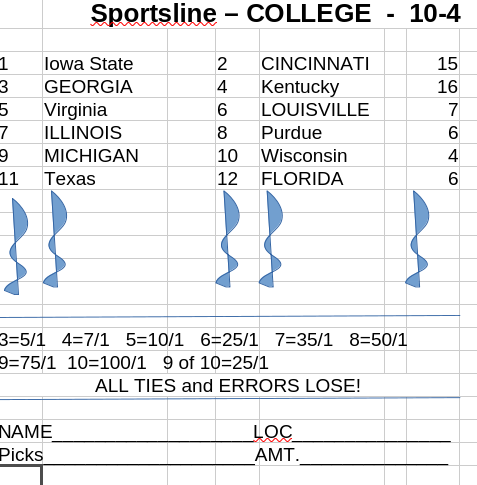
Sample of a portion of a football ticket

A well-run ticket made money for everybody – all the employees, even the normal run of the mill population, and yes, even people in security. Everybody is looking for the “big hit,” the “score,” the easy win. And, basically, they’re chasing an elusive butterfly that’s just always a little bit out of reach. Even a guy who was lucky enough to have a subscription to a print newspaper – yes, they are still a real thing.

So, the way it worked was like this: the point spread for the week’s games comes out in the Tuesday newspaper (some guys had other sources for getting a “quick point spread”…over the phone to a trusted friend on the streets perhaps). The “Gold Sheet” out of Vegas was another source. The spread comes out, the ticket man makes his own spread with minor adjustments here and there, eliminates unavailable TV games, and writes it up. He gives the master ticket to the typist/copyist who immediately sets it up. A good typist has his typewriter preset with tabs and knows right off the bat how many tickets will fit on a standard page, and sets to work.

The typist must be extremely accurate, intelligent and not prone to errors. (A missed or dropped or altered number is literally a break-the-bank mistake that can cost hundreds.) When he’s completed his job, he returns it to the ticket man so it can be proofread and approved, then it goes to the copy man. The copy man is someone in an office or who has access to an office where a copy machine is located and has the opportunity to make multiple copies of the sheet. The ticket man knows how many tickets he’ll need for a given week and tells the copy man, he runs that many and returns it to the ticket man.

The ticket man cuts them up from the pages and gives a stack of tickets to his runners, and knows how many to give to each runner based on their popularity or access to the population (certain segments such as cellblocks have specific needs such as the ability to move freely). Now, the real work starts. The runners head out and start distributing the tickets, going first to their guaranteed customers, their hardcore bettors.

Then they do their real work – hustling new players. They never carry their full supply of tickets with them, just enough to work with and keep the rest stashed. The runner has quickly learned who the “looky-loos” are, the ones who just want to look and won’t bet a nickel; he doesn’t waste a ticket on these guys.

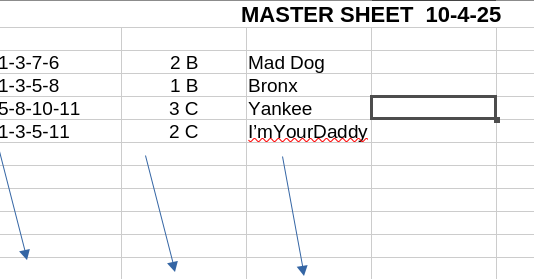
By now, it’s Thursday and the pick-up begins. The first pick-ups are usually smaller, one pack or the equivalent, normally 4 or 5 (team) picks for the early games. The ticket man can start to get a sense of how the bets are going, what teams are “hot,” and how the pickup will be. The runner passes his pickup to the vault and as soon as feasible goes in and makes a sheet listing all the bettors, the picks they made, and the amount bet. He then passes all of the stubs to the ticket man, who makes his own “master sheet,” listing all of the bettors, the picks they made, and the amount bet.

The pickup increases as time goes on, and although many of the bets are still 1 or 2 packs, the amount wagered gets bigger. By the time Saturday breaks dawn, things get really hectic. The runners are besieged with late and last-minute bets, some larger 4-picks…well thought-out 5 or 6 picks, here and there some 10-picks. Every single one is picked up, dutifully logged in and given to the ticket man. There is no room for error. When gametime arrives, it’s “sweat time,” meaning that everyone is sweating the games they bet, and the ticket man is sweating a pivotal game he changed the point spread on by one or two points, maybe even flipped the favored team.

By halftime, everybody has a good idea of how they’re going to fare – the bettors know the one team they really counted on is losing or won’t cover the point spread and the ticket man can tell whether someone’s going to hit. If cigarettes need to be moved they get moved – well in advance of the final scores. It’s vitally important to be extremely prompt in paying a winner. The losing bettors are already turning in another ticket for the late games or for the Sunday games in hopes of another chance of winning their money back.

If you now have at least a rudimentary understanding of how the tickets work it is perhaps time to tell you about some of my own experiences as a ticket man – and I’ve had the whole run: typist, runner, bookkeeper, vault, and banker. It is kind of like the job market in the free world – you usually have to start at the bottom and work your way up to the top. A word of caution here: the only thing a convict has in prison is his word. If you’ve ever had a bad debt, if you’ve ever failed to honor an obligation, your future as a ticket man is doomed from the start. Don’t think that your reputation does not quickly spread – in a prison housing over 5,000 men – you are mistaken.

My start in the ticket world began as a typist when I was a clerk on the Industrial Compound. I typed (and copied) for a guy on the East Yard at Main Prison. I handled it for the return of a mere 5 packs of Camels a week (roughly $20.00). Then I became a runner for the same guy – instant boost! – I jumped up to roughly $50.00 per week. sometimes less sometimes more, or 10% of what I picked up. During the heat of the season, like “Rivalry Week,” I might pick up $1,000, leaving me with a cool$100.00 a week. In prison, 100 x 4 = $400.00 a month which is a great standard of living, but especially in the 70’s and 80’s when I was doing this and it was my primary means of support.

So, I was a runner for a couple of years and just like with any budding entrepreneur, I set aside a little something every weekend of every season. When I found myself in the right situation I took the plunge and decided to put out my own ticket. I called it “SportsLine,” and ran it like a business. I was even more rigorous than normal because I didn’t hire any typists or runners my first year, keeping expenses to the absolute bare minimum. The first year I was scared 24/7 – worried about all the risks. What are the risks?

EVERYTHING is a risk. EVERYONE involved with the ticket is taking risks every minute of every day. The typist runs a risk every time he sets his typewriter up, and the copy man every time he turns the copier on. The runner runs the risk every time he walks out of his dorm with a pocket full of tickets, every time he sits down and writes his sheet, every time he delivers the stubs to the ticket man. The vault runs a risk every time the shakedown crew enters his dorm – sometime many years ago DOC set out a new policy that said that no inmate “shall have in his possession or control more than 5 cartons of cigarettes or Bugler tobacco at any time.”

This was for a variety of reasons, but more than anything else it was to try to eliminate the gambling and ticket operations. It obviously didn’t work, because every vault I ever knew had multiple people holding cigarettes for him. At the height of my ticket operations, I had about 8 vaults and each of them had 4-5 people holding cigarettes for him. Of course, there was also the case of “GP,” who was busted when the shakedown crew found a couple hundred cartons of cigarettes hidden in the ceiling of the Camp C Law Library. GP was like me, and didn’t like paying people for taking risks when he could take them himself for free!

My biggest and worst situation I found myself in was when I found myself at the intersection of convicts, politics and free people. You usually stay out of their business and for non-security issues they pretty much stay out of yours. There are usually pretty strict and straight lines separating convicts and free people, but when you work for a long time in close proximity to them that line tends to blur a bit.

I had been a clerk at Camp F for a number of years when this happened, and had been running SportsLine for about 4 years {seasons} when this happened. My boss (who I had a good understanding with), “Major X,” was suddenly suspended without pay and transferred to being a supervisor over the Farm Lines. This was because a convict running the CPR Club at Camp F was caught in possession of more than $3,000 cash (green money) and vending machines under his control were found to have been compromised.

Now, let’s be clear here – Major X had never done anything with any club at Camp F that Colonel Y didn’t tell him to do. Colonel Y was – plain and simple – an asshole. About 40, tall, a big man with a big attitude. When he entered a room, he commanded everyone’s attention. I won’t deny him his credit. It seemed as though he had earned his rank. Once he had attained a certain amount of power, however, he began to use it in surprising ways, both to shield his “pets” and to attack others. I was obviously not a pet.

It was early on a Saturday morning and Colonel Y had weekend duty. I was in the office typing up the week’s accreditation summaries and preparing for the coming week when he came in. The 2 female officers working the front desk each bought Community coffee every week, and I would make them a pot as soon as I got to work and it was the only pot made unless they specifically asked for it. The pot was empty when he came in, and he looked at it disgustedly.

“You gonna’ make some coffee or what?” he snarled.

“No, sir,” I responded, not looking at him.

“Why the hell not?” shock and surprise crossing his face.

“Well, sir, the ladies up front buy that coffee and I make them one pot a day, and that’s what they want.”

“They’re sergeants and I’m a Colonel. What part of that don’t you understand?!”

Now, I’d had it with his attitude, and I turned around and faced him.

“The part I don’t understand is the part where you wrote the report on Major X and recommended his suspension and transfer. He never did a damned thing with that club unless you or Warden Z told him to. That stuff happened with CPR and now he’s riding a damned mule in the fields. It’s that part,” and I turned back around.

I guess that in some circles it would be said that I had “let my alligator mouth overload my hummingbird ass,” but I just didn’t care. This guy needed to be told that he had messed over a good man and had done it wrongly to protect himself from blowback for the loose supervision over the club.

The repercussions were instant and though it was expected, I didn’t realize it yet. As a ticket man I had to hold all the stubs from the pickup until Tuesday so that I had incontrovertible proof of a bettors picks. Everybody of consequence at Camp F knew I ran SportsLine. EVERYBODY. An unnamed Warden once (several times, actually) played one of my tickets – pulled the cash money from his wallet and handed me the ticket with his picks under an alias. Nothing about it was secret.

That was Saturday morning. Tuesday morning I was startled when the head of the Shakedown Crew appeared at my door and ordered me to stand up and get away from the desk. The very same man had a standing bet with me every LSU game – if he won, he paid me in cigarettes, and if I won I paid him with a pizza. I thought he was joking when he said it, and grinned and told him, “Come on, man. You just lost a pack!” He looked me in the eyes and said, “I don’t have a choice,” very clearly implying that he had been ordered to do this.

To make this shorter, he and the crew shook me down and found the bag with my stubs, and curiously, confiscated from me a printed DOC policy regarding polygraph exams and the process for administering them. DOC policies are easily discoverable in the Law Library. They wrote me up for Gambling and Contraband. The stubs were definitely contraband, but the policy? Hmmm……

While this was going on, Colonel Y and Warden Z came in and told me to come to the lobby and have a seat. They both sat down and started trying to interrogate me, asking about the shift Lieutenant and a couple of other officers. I just looked at them and said,

“I don’t have any idea what you’re talking about, besides that, ratting on a convict is bad enough but ratting on a free man? There’s no win in that. I got nothing to say.” Of the 7 people in the building at that moment, 4 of them were on the take from my ticket. It was kind of quiet but I could swear I heard a sigh of collective relief emanating from them all.

An hour later I was stepping down from a van, shackled at the ankles and waist and led down a hall and placed in the Camp C Tiger dungeon in solitary. Four days later, I was fortunate to go to DB Court in front of a Colonel whom I had known for many years and was cool with.

As soon as we had gone through the formalities, he switched off the recorder and said, “I got a phone call early this morning telling me to send you to a working cellblock. But that call came from a Colonel, and I’m a Colonel, too. So, I reckon that means I can do it or not do it.”

I let out a huge sigh of relief – salvation in sight! He turned the tape back on and I gave my statement, and questioned the confiscation of the polygraph policy as we are allowed to have them. He turned the tape off again and told me, “Kissinger, you gotta’ understand – they’re trying to throw the book at you. Just plead guilty and I’m not gonna’ send you to the blocks.”

Ten minutes later he sentenced me to a quarters change to the Main Prison and job change to the Farm Line. A week later, Major X drove out to where we were working and told the free man working the line to call me to the headland. When I got there and saw him, I broke out into a huge smile. He greeted me and told me that he had heard about the whole thing, and said that he appreciated the fact that I had “held my water.” He then told the free man line pusher (who was notorious for being a hardass on White boys) to take it easy on me, and that he would be checking in on me from time to time. Two weeks later, I had a job as a clerk at the Tag Plant. The next season, I was back at Camp F, and SportsLine was more popular than ever before.


Thank you for reading! Hope you enjoyed it, and come back for more true tales from the bayou! See you again soon!

Cow Patties and The Fat Man

William Kissinger · October 9, 2025 · Leave a Comment

A Bloody Encounter and An Angry Doctor

There were a whole lot of times when I was in Angola that I thought I had reached the end of my rope, that I just couldn’t go one more day, that I couldn’t take one more work call. This is just one of those times. Fortunately, it worked out so that I was able to live to serve a lot more of the 47 flat calendar years I did in that hellhole.

Medical care at Angola has ALWAYS been horrible. It was horrible in the 70’s, and has gotten only slightly better, and only because of court-ordered changes.

  • Constitutional Violations:Federal judges have ruled that Angola’s medical care is not only subpar but also constitutes cruel and unusual punishment.
  • “Callous and Wanton Disregard”:The court found that prison staff and administration have “callous and wanton disregard” for the health needs of the incarcerated population, leading to a pervasive state of illness.
  • Specific Deficiencies:Deficiencies were noted in:
    • Clinical care (including sick call and medication management)
    • Inpatient/infirmary care
    • Emergency care
    • Specialty care
  • Decades of Neglect:Evidence shows the state has been aware of and failed to address these deficiencies for decades.

So, it was well on into my early years in Angola when I came very close to seeing the end of my sentence. This was a period where virtually everything was in short supply. Repair of anything was an unrealized fantasy, silverfish and cockroaches ruled the dormitories. If something in the prison was broken, the attitude was pretty much, “Well, just paint it.” I was still dealing with the ugly grind of field work in the Farm Line. Camp A had its’ own farm line and I had been toting that standard for a couple of years.

Long days of backbreaking and mind-numbing labor, most of which was “make-work,” just something to work the hell out of you and make you bone-tired. ALL of it took a toll on you, mentally, emotionally and physically.

I’d already been down a few years at Angola, staring at an LWOP, and by then the days just started running together. I was housed at Camp A, which carried its own kind of crazy — a different vibe, a harder edge, like the walls themselves had soaked up all the madness and spit it back out at us. It used to be known as the “White Elephant,” and had a bloody history tied to it like an anchor.

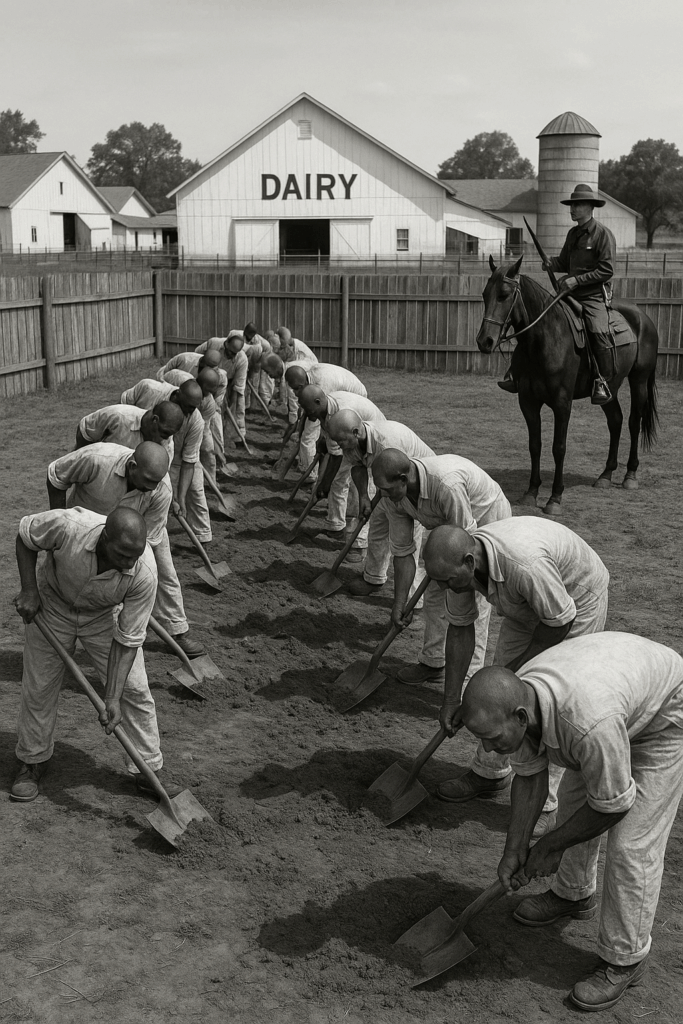
They had us working Line 2, and that morning my squad was sent behind the Camp A Dairy. What we did was called “quarter-draining,” which was to dig little paths through the pen for drainage. The spot was called the grab pen — where the cows got bunched up before they were herded inside to be milked. The ground out there stayed slick and nasty, churned up mud mixed with piss and shit from all those cows standing around too long. Every step was a fight not to lose a boot, and the smell of it hit you deep in your throat, like you couldn’t ever wash it out.

We were out there in that mess, maybe 15 of us, just moving slow, trying to keep from slipping. Nobody wanted to bust their ass in that slop. The free-man boss sat up on his horse, watching us like he always did, not saying much, just chewing on his toothpick like he owned the whole damn world, occasionally spitting tobacco juice around the toothpick. Every once in a while just in case anybody thought he wasn’t paying attention, he’d spit out a stream of juice and snarl out an oath – “Get your cracker ass on and get to digging my fuckin’ quarter drains!”

The cows weren’t in any hurry either. Big, heavy bodies pushing against each other, lowing, shitting, pissing, making the ground worse with every step. You’d try to guide one along and another would swing its head at you, big floppy ears catching the air close enough to make you flinch. Out there, you learned real quick that you weren’t the meanest thing in the pen. It was mostly the buzzing blue flies that were the meanest. They landed on all that piss and shit, buzzed all around you and then landed on you and you got chills running up your spine.

I remember standing there, sweat running down my back, mud and cow shit creeping over the tops of my boots, and thinking: this was my life now. Not a season, not a stretch, but forever. Every morning another field, another pen, another stink that clung to me long after I left it.

The grab pen was its own kind of trap. There was nowhere to stand clean, nowhere to breathe easy. Every time the sun came up, that steam would rise off the ground — piss and shit cooking together — and it would wrap around you, stick to your clothes, crawl up into your nose until you almost couldn’t taste anything else.

The men didn’t talk much out there. Maybe a curse when a boot got stuck, or a laugh if somebody damn near went down face-first. But mostly it was just the sounds of the cows and that steady creak of the boss’s saddle as he shifted on the horse. His rifle lay across his lap, casual, like it wasn’t even meant for us — but we all knew it was.

After a while, you stopped noticing the smell, stopped noticing the mud pulling at your legs. What you couldn’t stop noticing was the weight of it all. The fence around the pen. The fence around the farm, the fence around the camp. The fences inside your own head.

Convicts Digging A Narrow Quarter-Drain

Not long before this, they’d issued me a new pair of brogans. Heavy, ankle-high stiff boots meant for dry land, not for the swamp of a grab pen. First day I laced them up, they already felt wrong, cutting at my ankles, rubbing at my heels. But you don’t complain about boots in Angola — you just wear what they give you and keep moving.

What I didn’t know was that a little piece of rock, maybe no bigger than a sliver of a fingernail, had slipped down inside one of my brogues. The mud and water kept my socks wet all day, and the rubbing started carving at my foot without me realizing it. By the time I did, the skin was scraped open, raw. Out there, raw skin didn’t stay clean for long.

Every step I took in that slop, the mix of piss and shit worked its way into that cut, deeper than I wanted to think about. At first it was just sore, a little sting when I put weight on it. But the next day, I woke up with my whole foot throbbing. By noon, I could feel it climbing my leg, burning inside me in a way that had nothing to do with the sun overhead.

Two days in, it was bad. My foot was so swollen I couldn’t pull my boot onto it. My fever kept climbing, and my body felt like it was shutting down one piece at a time. I was dizzy, weak, couldn’t keep food down, couldn’t even make myself care about eating. My skin was hot, but I was shivering inside. I knew something was seriously wrong, but I was too sick to do much more than just drag myself through it. By nightfall, my leg had angry-looking red streaks criss-crossing and running all the way up to my waist. I knew this was bad, just not how bad.

I finally hit the point where I couldn’t tough it out anymore. It went against everything in me to do it, but I had no choice — I had to call on the free man. That was the CO over the dorm, the one who held the keys and the clock, and usually couldn’t care less if you dropped dead in your rack.

I staggered up to the front of the dorm and started banging on the door, hard as I could manage. The sound echoed, but it still felt like it took forever before he showed. When he did, he looked pissed, like I’d interrupted his cigarette break or his crossword.

I told him I needed help. He laughed it off, told me there wasn’t a damn thing wrong with me that couldn’t wait until morning. Basically told me to get fucked, and started to walk away. But I wasn’t letting go — not this time. I leaned on the bars, kept insisting, told him I was serious.

Finally, I yanked my pant leg up and showed him my foot, swollen and purple, and then I pulled my shirt up so he could see the angry red streaks running all the way up my side. I was shaking, sweating through my clothes, barely able to stand upright.

That got to him. His face didn’t go soft, exactly, but something shifted. He stood there looking at me for a long beat, then muttered that he’d go see the lieutenant. Then he disappeared, and I was left holding myself up on the bars, praying he didn’t just forget about me.

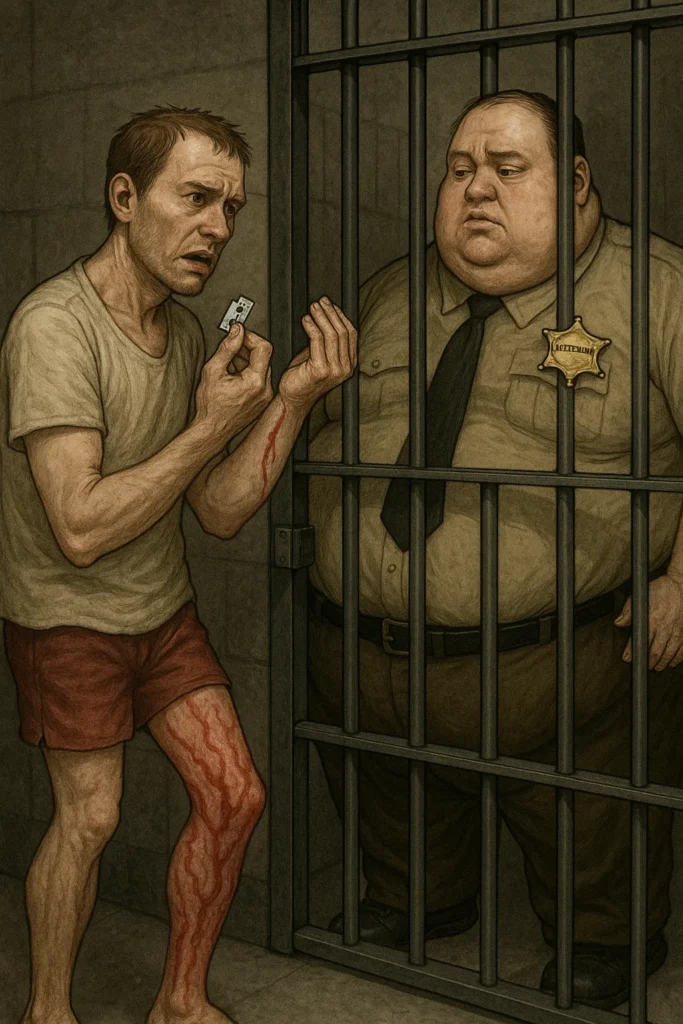
About twenty minutes later, Lieutenant Hart finally showed up. Everybody called him Big Daddy. He was a mountain of a man — had to be pushing four hundred and fifty pounds easy — and he moved like it hurt him just to be upright. Each step was a slow roll, like the floor dipped under him.

He came up on me, eyes small in that big red face, and asked what was going on. I told him. He looked at my foot, at the streaks crawling up my leg, and just shrugged. Told me to wait until the next day, like I’d been making a fuss over nothing, like I was mad he took my cookies or something.

Something in me snapped right then. We started going back and forth, him gruff and dismissive, me desperate and sick and not caring anymore. My head was burning but my hands were steady. I pulled out a little razor blade I’d been holding onto, laid it across my arm, and dragged it just enough to open the skin so he could see the blood. Then I laid it back on my arm and stared at him.

“You can either send me to the hospital for my leg,” I said, voice shaking, “or you can send me to get this motherfucking arm sewed back on!”

Big Daddy froze for a second, staring at the thin line of blood on my arm. His face twitched like he couldn’t decide whether to roar at me or grab me. Then he cursed under his breath, spat tobacco juice at the floor, and barked for two rank-and-file night guards. They came stomping up the stairs and in from the corridor, both of them in sweat-stained khakis and scowls like permanent scars.

“Take this fool to the infirmary,” Big Daddy snapped. “Now.”

They didn’t handle me gently. Each one took an arm and yanked me forward hard enough to make my knees buckle. I stumbled between them, half-dragged down the hallway, my foot throbbing so bad I couldn’t feel the floor. The guards muttered and cussed the whole way—about being pulled off their posts, about “malingering,” about “another dumb-ass convict trying to milk a sick call.” Their grips were iron, fingers digging into my arms, but I didn’t care. The only thing keeping me upright was the thought that I was finally, maybe, headed somewhere I could get help.

We reached the infirmary at the Treatment Center — a low-lit room with chipped paint and the stale smell of antiseptic. The night duty doctor was already there, a big man with a gray beard and a face like carved stone. He didn’t look up at first, just kept scribbling something on a clipboard. “Put him on the table,” he said flatly.

The guards shoved me onto the exam table, and I swayed, gripping the edge with white knuckles. The doctor finally looked up, and when his eyes hit my leg, his expression changed fast. He dropped the clipboard onto the counter with a clatter.

“Jesus Christ,” he growled, pulling on gloves. “How long has it been like this?”

I mumbled something—two days, maybe three—but my voice was thin. He didn’t even answer. He yanked my pant leg up, peeled back the filthy band of my sock, and let out a sharp hiss of breath. Red streaks like lightning bolts raced up my calf, across my thigh, and vanished under my shirt. He lifted the hem and saw the rest. His jaw tightened.

“You’re about eight hours from this hitting your heart,” he snapped, turning on the guards. “And when it does, he’s dead. You understand that? DEAD.” His voice cracked like a whip. “This is a severe septic infection—blood poisoning. This man needed treatment yesterday.”

The guards shifted uncomfortably but didn’t say anything. One of them muttered, “He didn’t look that bad—”

The doctor whirled on him, eyes blazing. “You idiots can’t see a man dying in front of you? If he’d waited until morning, you’d be zipping him into a body bag!”

He slammed a drawer shut and started pulling supplies out—IV kit, antibiotics, things I couldn’t even name. His hands were fast but steady. “We don’t have time for this place’s nonsense,” he barked. “Call the control center and tell ‘em he’s going to Charity Hospital. Get a van ready. I don’t care who you wake up or what strings you have to pull. He’s going out tonight.”

“No ambulances at this hour,” one of the guards said.

“Then get the van,” the doctor snapped. “I’ll ride with him if I have to. Move!”

They bolted out. The doctor turned back to me, his eyes softer now, but only just. “You’re damned lucky you made it here when you did,” he muttered. “Another eight hours, and you wouldn’t have had a prayer.” He jammed the IV needle into my arm with practiced speed, hooked up a bag of clear fluid, and pressed a mask over my face.

The last thing I remember was the cool rush of liquid sliding into my veins and the smell of disinfectant, the doctor’s rough voice still echoing in my head: “Eight hours from your heart. Eight hours from dead.” Then the room tilted, and the lights blurred as they wheeled me out toward the waiting van and whatever came next.

Katrina – When She Hit Angola – Part III

William Kissinger · October 9, 2025 · Leave a Comment

These Weren’t Any Candy-A$$ Girls !!

This is Part III of my series on the affects of Hurricane Katrina striking Louisiana and a large portion of the Gulf states twenty years ago this week. Almost everyone, when you mention Katrina, gets images of a flooded city, people stranded on rooftops or wading slowly through toxic waters, savage acts or even tales of individual heroism and bravery.

Very few people think of the plight of either the prisoners of Angola or OPP or any of the smaller parish jails, about where they went and how long it took them to get help, but especially, what happened to the female prisoners. In this series, I tell you about it. If this is your first encounter with my writing here, please go back and read Part I and Part II to fully understand what was going on.

“The first really impactful item that sent shivers down our spines was when word began to filter up to us of frightening events in New Orleans – prisoners were abandoned in their cells, left to the steadily rising waters when their guards abandoned them and fled their posts. The reports were horrendous. Already off-balance with our own conditions, our only thought was “Could we be next?”
Bill Kissinger from Part 1 of this series.

Conditions were in chaos in the gym….

So, when I left Part II, I had finished creating the initial database and was preparing to get started on assigning beds and creating a roster for the officers. Those plans, however, had to be put on hold when an officer called me to come up front and told me they needed help unloading a truck. When I arrived and the officer unlocked the door for me to pass through I saw not one, but three big-bed pickup trucks parked and idling, their bulging loads concealed beneath tied down tarps.

Pulling the tarps to the side I discovered cases of fancy, high-end soaps, some with hotel logos on them; cases of extravagant body washes and lotions, cases of baby powder, even cases of little, tiny bottles of perfumes and colognes. The next trucks revealed cases of toothbrushes and toothpaste, feminine razors, cases of casino playing cards with the casino’s name emblazoned across them, and to my utter embarrassment – female undergarments and sanitary napkins. Now, please, bear in mind that I had been locked up for 36 years at this point!

So you could at least understand my embarrassment at handling such items. After quickly “inventorying” the items, I started to unload the first truck. I was only slightly surprised when the free man told me, “Kissinger, hold up…set a couple of those cases – of everything – off to the side. For me.” Hmmmpphhhh. This particular free man had a reputation of pilferage on a regular and giant scale, and virtually everyone knew it. What was gonna’ be the takeaway here – would I be in a trap or would I be in a perfect situation? If I refused or if I went along? If I did or if I didn’t? What was gonna’ be the victimhood breakdown here?

Throwing caution to the wind here, I set two stacks to the side – one of one case of each commodity and one of two cases of each.

If he went down, I’d go down. However, I knew that if I went down, I’d go down alone. In prison NOBODY likes a snitch, so ya’ gotta’ be careful – snitch on a convict and all the convicts hate you, snitch on a free man and all the free people hate you. There just isn’t a middle road to walk down.

He told me to take all the stuff we had set aside for him and load it into his truck and I did. Job completed, I took the cases set aside for me and shot straight back into the office and stashed it for later. Now, let’s be clear here – I did NOT take any female undergarments or sanitary napkins or anything like that. I COULD have and could have made money with it. Shocking to think, but there is a black-market for that stuff in Angola.

What I concentrated on (for myself and friends) mostly were the casino playing cards, soaps, body washes, lotions and powder. We had no clue when we’d be allowed to return to Camp F, and these would come in very handy over what turned out to be a year.

The patrol came to pick me up around 8:30-9:00 at night, and I always carried a pillow-case back to the gym with me. The driver would shake me down and seeing that it was all harmless, let me carry it with me.

The next day the officer and I, along with several female officers, set up an assembly line operation and distributed a “care bag” to every single female in the camp. They were overjoyed to receive these small comforts – little reminders of a world they had left behind and that was now beyond their reach. They could now apply a little makeup and take care of their hygiene and feel human again, even if only for a while,

While they were beginning to feel human again, we were still trying to gain our footing and get our balance back. Strange, but I went to sleep that night feeling that I had done some good in this world we live in.

The next day brought even more surprises, and this time I would be personally impacted, and impacted in a way that would last for several years.


Katrina – When She Hit Angola – Part 2

William Kissinger · October 9, 2025 · Leave a Comment

Let ‘Dem Trucks Roll On In !!

This post is Part 2 of my series on the anniversary of Hurricane Katrina striking the Louisiana coastline, causing immense damage and costing at least 1,800 lives. Since virtually everyone knows how it impacted civilian life but very few people know how it affected those of us serving LWOP and lengthy sentences in Louisiana State Prison (Angola).

“The first really impactful item that sent shivers down our spines was when word began to filter up to us of frightening events in New Orleans – prisoners were abandoned in their cells, left to the steadily rising waters when their guards abandoned them and fled their posts. Thereports were horrendous. Already off-balance with our own conditions, our only thought was “Could we be next?”
Bill Kissinger from Part 1 of this series.

Nothing happens to improve your lot in life immediately. Anywhere. In prison it takes an inordinate time longer. How much is “inordinate?” What is “safety?” How “uncomfortable” are prisoners supposed to be and for how long? Are prisoners supposed to be considered “less than” outside civilians?

For the first few weeks of our life in the gym, chaos continued to reign and it was on free people (guards) and convicts alike. We had gotten folding Army-style surplus cots to sleep on, we were eating in the Main Prison chow hall although at separate feeding times. We were starting to return to our regular jobs (although, those of us who were able-bodied had been working every day on emergency clean-up crews) and new procedures had been worked out between crew foremen, Main Prison wardens (5) and the Outcamp Warden and the Camp F warden . The wardens passed down their agreements to their colonels and lieutenant colonels who passed it to majors and captains and lieutenants and – theoretically, at least – orders were carried out and changes made and policies implemented.

Nothing really quite worked that way with us as we were the new kids on the block and would remain that way for a long time. There had always been a kind of veiled hostility towards prisoners who lived at Camp F from both security and Main Prison convicts. They saw us as spoiled brats with way too many freedoms and comforts and way too much “political” power; politics in Angola is everything, and at every level: sergeants, lieutenants, captains, majors, colonels, wardens – everybody had their favorites and every favorite had their own connections. It’s just the way things work and it’s the way things have always worked – think back to your school days or your military service or even the company you work at. It’s just that way.

So, the majority of our obstacles were based on this type of thing – the way we were viewed. So what did we do to counteract the “little brother” dilemma we were boxed into? We worked together to accomplish more, to secure what we felt was ours, to improve our lot, and we did it in small ways. We had a stellar plumbing crew, a skilled electrical crew, a grand carpentry crew, and a whole bunch of crafty wise little dudes in various positions who were capable of pulling off semi-miracles.

Our leaky toilet? Fixed! Our lack of electrical outlets? Fixed! Phone lines installed and ready for Securus to come in? Done! Hygiene supplies and cleaning supplies? Done! Real, metal bunks and mattresses for sleeping comfortably? Done! Water fountain? Done! Fans? Done! Over time, when we finally returned to Camp F a year later, we left behind a much better framework for the next group of people who found themselves here under similar circumstances.

On only our 3rd day in the gym, I was summoned to a Camp F supervisor’s office. They told me I needed to be ready to go to work in the morning. WHAT? I was the Clerk for Camp F. At F, my duties consisted of filing paperwork generated by each shift, creating new blank forms for them, doing ACA mandatory paperwork (i.e., temperature logs, hobbyshop inventories, tower checks, camp vehicle mileage reports, flammable inventories, etc.), making coffee for the E-Bldg, keeping the lobby clean, and in general, generating whatever written reports my boss needed when needed so that he’d look good when called upon.

I Went To Work The Next Day…

The next morning I was up and cleaned up and dressed and ready to go to work. By this time, there was a procedure worked out for the patrol driver to pass through the Sallyport and drive to the back door of the gym, load up callouts, and drive back out. The patrol van driver picked me up at a little before 5:00am, which guaranteed that I would be a few minutes late to get coffee made for the shift, but I was so happy to get out of the gym and back to work that I didn’t care.

Little did I know how happy and excited I would be at the end of the day, my first day back at work. First, I would be free to do what I loved doing – bringing efficiency and order to an office – and second, that I would meet and be entranced by a girl from New Orleans, and that I would also take a trip to the dungeon and back.

We got to Camp F, and one of the female security officers told me, “Alright, Kissinger, they’ve got a few hundred ladies here now, so things are gonna’ be a little bit different. We need to figure out a way to get all these ladies assigned to a bed, and once we do that, we can figure out what to do next.”

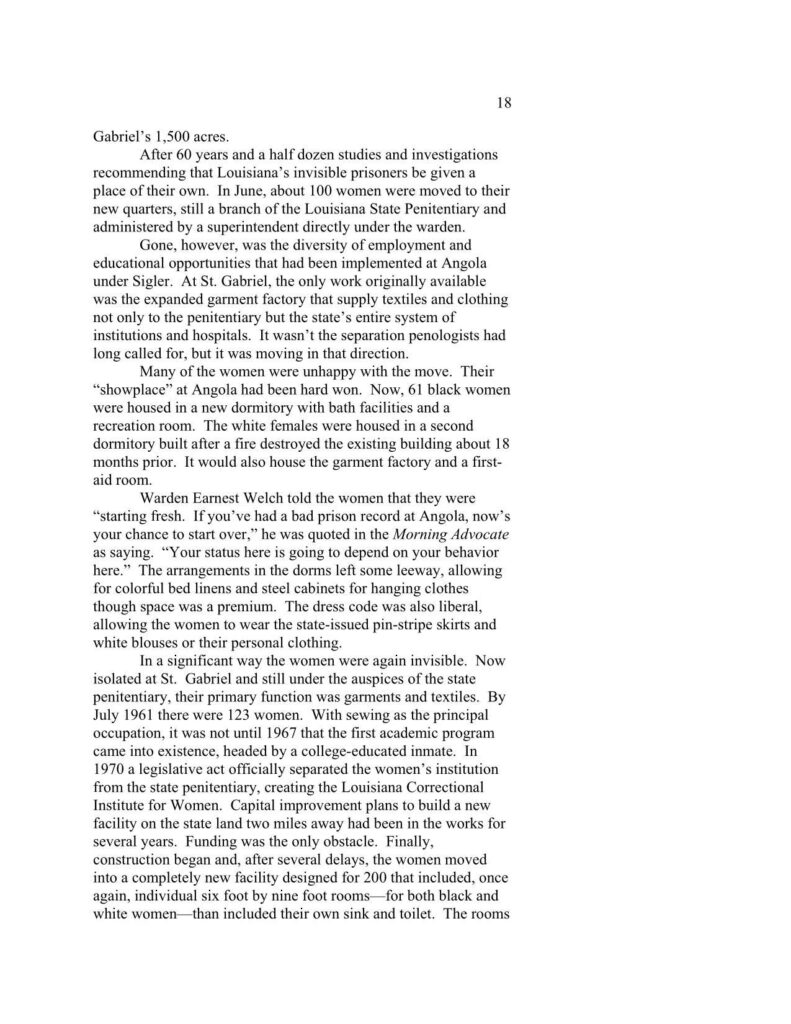
Females? WHAT?! I’m really, really confused because Angola is a MEN’S maximum security prison! Females had originally been sent to Angola to what had become known as “The Willows,” a small collection of clapboard buildings that typically housed anywhere up to 125 women at a time and was located in the northwestern corner of the prison.

Women had been housed at Angola since around 1901. Remember that all during that time, throughout the South, was a period of extreme segregation, so there were separate living quarters for Blacks and Whites. There were several occasions when the females came under close scrutiny from “committees” and “study groups” and “prison experts.” Was anything ever done to resolve the problems that existed? No….especially during the Huey Long administration. The state’s legislature, as a matter of course, kept their hands off of the penitentiary, as it had always been viewed as the Governor’s “property.”

It took a stripper from New Orleans to cause the women to be moved to an entirely separate facility of their own. (Source: Academia, Marianne Fisher-Giorlando, originally Kerry Myers of the Angolite)


The “Forbidden City” held many, many secrets. The last of the females left Angola in the summer of 1961. A new era dawned. Forty-four years later, women would once again walk through Angola, and would walk in my dorm.

When I got over my initial shock it was time to look at what was before me. There was a stack of different spiral-bound logbooks and single pieces of lined paper with handwritten and nearly illegible names and numbers scrawled across them. Pure turmoil, and the office phone constantly ringing, radios continually chattering with Control Center traffic and a few highly frustrated free people expressing themselves in colorful terms.

A Nightmare Of Work Awaited Me

I grabbed a cup of coffee and dove into it. First, I had to figure out what the logbooks contained and how the information was put together (they were all filled with lists of names and DOB’s and DOC numbers….next to some of the names was a single letter – “W” or “B” or “O” indicating race – but not all of them were indicated.) Then, had to assemble all of the individual pieces of lined paper into some form of order and try to match them up with names already in the logbooks to make sure there were no double entries.

Suffice it to say that the entire office was in total disarray and the king of the day was Utter Chaos. It took the better part of several hours to get everything organized to where I could start to enter data into a hastily constructed database and begin to match it to the database updated by Control Center at midnight every night. So, as it was quickly approaching the second “mandatory” count of the day, I needed to get them an accurate printout showing how many and who Control Center said was actually here.

Now, let me remind you of something I’ve talked about several times throughout my writings. Angola ran about 15-20 years behind the times with everything technological. Here it was 2005, and the office computer was still running old versions of MS Windows (and different versions in separate offices!) and the master database operated by Control Center was an old, clunky and slow DOS-based relational database called “NutPlus.”

Let me be the first to admit here that what I was doing was pretty much considered “illegal” by rank or authority. There was actually a policy that prohibited me from using this computer because it had inmate data on it. Let me tell you how much that mattered when there is a crisis or emergency situation and you’re the only one around who has the knowledge to do it. Yeah, about that much. The point is to get the work done, and pretty much everyone will turn their head while you get it done.

Miraculously, the 11:00 count cleared after only 3 or 4 recounts! (And, I can testify that there was NOT a “paper count,” with imaginary numbers.) So, what remained was to get everybody into an assigned bed so that they could be located at any time of the day or night, and make an accurate record of that assignment. The phone rang again, and the major called for me. The bed assignments would have to wait, as there were trucks pulling up at the camp with donations for the women. Oh boy….this would turn out to be an interesting episode and a chapter of Angola’s already infamous history, and I’ll tell you about it next time.

NOTE: For a look at other sides of Angola, might I suggest you take a look at my friend Rose Vines Substack, “Graphic Dead Man Walking.”

  • Page 1
  • Page 2
  • Page 3
  • Interim pages omitted …
  • Page 5
  • Go to Next Page »

My Life After Prison

Copyright © 2026 · Website provided by Boomajoom