Football is in mighty fine swing right now and people are starting to get excited about their teams – sorry if you’re a Saints or Cowboys fan! – I am, too. I’m a HUGE Texas A & M fan, and right now we’re ranked #5 nationally! So, it seemed like a good time to tell you about a lesser-known aspect of prison – the gambling culture, and more specifically, the football (and basketball) tickets operation. I have a lot of experience with this one, (and had a couple of DB writeups and did some dungeon time) and found myself in the middle of some dirty free folks’ politics and got transferred once.
Gambling makes up a HUGE subset of the prison culture, and everybody knows that where there’s a need there’s always going to be somebody willing to step up and fill that need (especially if there is the potential for financial reward). It is fairly simple to become a “ticket man” – the only thing that really matters is what degree of risk you are willing to assume. If you want to minimize the financial risk, you can easily bring in partners; if you want to hog all the profits (minus operating expenses, of course), you ride by yourself. Along with all of the profits, you also assume all of the risks.
And, BOTH can be huge, at least in terms of the prison economy. The risks are extreme because you’re offering great odds – you’re paying out MANY times what a prisoner is betting.
On a “lucky” bet, a $10.00 wager could easily (but rarely) cost you $1,000.00!
At the time I’m writing about, the price of a pack of Camel’s (primary brand in Angola, when smoking was still permitted) was $4.97 and two packs was rounded up to $10.00. Community coffee was also a good fit. Some ticket men would take almost any commissary items (soups, cookies, candy, stamps, etc.) and negotiate the value with the bettor. It would also probably be the first items paid out to a willing and hungry winner.
That practice of accepting almost anything on a bet carried its own risks as it required larger hiding spaces, more clever means of concealment and transportation from the bettor, storing it during the games, and delivering payoffs to a winner. But, as the old saying goes, “Where there’s a will, there’s a way,” and absolutely no one on earth has a stronger will than a convict trying to put his hustle down. So, means were found and hustlers were employed, guys that could move, that had common sense (or absolutely none and just relied on their balls!) or were just in the right places and positions.
Convicts that were needed to run a ticket:
Typists / copy makers
Runners
Bookkeepers
Vaults (temporarily held pick-ups, or bets)
Bankers (emergency loan sources for large “hits”)
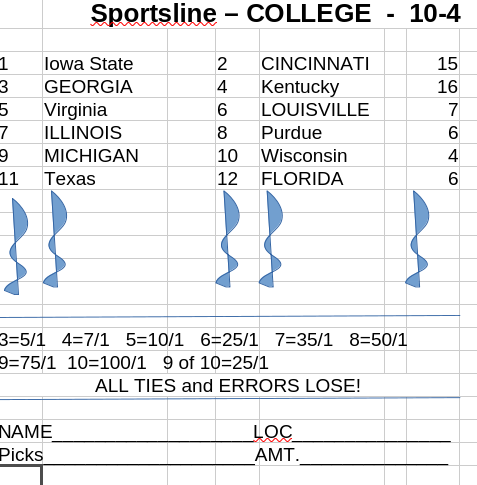
Sample of a portion of a football ticket
A well-run ticket made money for everybody – all the employees, even the normal run of the mill population, and yes, even people in security. Everybody is looking for the “big hit,” the “score,” the easy win. And, basically, they’re chasing an elusive butterfly that’s just always a little bit out of reach. Even a guy who was lucky enough to have a subscription to a print newspaper – yes, they are still a real thing.
So, the way it worked was like this: the point spread for the week’s games comes out in the Tuesday newspaper (some guys had other sources for getting a “quick point spread”…over the phone to a trusted friend on the streets perhaps). The “Gold Sheet” out of Vegas was another source. The spread comes out, the ticket man makes his own spread with minor adjustments here and there, eliminates unavailable TV games, and writes it up. He gives the master ticket to the typist/copyist who immediately sets it up. A good typist has his typewriter preset with tabs and knows right off the bat how many tickets will fit on a standard page, and sets to work.
The typist must be extremely accurate, intelligent and not prone to errors. (A missed or dropped or altered number is literally a break-the-bank mistake that can cost hundreds.) When he’s completed his job, he returns it to the ticket man so it can be proofread and approved, then it goes to the copy man. The copy man is someone in an office or who has access to an office where a copy machine is located and has the opportunity to make multiple copies of the sheet. The ticket man knows how many tickets he’ll need for a given week and tells the copy man, he runs that many and returns it to the ticket man.
The ticket man cuts them up from the pages and gives a stack of tickets to his runners, and knows how many to give to each runner based on their popularity or access to the population (certain segments such as cellblocks have specific needs such as the ability to move freely). Now, the real work starts. The runners head out and start distributing the tickets, going first to their guaranteed customers, their hardcore bettors.
Then they do their real work – hustling new players. They never carry their full supply of tickets with them, just enough to work with and keep the rest stashed. The runner has quickly learned who the “looky-loos” are, the ones who just want to look and won’t bet a nickel; he doesn’t waste a ticket on these guys.
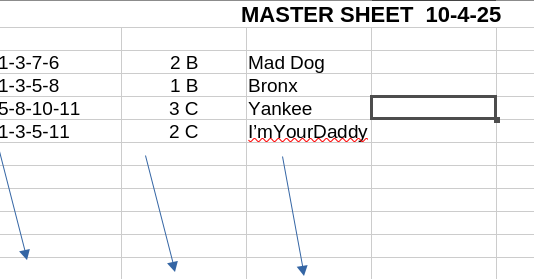
By now, it’s Thursday and the pick-up begins. The first pick-ups are usually smaller, one pack or the equivalent, normally 4 or 5 (team) picks for the early games. The ticket man can start to get a sense of how the bets are going, what teams are “hot,” and how the pickup will be. The runner passes his pickup to the vault and as soon as feasible goes in and makes a sheet listing all the bettors, the picks they made, and the amount bet. He then passes all of the stubs to the ticket man, who makes his own “master sheet,” listing all of the bettors, the picks they made, and the amount bet.
The pickup increases as time goes on, and although many of the bets are still 1 or 2 packs, the amount wagered gets bigger. By the time Saturday breaks dawn, things get really hectic. The runners are besieged with late and last-minute bets, some larger 4-picks…well thought-out 5 or 6 picks, here and there some 10-picks. Every single one is picked up, dutifully logged in and given to the ticket man. There is no room for error. When gametime arrives, it’s “sweat time,” meaning that everyone is sweating the games they bet, and the ticket man is sweating a pivotal game he changed the point spread on by one or two points, maybe even flipped the favored team.
By halftime, everybody has a good idea of how they’re going to fare – the bettors know the one team they really counted on is losing or won’t cover the point spread and the ticket man can tell whether someone’s going to hit. If cigarettes need to be moved they get moved – well in advance of the final scores. It’s vitally important to be extremely prompt in paying a winner. The losing bettors are already turning in another ticket for the late games or for the Sunday games in hopes of another chance of winning their money back.
If you now have at least a rudimentary understanding of how the tickets work it is perhaps time to tell you about some of my own experiences as a ticket man – and I’ve had the whole run: typist, runner, bookkeeper, vault, and banker. It is kind of like the job market in the free world – you usually have to start at the bottom and work your way up to the top. A word of caution here: the only thing a convict has in prison is his word. If you’ve ever had a bad debt, if you’ve ever failed to honor an obligation, your future as a ticket man is doomed from the start. Don’t think that your reputation does not quickly spread – in a prison housing over 5,000 men – you are mistaken.
My start in the ticket world began as a typist when I was a clerk on the Industrial Compound. I typed (and copied) for a guy on the East Yard at Main Prison. I handled it for the return of a mere 5 packs of Camels a week (roughly $20.00). Then I became a runner for the same guy – instant boost! – I jumped up to roughly $50.00 per week. sometimes less sometimes more, or 10% of what I picked up. During the heat of the season, like “Rivalry Week,” I might pick up $1,000, leaving me with a cool$100.00 a week. In prison, 100 x 4 = $400.00 a month which is a great standard of living, but especially in the 70’s and 80’s when I was doing this and it was my primary means of support.
So, I was a runner for a couple of years and just like with any budding entrepreneur, I set aside a little something every weekend of every season. When I found myself in the right situation I took the plunge and decided to put out my own ticket. I called it “SportsLine,” and ran it like a business. I was even more rigorous than normal because I didn’t hire any typists or runners my first year, keeping expenses to the absolute bare minimum. The first year I was scared 24/7 – worried about all the risks. What are the risks?
EVERYTHING is a risk. EVERYONE involved with the ticket is taking risks every minute of every day. The typist runs a risk every time he sets his typewriter up, and the copy man every time he turns the copier on. The runner runs the risk every time he walks out of his dorm with a pocket full of tickets, every time he sits down and writes his sheet, every time he delivers the stubs to the ticket man. The vault runs a risk every time the shakedown crew enters his dorm – sometime many years ago DOC set out a new policy that said that no inmate “shall have in his possession or control more than 5 cartons of cigarettes or Bugler tobacco at any time.”
This was for a variety of reasons, but more than anything else it was to try to eliminate the gambling and ticket operations. It obviously didn’t work, because every vault I ever knew had multiple people holding cigarettes for him. At the height of my ticket operations, I had about 8 vaults and each of them had 4-5 people holding cigarettes for him. Of course, there was also the case of “GP,” who was busted when the shakedown crew found a couple hundred cartons of cigarettes hidden in the ceiling of the Camp C Law Library. GP was like me, and didn’t like paying people for taking risks when he could take them himself for free!
My biggest and worst situation I found myself in was when I found myself at the intersection of convicts, politics and free people. You usually stay out of their business and for non-security issues they pretty much stay out of yours. There are usually pretty strict and straight lines separating convicts and free people, but when you work for a long time in close proximity to them that line tends to blur a bit.
I had been a clerk at Camp F for a number of years when this happened, and had been running SportsLine for about 4 years {seasons} when this happened. My boss (who I had a good understanding with), “Major X,” was suddenly suspended without pay and transferred to being a supervisor over the Farm Lines. This was because a convict running the CPR Club at Camp F was caught in possession of more than $3,000 cash (green money) and vending machines under his control were found to have been compromised.
Now, let’s be clear here – Major X had never done anything with any club at Camp F that Colonel Y didn’t tell him to do. Colonel Y was – plain and simple – an asshole. About 40, tall, a big man with a big attitude. When he entered a room, he commanded everyone’s attention. I won’t deny him his credit. It seemed as though he had earned his rank. Once he had attained a certain amount of power, however, he began to use it in surprising ways, both to shield his “pets” and to attack others. I was obviously not a pet.
It was early on a Saturday morning and Colonel Y had weekend duty. I was in the office typing up the week’s accreditation summaries and preparing for the coming week when he came in. The 2 female officers working the front desk each bought Community coffee every week, and I would make them a pot as soon as I got to work and it was the only pot made unless they specifically asked for it. The pot was empty when he came in, and he looked at it disgustedly.
“You gonna’ make some coffee or what?” he snarled.
“No, sir,” I responded, not looking at him.
“Why the hell not?” shock and surprise crossing his face.
“Well, sir, the ladies up front buy that coffee and I make them one pot a day, and that’s what they want.”
“They’re sergeants and I’m a Colonel. What part of that don’t you understand?!”
Now, I’d had it with his attitude, and I turned around and faced him.
“The part I don’t understand is the part where you wrote the report on Major X and recommended his suspension and transfer. He never did a damned thing with that club unless you or Warden Z told him to. That stuff happened with CPR and now he’s riding a damned mule in the fields. It’s that part,” and I turned back around.
I guess that in some circles it would be said that I had “let my alligator mouth overload my hummingbird ass,” but I just didn’t care. This guy needed to be told that he had messed over a good man and had done it wrongly to protect himself from blowback for the loose supervision over the club.
The repercussions were instant and though it was expected, I didn’t realize it yet. As a ticket man I had to hold all the stubs from the pickup until Tuesday so that I had incontrovertible proof of a bettors picks. Everybody of consequence at Camp F knew I ran SportsLine. EVERYBODY. An unnamed Warden once (several times, actually) played one of my tickets – pulled the cash money from his wallet and handed me the ticket with his picks under an alias. Nothing about it was secret.
That was Saturday morning. Tuesday morning I was startled when the head of the Shakedown Crew appeared at my door and ordered me to stand up and get away from the desk. The very same man had a standing bet with me every LSU game – if he won, he paid me in cigarettes, and if I won I paid him with a pizza. I thought he was joking when he said it, and grinned and told him, “Come on, man. You just lost a pack!” He looked me in the eyes and said, “I don’t have a choice,” very clearly implying that he had been ordered to do this.
To make this shorter, he and the crew shook me down and found the bag with my stubs, and curiously, confiscated from me a printed DOC policy regarding polygraph exams and the process for administering them. DOC policies are easily discoverable in the Law Library. They wrote me up for Gambling and Contraband. The stubs were definitely contraband, but the policy? Hmmm……
While this was going on, Colonel Y and Warden Z came in and told me to come to the lobby and have a seat. They both sat down and started trying to interrogate me, asking about the shift Lieutenant and a couple of other officers. I just looked at them and said,
“I don’t have any idea what you’re talking about, besides that, ratting on a convict is bad enough but ratting on a free man? There’s no win in that. I got nothing to say.” Of the 7 people in the building at that moment, 4 of them were on the take from my ticket. It was kind of quiet but I could swear I heard a sigh of collective relief emanating from them all.
An hour later I was stepping down from a van, shackled at the ankles and waist and led down a hall and placed in the Camp C Tiger dungeon in solitary. Four days later, I was fortunate to go to DB Court in front of a Colonel whom I had known for many years and was cool with.
As soon as we had gone through the formalities, he switched off the recorder and said, “I got a phone call early this morning telling me to send you to a working cellblock. But that call came from a Colonel, and I’m a Colonel, too. So, I reckon that means I can do it or not do it.”
I let out a huge sigh of relief – salvation in sight! He turned the tape back on and I gave my statement, and questioned the confiscation of the polygraph policy as we are allowed to have them. He turned the tape off again and told me, “Kissinger, you gotta’ understand – they’re trying to throw the book at you. Just plead guilty and I’m not gonna’ send you to the blocks.”
Ten minutes later he sentenced me to a quarters change to the Main Prison and job change to the Farm Line. A week later, Major X drove out to where we were working and told the free man working the line to call me to the headland. When I got there and saw him, I broke out into a huge smile. He greeted me and told me that he had heard about the whole thing, and said that he appreciated the fact that I had “held my water.” He then told the free man line pusher (who was notorious for being a hardass on White boys) to take it easy on me, and that he would be checking in on me from time to time. Two weeks later, I had a job as a clerk at the Tag Plant. The next season, I was back at Camp F, and SportsLine was more popular than ever before.
Thank you for reading! Hope you enjoyed it, and come back for more true tales from the bayou! See you again soon!
Louisiana last week adopted a grab bag of new laws, 37 in all, that double down on the state’s culture of incarceration and punishment. The bills were passed over a period of just nine days, during a special session called by Governor Jeff Landry, who won the office last year. Landry vowed in his inauguration speech to “bring an end to the misguided and deadly tolerance for crime and criminals,” even though the state already has the nation’s highest imprisonment rate.
We found that the state’s criminal justice reform advocates are gearing up for a significant growth in Louisiana’s incarcerated populations—people held pretrial as well as those sentenced and serving time. Among other things, the new laws effectively eliminate parole, vastly restrict “good time” credits, mandate prison time for technical violations of parole and probation, and move all 17-year old’s charged with a crime into the adult system.
“Of course it’s going to balloon the prison population. Every single time these kinds of laws go into play, the incarceration rate jumps,” said Lydia Pelot-Hobbs, a researcher who wrote a book on Louisiana’s history of incarceration. “That’s just basic math.”
The laws are also likely to empower local sheriffs, and send more money into their coffers. Owing to a unique arrangement designed to address overcrowding, Louisiana’s local lock-ups house more than half of its state prisoner population in a system that runs on “per diem” payments from the state to local law enforcement in exchange for jailing people who have been sentenced to state prison. The payments this year will total $177 million. More prisoners means more money for sheriffs across the state—and likely future efforts to expand jails.
“Louisiana law enforcement agencies are uniquely invested in incarceration” because of the per-diem system, one advocate told Bolts. “They financially benefit from people who are being held in their jails without providing any of those programs or resources.”
The U.S. prison population is rapidly getting grayer: The proportion of state and federal prisoners who are 55 or older is about five times what it was three decades ago. That’s largely because people are serving out longer sentences — and because people tend to age faster behind bars. Prison systems across the country, which are constitutionally obligated to provide adequate health care, are now grappling with how to pay for the equipment and staffing to meet their needs.
Even before his inauguration, Landry surrounded himself with industry heads and business leaders. He put oil lobbyists and executives at the helm of the Department of Energy and Natural Resources, formerly known as the Department of Natural Resources.
When a federal judge ordered lawmakers to create a second majority-Black congressional district, Landry added more than a dozen unrelated topics to his official call for the required special legislative session.
Though lawmakers didn’t give the governor everything he wanted then, they largely did in a special session on crime a month later.
Landry, previously Louisiana’s attorney general, made that session his top campaign issue. The session’s agenda included campaign promises such as longer jail terms, severely reduced opportunities for parole, and putting the state’s public defender system under the governor’s direct control.
And it’s only been two months.
The regular lawmaking session kicked off Monday, March 11, and must end no later than June 3.
More views on how the fear of crime, rational or not, has fueled a return to harsh criminal laws in some places. Add Tennessee and Vermont to the list of jurisdictions that plan to roll back justice reform measures, including rules to make police more accountable for cases of brutality and other misconduct, in the name of “public safety.” In Florida, for example, Republican lawmakers want to abolish civilian-run police review boards.
For decades, Louisiana had the nation’s highest rate of incarceration. And — given that the U.S. is among the most carceral countries on the planet — the state arguably spent some 20 years as the “prison capital” of the world.
Criminal justice reform advocates have pushed back on the legislation, arguing that people released on parole are less likely to commit new crimes than those who serve full prison terms. In 2023, fewer than 400 people, or about 1% of the state’s prisoners, were granted parole. There’s also evidence that getting rid of parole, alongside time reductions for good behavior behind bars, makes prisons more dangerous by removing the incentives for people to pursue rehabilitative programming and avoid disciplinary violations.
The package of laws included other components that may not directly increase the prison population, but are designed to signal a “tough” approach to crime. This includes authorizingelectrocution and nitrogen gas as execution methods, and making public the criminal records of minors accused of certain crimes. In total, the new suite of laws likely makes Louisiana the most punitive justice system in the nation, with harsher penalties than it had even before the bipartisan reforms passed in 2017. The new changes likely will bring a substantial cost to taxpayers.
Louisiana is not alone. Across the country, state legislatures are rapidly advancing punitive bills and rolling back criminal justice reforms, largely in response to fears about crime. In Georgia, Senate Bill 63 — which has passed the state Senate and House — would add 30 charges to the list of crimes that require judges to impose cash bail to release a person from jail pretrial. That list includes many minor and nonviolent crimes like shoplifting and forgery, if they’re not a first offense. The bill would effectively ban charitable bail funds in the state, in what some have interpreted as a direct attack on the “Stop Cop City” protest movement, which has relied on bail funds to get arrested activists out of jail.
Both Kentucky and Georgia have experienced serious issues with overcrowding and understaffing in jails and prisons in recent years, problems that the pending laws are likely to make worse.
This week the Washington, D.C., city council also passed a “massive” crime bill that, similarly, “puts the liberal city on a track toward harsher punishments for a range of crimes from illegal gun possession to retail theft,” according to The Washington Post. The new criminal code, which has increasingly become a political football in the nation’s capital, has to be approved by Congress to take permanent effect.
While they vary dramatically in scope and approach, punitive legislative efforts are also underway in Oregon, Tennessee, Vermont and elsewhere. As in Louisiana, many of these legislative efforts aim to undo reforms passed in recent years.
Aswad Thomas, the National Director for Crime Survivors for Safety and Justice, told me this week that some of these efforts also come as states cut resources “for victims to access healing and recovery services” and invest more in policing and incarceration. “That’s going to have a ripple effect on domestic violence victims, sexual assault victims, and victims of gun violence,” Thomas said.
For example, in Louisiana, the governor’s proposed budget — unveiled at the same time as the special session about crime — cuts $7 million in funding for domestic violence shelters in a state where more than half of all murdered women are killed by an intimate partner. “Every single person we are serving is a victim of crime,” the director of one shelter told the Louisiana Illuminator.
Louisiana expands death penalty, ends parole as Jeff Landry’s crime session ends
Major victory for Gov. Landry as most of his favored bills earn approval from Republican Legislature.
Louisiana death row prisoners could soon be executed with nitrogen gas and the electric chair under legislation given final approval by state lawmakers Thursday — part of a push by Republican Gov. Jeff Landry to toughen penalties for criminals and limit their opportunities for second chances.
The legislation, House Bill 6, headlined a whirlwind 10-day special session convened by Landry in a bid to fight crime. Lawmakers sent 19 other pieces of legislation to Landry’s desk Wednesday and Thursday, marking a victory in the governor’s effort to lurch the state’s policies to the political right by dismantling bipartisan justice system changes enacted in 2017.
“On behalf of countless citizens, victims, their families and the prosecutors who have labored for justice, I give you their thanks,” Landry told lawmakers who voted for his favored bills.
Those bills will have profound effects on the state’s courts and prisons: Landry, who took office last month, is set to sign legislation to eliminate parole for all adults who commit crimes after Aug. 1, slash prisoners’ chances at early release for good behavior, place 17-year-olds in the adult justice system and publicize a swath of youth court records, among over a dozen other measures.
The proposals faced withering criticism throughout the legislative process from Democrats, who argued that more punitive laws will do little to reduce crime — one of Landry’s stated goals for the session.
They tried repeatedly to water Landry’s bills down with a variety of amendments; most of those efforts failed.
“These new laws do nothing to prevent crime before it happens,” said Rep. Matthew Willard, D-New Orleans and chair of the House Democratic Caucus. “In fact, the bills passed will explode Louisiana’s prison population, increase recidivism and place an enormous burden on Louisiana taxpayers for generations to come.”
The GOP’s supermajorities in both the House and Senate powered almost all of Landry’s priorities through the legislative process intact. He will sign bills at ceremonies in Baton Rouge and New Orleans next Tuesday and Wednesday, said his press secretary, Kate Kelly.
Death penalty pushback
Silence enveloped the Senate chamber Thursday morning as Sen. Caleb Kleinpeter, R-Port Allen, presented the death penalty bill on behalf of its House sponsor, Rep. Nicholas Muscarello, R-Hammond. Besides growing the state’s list of approved execution methods, the legislation would seal records related to the procurement of lethal injection drugs.
Landry strode into the upper chamber and sat in the gallery with a group of victims’ loved ones — some of whom he shares personal bonds with. He watched the debate quietly then exited swiftly once the bill was approved, dodging reporters gathered outside the Senate.
Lawmakers of both parties invoked Scripture during the debate.
“Whoever sheds the blood of man, by man shall his blood be shed, for God made man in his own image,” said Sen. J. Adam Bass, R-Bossier City, reciting from the Book of Genesis. Moments later Sen. Joseph Bouie, D-New Orleans, walked to the mike and quoted the Sixth Commandment: “Thou shalt not kill.”
Louisiana last executed someone in 2010 when Gerald Bordelon chose to be put to death by lethal injection for the murder of 12-year-old Courtney LeBlanc. The state has since struggled to obtain lethal injection drugs, leaving 56 people currently held on death row. Louisiana’s last electric chair execution occurred in 1991.
Faith organizations campaigned vigorously against the bill in the days before the Senate’s vote. Tom Costanza, director of the Louisiana Conference of Catholic Bishops, condemned the bill as running counter to the Catholic Church’s “pro-life” values.
Rabbi Phil Kaplan of Beth Israel in New Orleans said the bill “unmistakably and immediately evokes for millions of American Jews horrific memories of the depravities our ancestors endured at the hands of Nazi Germany, when lethal gas was used to mass murder our people.” And Sen. Royce Duplessis, D-New Orleans, evoked the Holocaust on the Senate floor as he proposed an amendment to remove nitrogen from the list of execution methods.
Members of the Legislative Black Caucus also rose to warn of the bill’s potential outsize effect on Black Louisianans, noting the state’s history of executing Black men only to later unearth evidence of their innocence.
Officials carried out the first-ever nitrogen hypoxia execution in Alabama last month. They pumped nitrogen gas into the mouth of convicted killer-for-hire Kenny Smith, depriving Smith of oxygen until he died, according to an interview with an eyewitness. Smith writhed and gasped for air and was pronounced dead after about 20 minutes.
But the discomfort felt by Smith in his final moments should not outweigh what Kleinpeter described as a need to mete out the ultimate punishment for those convicted of heinous crimes, Kleinpeter said.
“We made an oath to uphold the laws of our state,” Kleinpeter said. “Today we can honor these families and remove the hurdles so that justice may be served for the victims.”
Capital Appeals Project Director Cecelia Kappel, whose group represents death row prisoners, noted that the Senate’s vote was among the closest of the session as four Republicans defied Landry and voted against the bill. The Senate approved the legislation 24-15.
“Many legislators struggled to choose between their conscience and their political allegiances,” Kappel said. “And what this shows us is that Louisiana should not rush to start executing people by brutal methods. … This isn’t about whether we should have the death penalty, it’s about how far we’d go to kill a man.”
Criminals will have fewer opportunities to appeal convictions after the Legislature gave final passage to House Bill 4, by Rep. Julie Emerson, R-Carencro. Republicans lined up in support while Democrats were opposed. The supporters said passage of the bill will limit “frivolous” lawsuits that gum up the legal system.
Critics, led by Duplessis, argued that HB 4 will make it harder for imprisoned people to win exoneration for crimes they didn’t commit when new evidence emerges years after a conviction.
House Bills 9 and 10, both sponsored by Rep. Debbie Villio, R-Kenner, also earned final approval from the Senate Thursday. HB9 would eliminate parole for everyone convicted of a crime after Aug. 1, while HB10 makes prisoners serve 85% of their sentences before they’re eligible for early release based on good behavior.
Villio, Landry and other supporters said the bills would create a more transparent sentencing system by forcing criminals to serve the precise number of years to which they’re sentenced.
They batted away opponents’ concerns that the legislation would hike jail populations and raise costs, saying they will work to educate judges about the need to adjust sentences. Legislative analysts estimate that HB9 will cost millions annually due to the likelihood it will inflate prison populations.
“Today is a great day in Louisiana,” Landry said in a statement.
I, for one, beg to differ. This presents a very dark day for Louisiana, indeed.
AUTHOR’S NOTE: Much of the information contained in this article came from the Marshall Project, and from NOLA.COM, and I am not copyrighting any of this information. I am providing it to you under the fair use doctrine.
SEXUAL ABUSE IN WOMEN’S PRISON INVESTIGATED
FBI removes prison officials as sexual abuse investigation ramps up. Federal law enforcement agents again searched a women’s prison in California known for rampant sexual abuse behind bars. More than a dozen FBI agents arrived at FCI-Dublin, about 20 miles east of Oakland, early Monday. They removed the warden, associate warden and a captain from the facility, and seized computers and documents in a clear escalation of a years-long investigation into one of the Bureau of Prisons’ most troubled penitentiaries. The probe has already resulted in charges against a former warden and other prison staff.
Louisiana ramping up for surge in prisons/solitary use
A recent Louisiana bill changes sentencing requirements for 17-year-olds, moving them out of the juvenile justice system and into the adult system. When in adult facilities, teenagers are uniquely vulnerable to physical and sexual abuse and federal law requires that they be separated from the adult population, which in practice often means placement in solitary confinement. The passing of Senate Bill 3 will result in a massive increase in the overall prison population in Louisiana and a heavy reliance on solitary for teens due to a lack of adequate housing.
Political Climate in Louisiana under John Bel Edwards: A Focus on Criminal Justice Reform
Louisiana’s political climate under Governor John Bel Edwards has been marked by a focus on criminal justice reform. In 2017, Edwards signed into law a bipartisan package of ten bills known as the “Justice Reinvestment Initiative” (JRI). This legislation made sweeping changes to the state’s criminal justice system, including:
• Reduced sentences for some nonviolent offenses
• Increased parole eligibility
• Overhauled drug sentencing guidelines
• Invested savings from reduced incarceration into re-entry programs and crime prevention initiatives
These reforms were praised by criminal justice reform advocates and credited with helping to reduce Louisiana’s incarceration rate, which was the highest in the nation. However, the JRI has also faced criticism from some Republicans who argue that it has been too lenient on criminals and has led to an increase in crime.
The Threat Posed by Jeff Landry’s Election
In October 2023, Attorney General Jeff Landry, a Republican who has been a vocal critic of the JRI, was elected governor of Louisiana. Landry has pledged to roll back many of the reforms implemented by Edwards, arguing that they have been “a disaster for the state.” He has specifically targeted the provisions of the JRI that reduced sentences and increased parole eligibility, arguing that these changes have made it easier for criminals to re-offend. Landry’s election has been met with alarm by criminal justice reform advocates, who fear that it will lead to a reversal of the progress made in recent years. They argue that Landry’s policies will only serve to increase incarceration rates and harm communities without making them safer.
Landry’s Expected Policies and Potential Impact on Criminal Justice Reform
Landry has outlined several specific policies that he intends to implement as governor, including:
• Repealing the JRI’s provisions that reduced sentences and increased parole eligibility
• Imposing harsher sentences for violent crimes
• Expanding the state’s prison system
• Reducing funding for re-entry programs
These policies would likely have a significant negative impact on criminal justice reform in Louisiana. They would lead to an increase in incarceration rates, which would disproportionately affect Black and Brown communities. Additionally, the cuts to re-entry programs would make it more difficult for individuals to successfully reintegrate into society after they are released from prison, increasing the likelihood of recidivism.
It is important to note that Landry has not yet taken office (he takes office on January 8, 2024) and it is possible that he will not be able to implement all of his proposed policies. However, his election represents a significant threat to the progress that has been made on criminal justice reform in Louisiana in recent years. It will be important for advocates to continue to fight for policies that promote public safety, racial justice, and rehabilitation.
With cuts to funding of important programs such as re-entry, it will be even more vital for community-based organizations to strengthen their bonds with donors, and continue to build bridges with the legislature and departmental entities.
Landry’s Expansion Plans for the Louisiana Prison System
Jeff Landry’s plans for expanding the Louisiana prison system are still evolving, but based on his statements and past actions, we can anticipate the following:
New prison construction: Landry has explicitly stated his intention to build new prisons in Louisiana. He currently faces opposition from some lawmakers and residents who argue it’s an expensive and ineffective solution to crime.
Private prisons: Landry has also expressed support for utilizing private prisons to alleviate prison overcrowding. This approach raises concerns about potential profiteering and reduced accountability compared to public prisons.
Increased incarceration: Landry’s policies aimed at harsher sentences and reduced parole eligibility are likely to lead to a significant increase in the number of individuals incarcerated in Louisiana, further straining the existing system and necessitating expansion.
Limited focus on rehabilitation: Landry’s emphasis on punishment over rehabilitation suggests that any expansion of the prison system might prioritize infrastructure and security over programs designed to reduce recidivism.
Impact on specific populations: Landry’s focus on “violent crimes” and his past support for the “three-strikes” law suggests that the expansion could disproportionately impact Black and Brown communities, who are already overrepresented in the prison system.
Funding challenges: The costs of expanding the prison system are substantial and could divert resources away from other important areas like education, healthcare, and social services. Landry may need to propose significant budget increases or find alternative funding sources to support his plans.
Political and legal challenges: Landry’s plans face potential legal challenges from civil rights groups and other organizations concerned about the impact on vulnerable communities and the potential violation of constitutional rights. Additionally, political opposition from lawmakers who disagree with his approach could delay or even derail his plans.
Public opinion: Landry’s plans are likely to face public scrutiny and debate. While some citizens may support expansion as a solution to crime, others may voice concerns about its cost, effectiveness, and potential negative consequences for communities.
Uncertainty and evolving plans: Landry’s specific plans for expanding the prison system are still under development and may evolve over time. It is important to monitor his actions and statements for further details and potential changes in direction.
While the specifics of Landry’s expansion plans are still unfolding, it is clear that he intends to significantly increase the size of the Louisiana prison system. His approach raises a number of concerns about its effectiveness, cost, and potential negative consequences for communities and individuals. It will be crucial to closely monitor the development and implementation of his plans and advocate for policies that prioritize public safety, racial justice, and rehabilitation.
WHAT ARE ARGUMENTS TO GIVE THE LEGISLATURE TO CURB PRIVATE PRISONS?
Private prisons face a number of drawbacks that the public and civic organizations can leverage to organize against their use:
Reduced accountability and transparency: Private prisons are not subject to the same level of public scrutiny and oversight as public prisons. This can lead to problems such as:
• Increased abuse and neglect of inmates: Lack of transparency makes it harder to hold private prisons accountable for mistreating inmates.
• Poor living conditions: Private prisons may cut corners on food, medical care, and other essential services to maximize profits.
• Understaffing and inadequate training: Private prisons often pay lower wages and provide less training than public prisons, leading to higher staff turnover and potentially unsafe conditions. Profit motive incentivizes longer sentences and higher incarceration rates: Private prison companies profit from having more inmates, which creates an incentive to lobby for harsher sentencing laws and policies that increase incarceration rates. This can lead to:
• Mass incarceration: The United States already has the highest incarceration rate in the world, and private prisons contribute to this problem.
• Racial disparities: Black and Brown people are disproportionately incarcerated, and private prisons exacerbate this racial injustice.
• Undermining rehabilitation: The focus on profit incentivizes private prisons to prioritize security and control over rehabilitation programs, hindering inmates’ chances of successfully reintegrating into society.
Higher costs: Despite claims of cost-effectiveness, studies have shown that private prisons are often not cheaper than public prisons. This is because:
• Hidden costs: Private prison contracts often include hidden fees and costs that are not initially apparent. • Inefficiencies: Private prisons may be less efficient than public prisons due to their profit-driven nature. • Long-term costs: The long-term costs of mass incarceration, including increased social service costs and lost productivity, are significant and outweigh any potential savings from private prisons.
• Negative impact on communities: Private prisons can have a negative impact on the communities in which they are located, such as: • Job displacement: Private prisons often hire local workers at lower wages and with fewer benefits than public prison employees. • Strain on resources: Private prisons can compete with local communities for resources such as water, electricity, and infrastructure. • Increased crime: Some studies have shown that private prisons are located in areas with higher crime rates, which can negatively impact the surrounding community.
Public opposition: Public opinion polls consistently show that a majority of Americans oppose the use of private prisons. This public opposition can be a powerful tool for advocacy and organizing against private prisons. Civic organizations can use these drawbacks to organize against private prisons in a variety of ways, such as:
• Raising public awareness: Educating the public about the problems with private prisons can help build support for reform.
• Lobbying for legislation: Civic organizations can lobby state and federal legislators to pass laws that restrict or ban the use of private prisons.
• Filing lawsuits: Civic organizations can file lawsuits against private prisons that are violating the law or abusing inmates.
• Supporting community campaigns: Civic organizations can work with local communities to organize protests, rallies, and other actions against private prisons.
• Partnering with other organizations: Working with other organizations that share similar goals can amplify their collective impact. By using these and other strategies, the public and civic organizations can effectively organize against the use of private prisons and promote more humane and just criminal justice policies.
Conclusion
Under Governor John Bel Edwards, Louisiana has made significant progress on criminal justice reform. However, the election of Jeff Landry as governor threatens to undo this progress. Landry has pledged to roll back many of the reforms implemented by Edwards, and his policies are likely to have a negative impact on criminal justice in the state. It will be important for advocates to continue to fight for policies that promote public safety, racial justice, and rehabilitation.