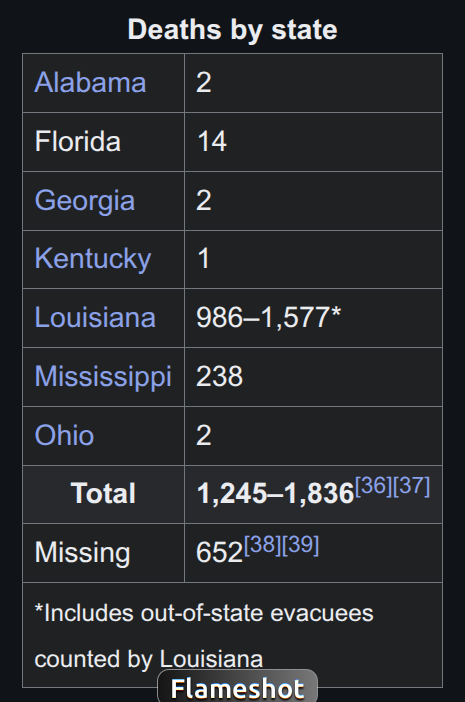
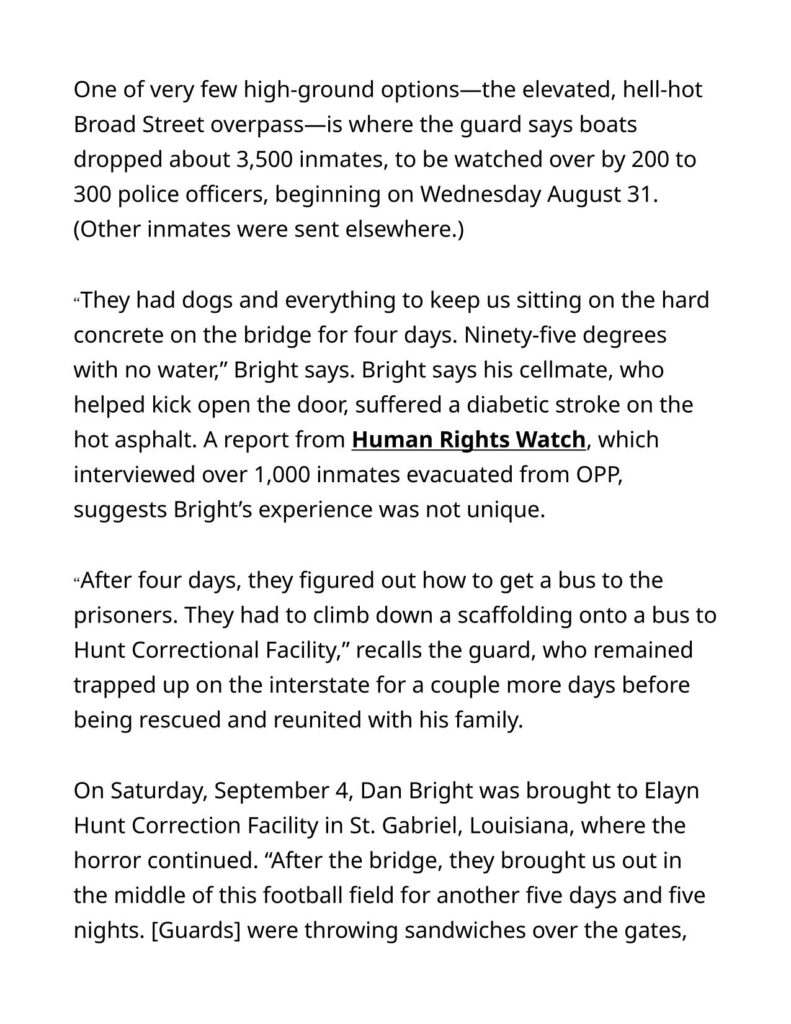
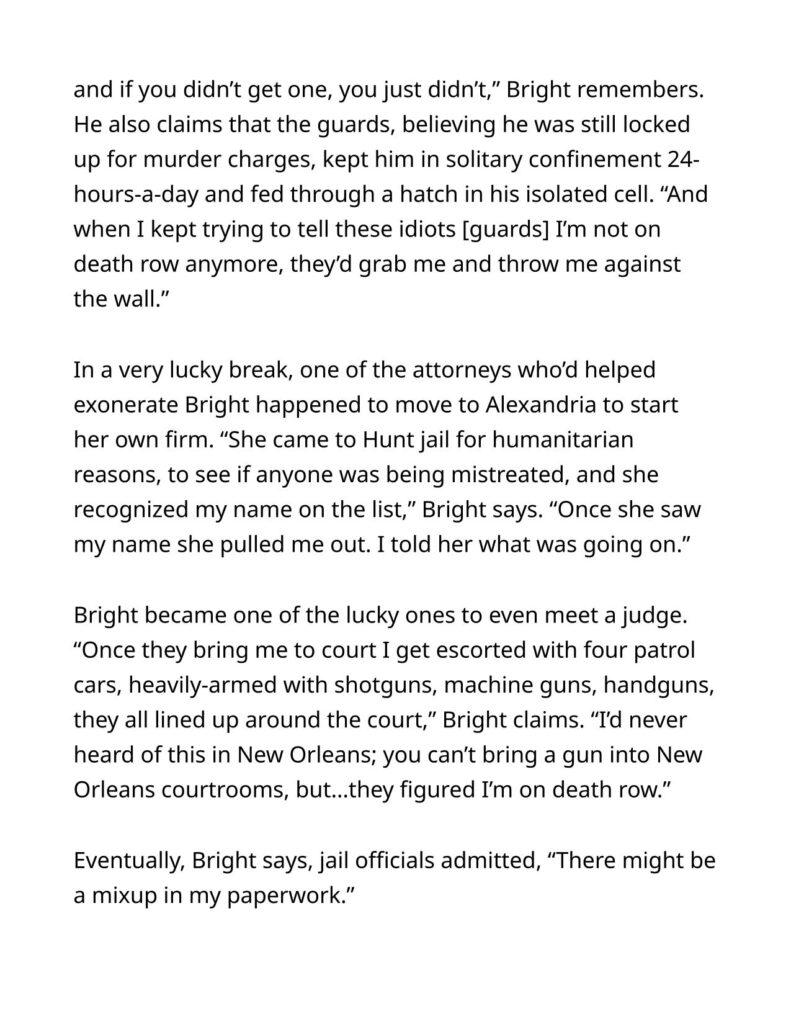
This post is Part 2 of my series on the anniversary of Hurricane Katrina striking the Louisiana coastline, causing immense damage and costing at least 1,800 lives. Since virtually everyone knows how it impacted civilian life but very few people know how it affected those of us serving LWOP and lengthy sentences in Louisiana State Prison (Angola).
“The first really impactful item that sent shivers down our spines was when word began to filter up to us of frightening events in New Orleans – prisoners were abandoned in their cells, left to the steadily rising waters when their guards abandoned them and fled their posts. Thereports were horrendous. Already off-balance with our own conditions, our only thought was “Could we be next?”
Bill Kissinger from Part 1 of this series.
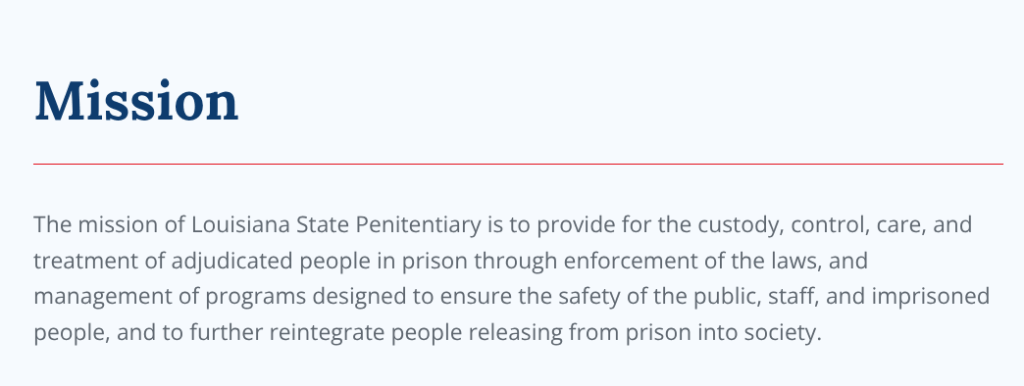
Nothing happens to improve your lot in life immediately. Anywhere. In prison it takes an inordinate time longer. How much is “inordinate?” What is “safety?” How “uncomfortable” are prisoners supposed to be and for how long? Are prisoners supposed to be considered “less than” outside civilians?
For the first few weeks of our life in the gym, chaos continued to reign and it was on free people (guards) and convicts alike. We had gotten folding Army-style surplus cots to sleep on, we were eating in the Main Prison chow hall although at separate feeding times. We were starting to return to our regular jobs (although, those of us who were able-bodied had been working every day on emergency clean-up crews) and new procedures had been worked out between crew foremen, Main Prison wardens (5) and the Outcamp Warden and the Camp F warden . The wardens passed down their agreements to their colonels and lieutenant colonels who passed it to majors and captains and lieutenants and – theoretically, at least – orders were carried out and changes made and policies implemented.
Nothing really quite worked that way with us as we were the new kids on the block and would remain that way for a long time. There had always been a kind of veiled hostility towards prisoners who lived at Camp F from both security and Main Prison convicts. They saw us as spoiled brats with way too many freedoms and comforts and way too much “political” power; politics in Angola is everything, and at every level: sergeants, lieutenants, captains, majors, colonels, wardens – everybody had their favorites and every favorite had their own connections. It’s just the way things work and it’s the way things have always worked – think back to your school days or your military service or even the company you work at. It’s just that way.
So, the majority of our obstacles were based on this type of thing – the way we were viewed. So what did we do to counteract the “little brother” dilemma we were boxed into? We worked together to accomplish more, to secure what we felt was ours, to improve our lot, and we did it in small ways. We had a stellar plumbing crew, a skilled electrical crew, a grand carpentry crew, and a whole bunch of crafty wise little dudes in various positions who were capable of pulling off semi-miracles.
Our leaky toilet? Fixed! Our lack of electrical outlets? Fixed! Phone lines installed and ready for Securus to come in? Done! Hygiene supplies and cleaning supplies? Done! Real, metal bunks and mattresses for sleeping comfortably? Done! Water fountain? Done! Fans? Done! Over time, when we finally returned to Camp F a year later, we left behind a much better framework for the next group of people who found themselves here under similar circumstances.
On only our 3rd day in the gym, I was summoned to a Camp F supervisor’s office. They told me I needed to be ready to go to work in the morning. WHAT? I was the Clerk for Camp F. At F, my duties consisted of filing paperwork generated by each shift, creating new blank forms for them, doing ACA mandatory paperwork (i.e., temperature logs, hobbyshop inventories, tower checks, camp vehicle mileage reports, flammable inventories, etc.), making coffee for the E-Bldg, keeping the lobby clean, and in general, generating whatever written reports my boss needed when needed so that he’d look good when called upon.
I Went To Work The Next Day…
The next morning I was up and cleaned up and dressed and ready to go to work. By this time, there was a procedure worked out for the patrol driver to pass through the Sallyport and drive to the back door of the gym, load up callouts, and drive back out. The patrol van driver picked me up at a little before 5:00am, which guaranteed that I would be a few minutes late to get coffee made for the shift, but I was so happy to get out of the gym and back to work that I didn’t care.
Little did I know how happy and excited I would be at the end of the day, my first day back at work. First, I would be free to do what I loved doing – bringing efficiency and order to an office – and second, that I would meet and be entranced by a girl from New Orleans, and that I would also take a trip to the dungeon and back.
We got to Camp F, and one of the female security officers told me, “Alright, Kissinger, they’ve got a few hundred ladies here now, so things are gonna’ be a little bit different. We need to figure out a way to get all these ladies assigned to a bed, and once we do that, we can figure out what to do next.”
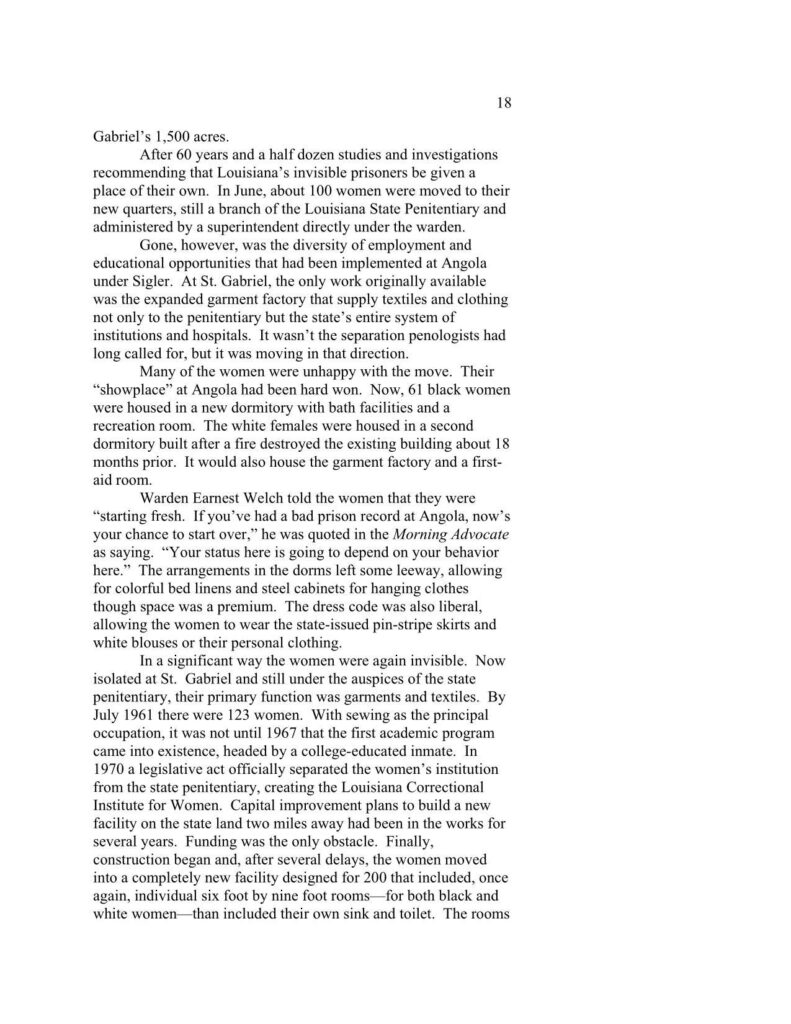
Females? WHAT?! I’m really, really confused because Angola is a MEN’S maximum security prison! Females had originally been sent to Angola to what had become known as “The Willows,” a small collection of clapboard buildings that typically housed anywhere up to 125 women at a time and was located in the northwestern corner of the prison.
Women had been housed at Angola since around 1901. Remember that all during that time, throughout the South, was a period of extreme segregation, so there were separate living quarters for Blacks and Whites. There were several occasions when the females came under close scrutiny from “committees” and “study groups” and “prison experts.” Was anything ever done to resolve the problems that existed? No….especially during the Huey Long administration. The state’s legislature, as a matter of course, kept their hands off of the penitentiary, as it had always been viewed as the Governor’s “property.”
It took a stripper from New Orleans to cause the women to be moved to an entirely separate facility of their own. (Source: Academia, Marianne Fisher-Giorlando, originally Kerry Myers of the Angolite)
The “Forbidden City” held many, many secrets. The last of the females left Angola in the summer of 1961. A new era dawned. Forty-four years later, women would once again walk through Angola, and would walk in my dorm.
When I got over my initial shock it was time to look at what was before me. There was a stack of different spiral-bound logbooks and single pieces of lined paper with handwritten and nearly illegible names and numbers scrawled across them. Pure turmoil, and the office phone constantly ringing, radios continually chattering with Control Center traffic and a few highly frustrated free people expressing themselves in colorful terms.
A Nightmare Of Work Awaited Me
I grabbed a cup of coffee and dove into it. First, I had to figure out what the logbooks contained and how the information was put together (they were all filled with lists of names and DOB’s and DOC numbers….next to some of the names was a single letter – “W” or “B” or “O” indicating race – but not all of them were indicated.) Then, had to assemble all of the individual pieces of lined paper into some form of order and try to match them up with names already in the logbooks to make sure there were no double entries.
Suffice it to say that the entire office was in total disarray and the king of the day was Utter Chaos. It took the better part of several hours to get everything organized to where I could start to enter data into a hastily constructed database and begin to match it to the database updated by Control Center at midnight every night. So, as it was quickly approaching the second “mandatory” count of the day, I needed to get them an accurate printout showing how many and who Control Center said was actually here.
Now, let me remind you of something I’ve talked about several times throughout my writings. Angola ran about 15-20 years behind the times with everything technological. Here it was 2005, and the office computer was still running old versions of MS Windows (and different versions in separate offices!) and the master database operated by Control Center was an old, clunky and slow DOS-based relational database called “NutPlus.”
Let me be the first to admit here that what I was doing was pretty much considered “illegal” by rank or authority. There was actually a policy that prohibited me from using this computer because it had inmate data on it. Let me tell you how much that mattered when there is a crisis or emergency situation and you’re the only one around who has the knowledge to do it. Yeah, about that much. The point is to get the work done, and pretty much everyone will turn their head while you get it done.
Miraculously, the 11:00 count cleared after only 3 or 4 recounts! (And, I can testify that there was NOT a “paper count,” with imaginary numbers.) So, what remained was to get everybody into an assigned bed so that they could be located at any time of the day or night, and make an accurate record of that assignment. The phone rang again, and the major called for me. The bed assignments would have to wait, as there were trucks pulling up at the camp with donations for the women. Oh boy….this would turn out to be an interesting episode and a chapter of Angola’s already infamous history, and I’ll tell you about it next time.
NOTE: For a look at other sides of Angola, might I suggest you take a look at my friend Rose Vines Substack, “Graphic Dead Man Walking.”
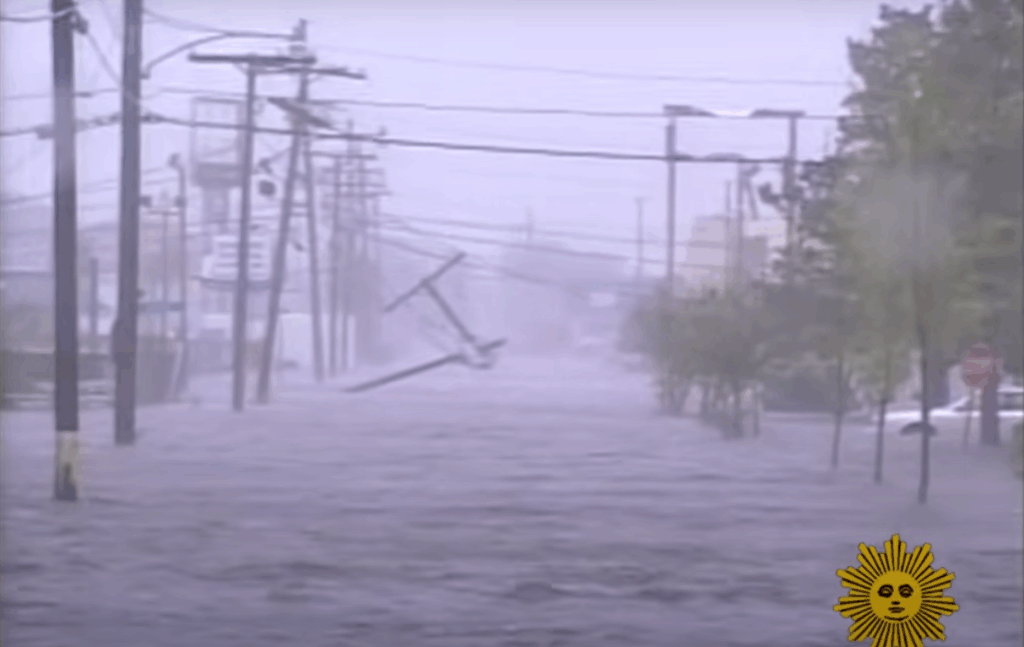
NOTE: Most people think of Hurricane Katrina and have images of people stranded on rooftops, crowds of people in the Superdome, helicopters flying overhead with lift-stretchers dangling below, or boats flying down city streets. Katrina upended a LOT of lives, but very few people stop to wonder what it was like in Angola State Prison or Orleans Parish Prison. In this short series of articles, I’ll tell you.
Things went south while we were asleep. Mother Nature was savagely angry with New Orleans and Angola and was showing her wrath, while we were still asleep. We woke to the shrill blaring of whistles, nightsticks banging on metal locker boxes and strident screams from correctional officers.
KATRINA Lay just offshore and grew to a MONSTER storm
Robert H. “Bubba” Butler, longtime Angola employee who had risen to command of Camp F and Death Row was standing at the head of the dorm, face red and usual cigar in his mouth. Camp F was the prison’s Trusty Camp, and we were about 430 prisoners of varying age, race, ability and temperament. Every one of us averaged 20-30 years served on LWOP (Life Without Parole) sentences. In other words, we were at home. “Here,” for me, was Camp F Dorm 3-Lower, a forty-man dorm, the first floor of a 2-story building that at one time served as a BOQ (Bachelor Officer Quarters) for free people. It was considered to be a plum assignment, even for trusties. Living there could only be approved by the warden.
“Allright! You’ve got about 30 minutes here!” Bubba’s booming voice, amplified with his raspy speech and cigar-laced depth, echoed out across the dormitory.
“Get up and get your shit together. You can carry ONE pillow case with you because we don’t know when you’ll get your property. Take anything you need and put it in that pillow case. Everything else, pack it up and put it in your locker boxes, and roll your mattresses up and put any loose stuff in that. We’ll have somebody come pick all that stuff up later and get it to you when we can. It’ll ALL be out of here by the night. Now, get moving!” And, he was gone just like that. The rest of the pushing and orders came from the sergeants
And THAT is how we learned that Hurricane Katrina was getting ready to devastate Louisiana and upend our – and thousands of others’ – lives for over a year. Angola was really no stanger to hurricanes or “massive storms,” as the media refers to them. We had heard the day before that Katrina was strengthening and growing but had no idea what was to come. It was to us an unreal concept that we could be completely uprooted from our lives, that we could lose our home, that virtually everything would change. I mean, we were in the penitentiary, for God’s sake! COs were always spouting out that they were there to “protect us” and to “protect the community from us.” Weren’t we supposed to be protected, and didn’t that include from Mother Nature and her wrath?
Evidently not. There were some serious failures on the part of correctional officers all around the state on that day and ensuing days, most notably in New Orleans which was much closer to the coast than Angola. We had some hours before the full fury of the storm hit us. In the meantime tragedy and disaster along with major failure was happening in New Orleans.
As Hurricane Katrina began pounding New Orleans, the sheriff’s department abandoned hundreds of inmates imprisoned in the city’s jail, Human Rights Watch said today.
“Of all the nightmares during Hurricane Katrina, this must be one of the worst,” said Corinne Carey, researcher from Human Rights Watch. “Prisoners were abandoned in their cells without food or water for days as floodwaters rose toward the ceiling.”
By (the scheduled) lunchtime, we found ourselves dropped off from the backs of flatbed trailers and buses and herded into the 75-year-old Gym, which once served as the Chow Hall for the entire Main Prison. The free people were in full-on panic mode; as for us, we were confused as hell, worried and somewhat panicked over the loss of all of our property, our goods, all our important memories and things we held dear. Our hobbycraft tools and materials – and this was very important. Many of us lived on what we produced in the hobby shops – in our spare time, we spent many hours in the shops producing arts and crafts that we sold at the semi-annual Rodeo. What about our tools and raw materials that we had spent the months since April working with? What would happen to this? How would we support ourselves in the future? Would there be a future? We had no idea – by this time, rumors were plentiful.
Along with the rumors, news from the outside started to filter in to us. As it is with rumors, some of the news confirmed what was circulating and some disproved it. Not everyone went to work for a day or so as new security procedures were planned and worked out. The first big job was getting bedding and toilets working and showers and figuring out how we were going to eat and just live. The only ones who went to work for the first full day were guys whose boss picked them up for an “emergency detail.”
The whole time we weren’t working we were learning more and more about just how dire the situation was for New Orleans and coastal cities. Within two days, 80% of New Orleans was completely submerged. At first, the death toll was horrible – first reports indicated dozens were dead. This fact alone caused worry and concern among the convicts. There were no phones and no way to contact family or friends on the outside to determine if they were safe.
Then when power was restored and TVs were brought back online and finally brought to us, the staggering truth was revealed. There were literally thousands dead and many, many more missing and unaccounted for. Horrifying images flickered across the television screen of poor, mostly Black faces in agony, struggling through chest-high brackish and toxic sewage-laden water, overflowing masses who had sought shelter in the iconic Superdome, only to find crime – reports of assaults, rape, suicide, even murder taking place inside. The bodies began to pile up. The more we learned, the more concerned we grew and the more our imaginations began to wander.
As KATRINA Hit The City, Infrastructure Began To FailThe Critical Routes Were Failing, Stranding ManyThe City Was Overwhelmed By KATRINA
Hundreds Of Locals Sought Shelter in The Superdome
The Superdome Became A Refuge
Ultimately, there have been several studies conducted which cast a doubtful light on many of the numbers, but THESE are confirmed:
The first really impactful item that sent shivers down our spines was when word began to filter up to us of frightening events in New Orleans – prisoners were abandoned in their cells, left to the steadily rising waters when their guards abandoned them and fled their posts. Thereports were horrendous. Already off-balance with our own conditions, our only thought was “Could we be next?”
Conditions were in chaos in the gym….
Nothing happens to improve your lot in life immediately. Anywhere. In prison it takes an inordinate time longer.
So, our personal safety and provision of necessities obviously took the back seat on the bus. We had nothing and were packed 400 into the gym.
When we first arrived, bedlam reigned. There were no supplies, no bedding, no hygiene materials, no food arrangements, not even rolls of toilet paper. Not even the free people knew what was going on, what to do, who to get advice or instruction from. All of the Main Prison supervisors were stretched out trying to get a handle on the situation. Sometime in the early morning of the next day trucks arrived carrying old army-surplus styled folding green cots and we were all given one, so that at least we could get up off of the floor.
Prison being what it is, when we were told that we could only bring one pillowcase with us, most guys stuffed their bags with cigarettes/tobacco, instant Maruchan soups, cookies and a change of clothing and – hopefully – a bar of soap and shower shoes, maybe a roll of toilet paper.
The gym was split down the middle by a floor-to-ceiling chainlink fence. On the side where I was told to go, there was one toilet – an old ceramic relic that had to have been 50 years old. Stained, cracked and leaking, when flushed it spread a flood of sewage across the red tiled floor, so that when anyone used the toilet when they walked out, they spread the sewage across the gym floor. And cleaning supplies? Non-existent.
It took weeks before we could get anyone to install phones and set up mailboxes so that we could call or send letters out to our families and friends. In the meantime, all we could do was fret, worry, work or sleep from utter exhaustion. Just a few days after we came to the gym, the sprawling Rodeo grounds were taken over by dozens of officers for processing and intake of hundreds of prisoners from various parishes.
PDF Montage of Dan Bright – Exonerated from Angola Death Row And His Personal Experience With Katrina
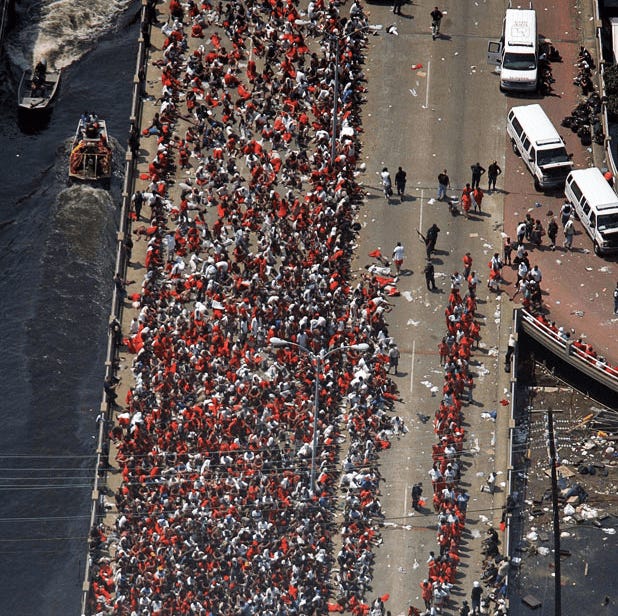
Thousands of OPP Prisoners were eventually herded onto a bridge/overpass where they would remain for several days without food or drink, in suffering heat. Finally, they would be rescued and lowered into boats that carried them to safety, and into another waiting mass for transfer to other prisons, other jails.
“It was complete chaos,” said a corrections officer with more than 30 years of service at Orleans Parish Prison. When asked what he thought happened to the inmates in Templeman III (A building within the OPP complex), he shook his head and said: “Ain’t no tellin’ what happened to those people.”
“At best, the inmates were left to fend for themselves,” said Carey. “At worst, some may have died.”
The stories of mass deaths of abandoned prisoners have not been verified, though a number of individuals and organizations have conducted their own studies and investigations have certainly pointed in that direction. If true, it would have called for a massive coverup.
In the gym, which was slowly beginning to become at least habitable, things became a bit more chaotic as we settled into a routine of work – both our regular jobs (plumbing, carpentry, electrical, etc.) and “emergency” cleanup work, repairs and preparing parts of the prison to house evacuated prisoners from parish jails. It was only the beginning.
While New Orleans received the most attention, smaller communities, particularly in coastal parishes east of the city and around Lake Pontchartrain, experienced massive damage from the storm surge.
Slidell: Located on the north shore of Lake Pontchartrain, more than 40% of the city was submerged by the storm surge, which topped 20 feet in some areas. More than 95% of homes and businesses were damaged.
St. Bernard Parish: The sparsely populated areas of this parish were hit unexpectedly hard by winds and floodwaters. The emergency center was submerged, and an estimated 40,000 homes were flooded.
Plaquemines Parish: Located south of New Orleans, this low-lying, rural parish was “devastated by high winds and floodwaters”.
Mandeville: Communities along the north shore of Lake Pontchartrain were significantly impacted by a storm surge of 12 to 16 feet.
Other even smaller towns simply disappeared. When evacuations finally began in earnest, people filtered out to Baton Rouge, Houston, Dallas, Atlanta and some even farther – Tennessee, Chicago, Arkansas and far-flung destinations.
After about 2 weeks, semi-trucks, pickups and even SUVs would begin arriving, packed to the gills with donations from churches, stores and organizations who had learned of Angola’s plight.
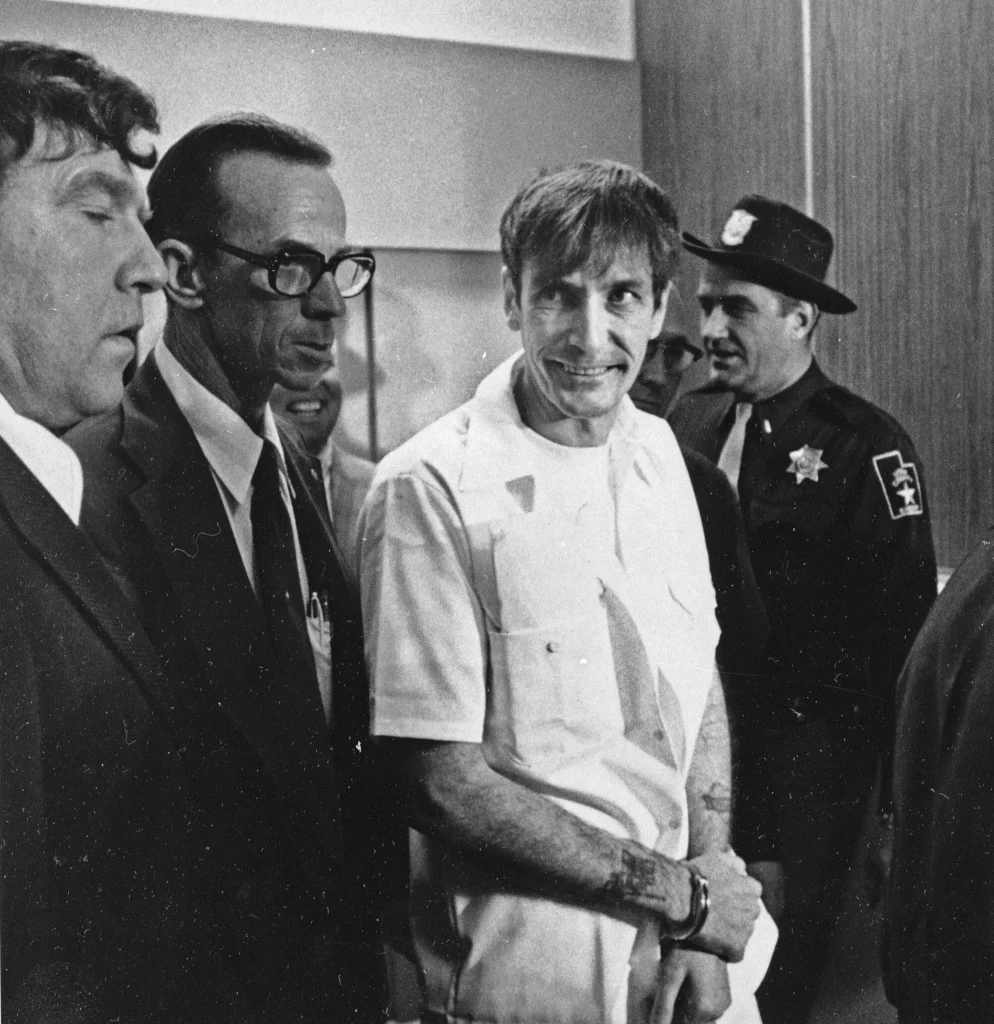
Ralph Menzies – Scheduled for Execution Sept. 5, 2025 (AP)
This is an exhausting journey to be on, this fight against the death penalty. Exhausting, but – yes, interesting. Interesting in that every case is similar yet different. Interesting in that we’re presented with so many different personalities as we trudge along this path, sometimes forward and sometimes walking backwards, sometimes being pushed backwards and off the path. The one consolation is that we never walk alone. The anti-death penalty community is a small but committed and tightly knit one, with friends and allies in the sometimes unlikeliest of places and at unlikely times.
He walked the cracked asphalt roads outside the state prison, his battered shoes softened by the hours of pacing with a placard in hand. The words, scrawled in uneven marker paint—”Mercy Is Justice” — alternating with — “Stop Gas Executions”, or “Execution Is NOT The Solution” — had long since grown heavy to him, acting more as a shield than a message. His voice was hoarse from chanting into the indifferent and non-hearing wind, yet he persisted, tracing the same worn path past chain-link fences, concrete walls, and rows of armed guards whose eyes followed him with cold amusement. Every step was a ritual, a prayer against the inevitability of a clock ticking toward midnight executions or stopping short at 6:00, praying for a stay, a reprieve, a gift from God.
Yet along this lonely march, allies emerged from unexpected shadows. A prison nurse, weary from tending to men who would not live to grow old, stopped to press a bottle of water into his hand, whispering, “I wish I could say this for myself, and say it out loud – but I must consider my retirement and my future.” A grizzled ex-guard—once his adversary across the fence—fell into step beside him one evening, muttering that the killing had rotted away at his soul until he could no longer bear it. Even a mother in mourning, her son murdered years ago, came not to condemn but to stand silently near him, carrying her grief as testimony that justice need not be sharpened to a blade.
The path wound longer than the road itself, each footfall carrying him deeper into a strange fellowship stitched from fragments of guilt, sorrow, and defiance, all pieces to a puzzle. He realized he no longer walked alone but at the head of a procession of unlikely companions, all tethered by the same invisible weight. Though the state’s machinery ground on, implacable and deaf, the protester found that his path was no longer only protest—it was pilgrimage. And on that path, every voice beside his own turned the solitary chant into something approaching a chorus.
These are the ghosts that join us. These are the voices that urge us on forward, to not give up the fight. To fight and protest for every death carried out by the State, for every murder committed by the State. We will not give up this fight.
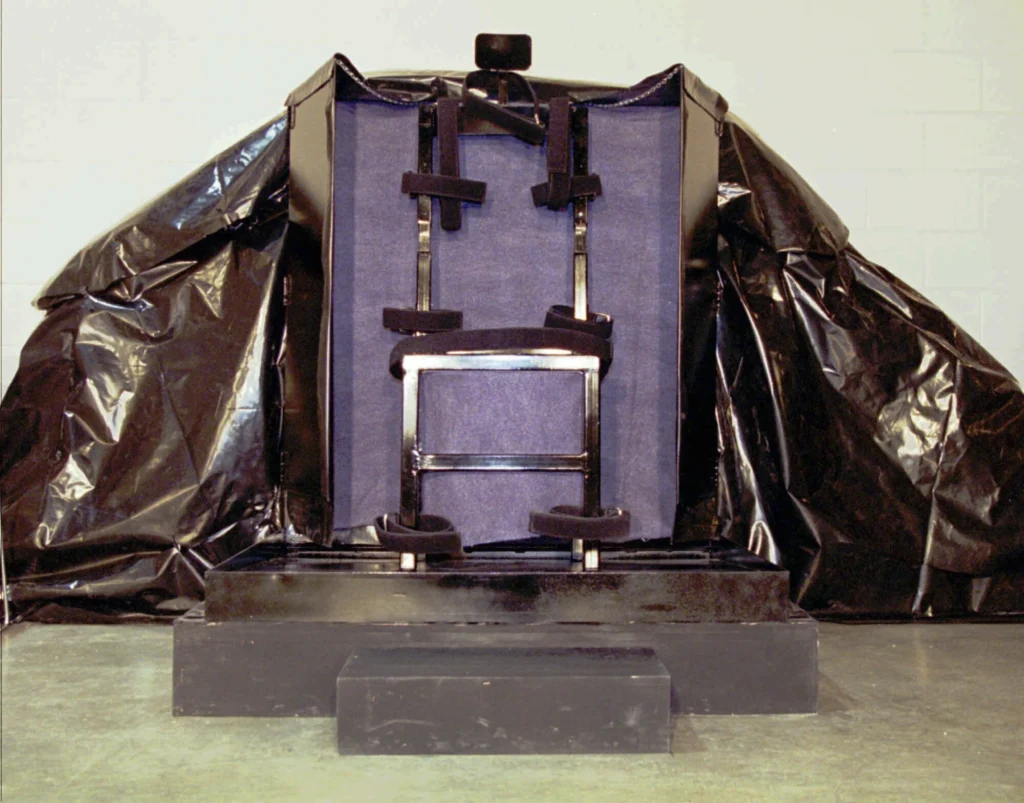
UTAH’S FIRING SQUAD CHAIR (AP Photo)
Condemned killer Ralph Leroy Menzies, arguably has one last chance to avoid a firing squad execution by appealing to the Utah Supreme Court.
Repetitive application? By far. Chances of evading execution? You pick the numbers…
On Thursday, the state’s top court heard arguments over whether Menzies’ upcoming execution should have been halted pending appeal, and whether a lower court judge should have ordered a new competency evaluation once his attorneys disclosed his dementia had gotten worse.
That same judge previously found Menzies competent to be executed for the 1986 murder of Maurine Hunsaker, who was taken from her job at a Kearns gas station, tied to a tree and her throat was slit.
“Mr. Menzies has a progressive disease. He is always getting worse,” his attorney, Lindsey Layer, argued to the justices.
He sat in the narrow cell, its walls painted the color of old bone, staring at the blank steel door as though it might one day speak to him. His hair had thinned to wisps, his body frail beneath the coarse prison uniform, but his eyes—clouded, drifting—held no recognition of the years or the sentence hanging over him. Once, he had argued with lawyers, shouted at guards, clung to scraps of appeals and promises. Now he no longer remembered those battles. He asked instead when his mother might visit, though she had been buried for half a century, or whether he could go home soon, confused why they kept him here at all.
The warden visited, speaking carefully, slowly, about the scheduled execution. The condemned man nodded politely, then asked whether dinner would come on time. He did not know what a firing squad was, nor why so many solemn faces gathered to watch him shuffle down the corridor during rehearsals of protocol. To him, the preparations were rituals without meaning, the men with rifles perhaps soldiers in some far-off war that never touched his understanding. When guards whispered “he doesn’t even know anymore,” he only smiled faintly, humming a song half-remembered from boyhood, the words lost to the ravages of time.
“If this particular illness is progressive, it changes all the time, how do we not end up in this situation repeatedly?” asked Justice Paige Petersen.
“With this particular illness? That is true,” Layer replied.
Justice Diana Hagen questioned where the line is for a defendant to understand the nature of their crime and the punishment being handed down and what qualifies as a substantial change. Layer told the Court that Menzies’ circumstances have substantially changed.
Chief Justice Matthew Durrant raised the issue of some prison phone calls that Menzies had made that prosecutors submitted as evidence that he is competent.
“He does seem to understand who he’s speaking with, he’s giving appropriate responses,” Chief Justice Durrant said, later adding: “How does that level of understanding, let’s say, figure into the legal standard for competency to be executed?”
But Layer argued it did not show the whole picture, where Menzies struggled to even make some phone calls to his lawyers and others.
Decades of waiting had stripped him of context, leaving only a fragile shell of routine. Each day was measured by trays of food slid through a slot, by the rattle of keys at dawn and dusk. Death, as the state decreed it, was no longer real to him; he could not grasp it, could not fear it, could not prepare for it. And yet the machinery of law continued grinding forward, as indifferent to his forgetfulness as the concrete floor beneath his feet. For him, there was no looming end—only another morning, another question, another fragment of memory slipping into silence.
“He’s clearly struggling, he’s not able to complete those calls,” she told the Court.
Assistant Utah Attorney General Daniel Boyer argued that not enough has changed to justify a new competency evaluation.
“The defendant must specifically allege a substantial change in circumstances, the petition must be sufficient to raise a question about the inmate’s competency,” he said.
Utah last executed prisoners by firing squad in 2010, and South Carolina used the method on two men this year. Only three other states — Idaho, Mississippi and Oklahoma — allow firing squad executions.
Ralph Leroy Menzies, 67, is set to be executed Sept. 5 for abducting and killing a Utah mother of three, Maurine Hunsaker, in 1986. When given a choice decades ago, Menzies selected a firing squad as his method of execution. He would become only the sixth U.S. prisoner executed by firing squad since 1977.
The most notable, perhaps, was Gary Gilmore about whom the book, “The Executioner’s Song” was written by bestselling author, Norman Mailer.
GARY GILMORE – Utahan Executed By Firing Squad (AP Photo)
Utah has a particularly long and bloody history with firing squad executions. Utah’s history with firing squad executions dates back to its original statutes, which allowed it as a method of punishment alongside beheading and hanging. The state has historically been a leader in its use, especially in the modern era following the reinstatement of capital punishment in the 1970s.
Utah was the first state to resume executions after the national moratorium with Gary Gilmore’s execution in 1977, and remained the only state to carry out a firing squad execution in the modern era until the 2010 execution of Ronnie Lee Gardner.
Executing someone with dementia is problematic because competency laws require a prisoner to fully understand the punishment they face (to be executed), which dementia impairs. The primary concern is that a person with dementia cannot rationally comprehend their execution or the reasons for it, rendering the execution unconstitutional under the Eighth Amendment. The firing squad execution itself adds to the concern, as it potentially increases the risk of suffering and error.
Legal and Constitutional Issues
Incompetency:Federal and state laws mandate that a death row inmate must be competent, meaning they understand they are facing execution and the reasons for it, according to the Death Penalty Information Center.
Ford v. Wainwright:The U.S. Supreme Court ruled that executing someone who doesn’t understand the reasons for their punishment violates the Eighth Amendment’s prohibition against cruel and unusual punishment.
2003 The Utah Legislature unanimously approves a bill that prohibits the execution of those with intellectual disabilities.
Attorneys for Mr. Menzies called the state’s decision to move ahead with Mr. Menzies’ scheduled execution “deeply troubling,” noting “[Mr.] Menzies is a severely brain-damaged, wheelchair-bound, 67-year-old man with dementia and significant memory problems. His dementia is progressive and he is not going to get better.” They have appealed the ruling to the Utah Supreme Court.
“It is deeply troubling that Utah plans to remove Mr. Menzies from his wheelchair and oxygen tank to strap him into an execution chair and shoot him to death.” Lindsey Layer, Attorney for Ralph
Navigating through a thick fog is difficult, and people can easily lose their bearings. This reflects how dementia can disrupt a person’s sense of direction and familiarity.
Disorientation: A person with dementia may feel lost even in familiar places or have trouble navigating familiar surroundings.
Social withdrawal: Like someone isolated in a fog, a person with dementia may withdraw from social situations due to communication difficulties and confusion.
This whole situation is frightening. It’s not frightening to Menzies, though, as he has no idea what’s happening to him. It’s only frightening to those who know and love him, to those working tirelessly to save his life, and to those who have a sense of responsibility and respect the rule of law.
Justice Diana Hagen questioned where the line is for a defendant to understand the nature of their crime and the punishment being handed down…
Your honor, there is no pill that one can take to force the defendant to understand the nature of their crime and the punishment being handed down, or meted out. There is no “alarm” that would alert the authorities that Mr. Menzies woke up one morning and was cognizant of all the factors involved here – his crime and the punishment, and how many years he spent wandering through the fog.
For now, he continues, still lost, still wandering….will he wander on September 6th, or will his journey end on September 5th, as ordered by the people who want to kill him?
OR YOU CAN BUY ME A COFFEE ! (Or a pot of coffee!)
Please be sure to check out my Substack for more articles and commentary on efforts to end the death penalty. If you don’t already, please hit that SUBSCRIBE button, and share!
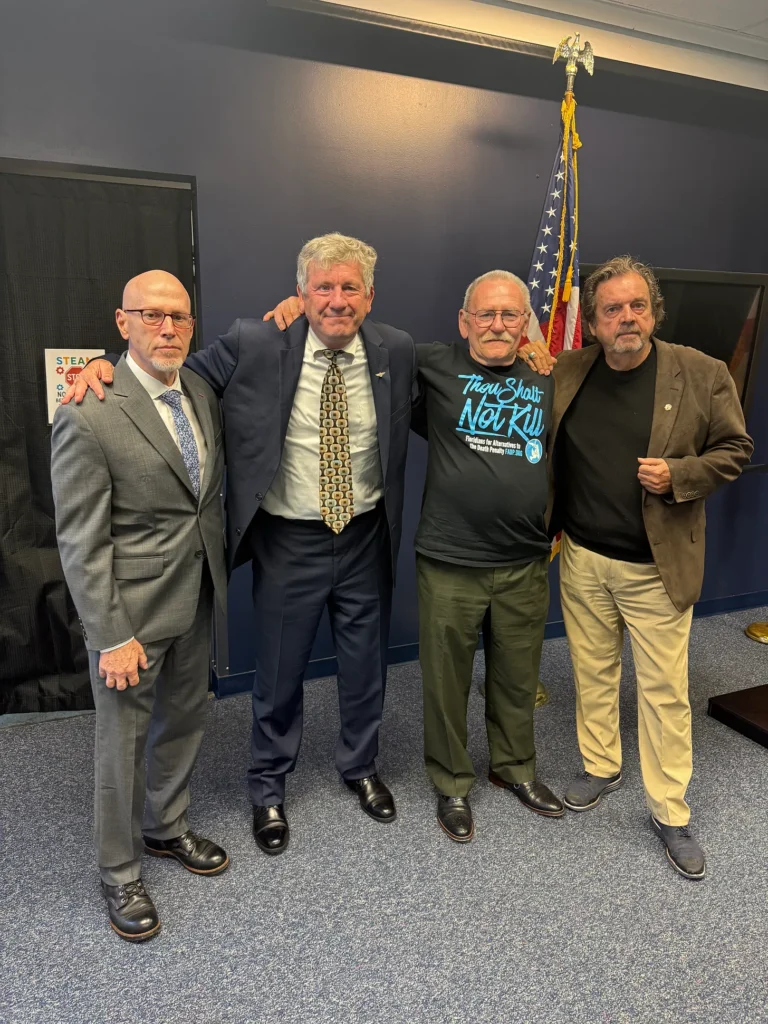
Today I had the honor of being the final speaker at an event/press conference sponsored by Floridians For Alternatives To The Death Penalty and Death Penalty Action. I was joined by 3 other Veterans who are active in representing Veterans and, honestly? I felt a good bit out of my depth. Man, EVERYBODY outranked me! There was a retired Navy Captain, a retired Army Major, a retired Army Sergeant and finally, me, a lowly Airman 1st Class, USAF.
Everybody was smarter than me. Everybody dressed better than me. They were charismatic like you just wouldn’t believe! They all had 20, 30, even 40 years invested in their careers doing exactly what they were doing. And I was the last speaker, so I really faced an uphill battle going into the fight. But I had a clearly distinct advantage in one regard and outranked them all in one aspect – I was the ONLY one in the room who had served 47 years in one of the worst prisons in America. I’m pretty certain that I was the only convicted murderer present (though I cannot be entirely certain of that detail !). LoL!
(L-R) Tom Dunn, Esq. (USA) [Kayle Bates’ Trial Attorney] , Art Cody, Esq., (USN), Director Center for Veteran Criminal Advocacy, Bill Kissinger, A1st, (USAF), Justice Advocate, David Ferrier, retired Sergeant (USA) Mitigation Investigator
We were all gathered together in a room at the Challenger Learning Center in Tallahassee, Florida, a beautiful complex with scale models of the Challenger spacecraft, an IMAX theater, and a planetarium that will dazzle you.
TOP – The Planetarium BOTTOM – The Event Room
It was a beautiful setting for a serious discussion on a gruesome event – the pending execution of Kayle Bates, whose execution at time of this writing is scheduled for 6:00pm, August 19, 2025.
The four of us had only met the night before at a dinner organized by the bubbly and energetic Grace Ellen Hanna, the Board Secretary of FADP. I cannot stress enough how calming of a presence Grace carries with her effortlessly, and in all of my moments of vulnerability (frequent!) was there to push me forward. She also served as my personal taxi service for which I am forever grateful.
Grace Ellen Hanna, Board Secretary, FADP
Art Cody was the last to arrive to the dinner due to travel complications, so Dave Ferrier, Tom Dunn and his wife, Millie, (Litigation Attorney, Federal Public Defender Program), Grace and I proceeded to enjoy each other’s company and a great meal. In the process, we discovered that we actually knew other people in each other’s orbit. See, the capital punishment circle is actually very small and it’s like the old adage that “Everybody knows somebody and somebody knows everybody.” Millie knew Federal Public Defenders in Louisiana that I’ve worked with and Dave knew ex-convicts that I had known and seen go home many years before that Dave had worked to prove his innocence.
The reason the circle is small is actually multifold: the job of representing and defending or appealing a death-sentenced prisoner demands a dedication, passion and commitment that very few attorneys possess. The passion comes from believing that every human life is sacred and to put it all very simply
Killing people who kill people to show people that killing people is wrong just doesn’t work. It only kills more people.
The job also requires that a person be able to set aside all of their own biases and prejudices and fight to save this life – this hated and reviled and contemptible life, and that’s a pretty apt descriptor for virtually every single death-eligible prisoner ever to stand trial. But, it’s also the descriptor used by those who wholeheartedly support and actually energize the push for more and faster executions.
I have talked with and interviewed many wardens and high-ranking security officials and they are almost unanimous in their belief that capital punishment does not serve the purpose of deterrence and does much more harm than good. It only creates more victims. The executioners, also, become victims as they are forced to kill another human being with whom they have near-daily contact and become familiar with over time.
And then, there are those who simply take a “clinical” or “sanitized” viewpoint: “It’s a part of the job and I may not like it, but I have to do it so I’ll be humane and kind to him while I do it.” Like shooting him with a bullet made of sugar? Suffocating him with a fragrant and aromatic, flower-scented gas? Hanging him with a rope made of the finest silk? Or, there’s this:
“When Warden Burl Cain came that afternoon to my office, I poured him coffee. He’d hosted a new coroner’s technician for dinner the night before and told me how he’d described the execution to him, to calm his worries: “Four officers will escort Dobie from his cell. The strapdown team is well trained, each officer has an arm or a leg. If he resists, they’ll carry him. They’ll strap him to the gurney and it’ll be over quickly—then you’ll pronounce him dead.” He spoke as matter-of-factly as discussing the weather. I was appalled; Cain was serene. Before leaving, he slipped off to deliver a brand-new “Stone Cold” Steve Austin T-shirt to Dobie—an awkward farewell gift.”
How do we distance ourselves from this mindset, from this policy-directed death, from this sanitized version of pre-meditated murder? By opposing it, fighting against it and demanding by every possible measure that we abolish it. Here is where the passion and commitment comes in. This is the passion that Tom Dunn carries with him to trial, that Art Cody defends his clients with and that David Ferrier investigates and searches for mitigating evidence with.
Kayle Bates was Tom’s first capital case after leaving the Army. It turned into a decades-long journey with Kayle that continues today.
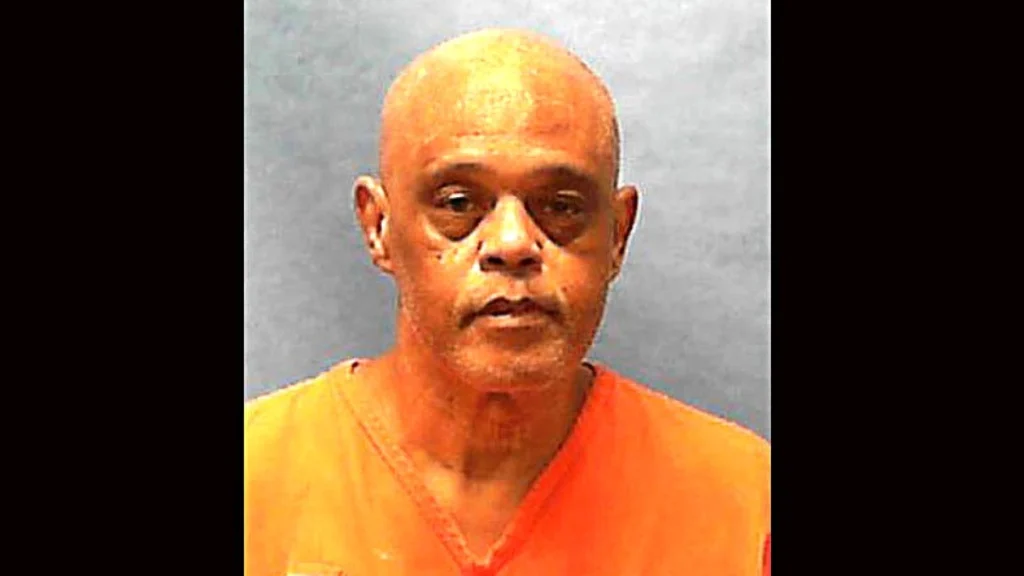
Kayle Bates – Scheduled for execution August 19, 2025
After graduating from high school, Kyle Bates followed his lifetime dream and he enlisted in the military with the Florida National Guard. He served for six years. He participated in the unit’s activation to quell the race riots in Liberty City in Miami in 1980. He also attended and completed the Army’s rigorous jungle training in Panama. Essentially, his wife said after those two incidences, Kyle was different. He had nightmares. He’d wake up screaming loudly, acting crazy, and not recognizing or remembering where he was.
As Art explained, every veteran on death row has service connected, post-traumatic stress disorder, traumatic brain injury, or other service related disabilities. It is a service connected disability because were it not for the fact he served, had he not raised his hand and volunteered for duty, he would not have this mental health problem and would not have committed this crime and never found himself on death row.
Every veteran who served – especially in combat or combat zones – brings home scars that are sometimes plainly visible, and sometimes invisible and unseen, and sometimes don’t manifest themselves for months, years, or even decades later. Such close and frequent association with violent death does not leave one unscathed. Of the general population of the United States, only about 5% are veterans. Yet the segment of veterans on death row is 10%, or twice the rate of normal population. That rate is growing – the United States has been in more wars in the past 30 years than any other period in history. More veterans are exposed to the horrors of war and ever more powerful and destructive weapons.
Sgt. David Ferrier, U.S. Army, a Vietnam veteran and longtime capital defense investigator, talked about how little the system accounts for veterans’ trauma. He said, “In criminal cases, it’s very common that the only person in the courtroom familiar with the veterans’ experience, with the veterans’ military experience, are the veterans themselves.”
He reminded the audience that PTSD is not a new thing, and neither is the state’s neglect of it.
“Although it’s been referred to by many different names over the centuries — soldier’s heart, shell shock, battle fatigue, Vietnam syndrome, post-traumatic stress disorder — it has been part of warfare since ancient times,” Dave said. “It’s written about in The Odyssey, it’s written about in All Quiet on the Western Front. It’s written about in a variety of Vietnam oriented books. Such close and frequent association with violent death in combat does not leave one unscathed.”
And then, it was my turn. I spoke not only as a former Airman First Class, U.S. Air Force, Vietnam veteran and criminal justice reform advocate, but also as an ex-offender who spent 47 years in prison. During much of my time in prison I served as an Inmate Counsel Substitute (paralegal) and much of it working on death row.
When I began, I recalled the lessons of military service from the first day of basic training through tech school and on to the combat zone:
“When a brother is hurting, when a brother is wounded, you run to him, you put him on your shoulders and you carry him as far as you can towards safety.”
I described the day I brought a petition with 4,000 signatures to Governor DeSantis’ office pleading to halt the execution of Edward “Zak” Zakzwreski only 2 weeks before this day on behalf of FADP and Death Penalty Action.
“When I did this, it reawakened something in me and it was hard for me to deal with, but it reminded me that when I went down that hall, I was carrying every veteran on death row with me.”
I also spoke about sitting with a condemned man on death row during his final hours.
I was given permission by the warden to spend the last 24 hours of his life with Dobie Gillis Williams. Dobie, at the time of his execution, was a 39-year-old black man that was tried and convicted by an all white jury with a white prosecutor, a white judge, a white defense attorney, white sheriffs in the courtroom, and he was terrified. The night before his execution, I stood at the bars with him talking to him, and we had his lawyer on the phone and she was just crying and screaming, “Dobie, there’s nothing else I can do! I can’t do anything else.”
Our veterans are in the same shape. We send them to war. They face the horrors of war. They come home and we ignore them. Governor DeSantis has had the opportunity four times this year to pick a veteran up and put him on his shoulder and carry him to safety. He’s not doing it. Instead, he’s choosing to rush them to the chamber of death and it’s wrong. It is time to stop executions for everyone, but most especially for our most vulnerable, and our most vulnerable are our veterans. They’re the most deserving of our care, our empathy, and they’re deserving of us picking them up and putting them on our shoulders and carrying them to safety.
I sincerely hope that I am able to continue carrying this weight towards safety for at least a bit farther. My appreciation extends to everyone who helps to shoulder the burden and help me carry it. My thanks to Grace, Bridget, Art, Dave, Tom and Millie, and to all the unseen hands that help to make it a little bit lighter.
Cherry Pie We ALL Supposed To Get A Piece Of – ‘Dat’s De’ “Lagniappe“
I was reading over a post that a good friend had made earlier today about what happened in his life when he exposed corruption in the Louisiana State Penitentiary and the Louisiana Board of Pardons and Paroles…the corruption reached all the way up into the Governor’s office. Doing so reminded me that I needed to get back over here and finish this story.
It is, of course, the never-ending story in Louisiana. Corruption is endemic to Louisiana. It’s something that we grow up with, and we always heard ,”Oh, yeah, cher’! It’s a pie. But everybody gets a slice of the pie.” They even have a peculiarly cute name for it: “lagniappe”.
“We picked up one excellent word – a word worth travelling to New Orleans to get; a nice limber, expressive, handy word – ‘Lagniappe.’ They pronounce it lanny-yap … When a child or a servant buys something in a shop – or even the mayor or governor, for aught I know – he finishes the operation by saying, – ‘Give me something for lagniappe.’ The shopman always responds; gives the child a bit of liquorice-root; (nb…)”: Mark Twain, Life on the Mississippi(1883)
On a totally related note, the gentleman who once famously uttered that particular “pie”-phrase served some prison time himself, I suppose, for taking too large of a slice of that same pie
Edwin Edwards, the former governor of Louisiana, served eight years in prison. He was sentenced to ten years in federal prison in 2001 after being found guilty of racketeering, extortion, money laundering, mail fraud, and wire fraud. The charges stemmed from a scheme to manipulate riverboat casino licenses. Edwards began his sentence in October 2002 and was released from prison in January 2011 to a halfway house, before being released from the halfway house in January 2011, and starting three years of probation in July 2011. He was granted an early release from probation in February 2013.
“In 1986, my wife and I exposed the largest “pardons for sale” (as it was dubbed by the media) criminal scheme in Louisiana history. The federal and state investigations that ensued sent the pardon board chairman to a federal prison, got one of the state’s most powerful legislators indicted (later acquitted), forced three prison officials into bribery guilty pleas, led to the resignation of a prison warden and a number of lesser prison officials, and, as you can imagined, pissed off a whole lot of people inside and outside of the Louisiana prison system—including then Gov. Edwin Edwards who never met a bribe he did not like.” (Billy Sinclair, FaceBook post, 8/11/25)
Billy went on to tell about the devastating effect that the incident had on his present and on his future…it would be many more years before he would see his freedom. He was branded a “snitch” by all, and allegations that he had “tarnished the integrity of the prison newsmagazine (The ANGOLITE) and violated some kind of unwritten code of journalism ethics by cooperating with law enforcement.”
“Through the co-editor’s (at the time, Wilbert Rideau) insider influence with the editorial board of the New York Times, I became the only inmate in history to ever be rebuked in an editorial by this massive media conglomerate for exposing corruption over protecting the “integrity” of The Angolite.”
Now, you see, I know a little something about (1) lagniappe, (2) corruption, (3) prison and (4) the consequences of doing “the right thing,” particularly in Angola prison. First, because I served 47 calendar years in that hellhole and, second, because I personally witnessed corruption on a daily basis, and finally because I was on the receiving end of a media-spun retaliation effort by those who dealt in the corruption plague within.
Twice.
The first occasion occurred in 1995 not long after Cain’s appearance on the state scene with his involvement in a private-sector company, Louisiana Agri-Can. The owner, Charles Sullivan, Cain and others with “high-level access, including to the Governor’s office,” had opened a can relabeling plant in the old cannery building at Main Prison. The inmates who worked there labored for hours daily at a rate of between .04 and .20 cents per hour.
At the time, I was an Inmate Counsel on the Civil Litigation Team at Main Prison, and because of a few well-known court victories, was a favored counsel to prisoners seeking assistance. When a prisoner assigned to the plant came to me with his request for help and answers to his questions, I helped, having no idea that it was the beginning of a months-long adventure involving a trip to the dungeon, field work, threats on my life via a plan to “shoot me while attempting to escape,” an emergency removal by U.S. Marshalls, a stay in the East Baton Rouge Parish Prison, multiple hearings in federal court, secretive information provided to my attorneys by an Assistant Warden, and ultimately, a financial settlement with the Department of Corrections.
I, too, was labeled a snitch – but not by prisoners. By guards. A few days after I was released from the dungeon and reassigned to the West Yard field lines, a friend came to me and told me that there was talk circulating among the guards that I could be shot while trying to escape. Much later, after I was in federal protective custody, when I was on the witness stand I was being cross-examined by Burl Cain’s attorneys. They tried to get me to tell them who told me that the guards intended to shoot me. I risked everything by refusing and looking at the judge and asking, “Your Honor, look what has happened to me. If I tell them who told me, that person has a job and is trying to feed his family and is trying to protect me. If they’ll do this to me, what do you think they’ll do to him?”
The judge ruled that I did not have to answer the question and ordered the attorney to ask his next question.
“U.S. district judge Frank Polozola ruled that Louisiana Secretary of Corrections Richard Stalder and Angola Warden Burl Cain be held in contempt. He ordered them each to contribute $1,000 to a victim compensation fund. Stalder, Cain, other wardens, assistant wardens and assorted prisoncrats were all ordered by judge Polozola to take a “refresher course” on the U.S. Constitution, particularly the First Amendment right to free speech.
The contempt ruling resulted from LA state prison officials failing to produce documents the court requested and for violating an order not to harass a prisoner. The prisoner, William Kissinger, had been employed in a private prison industry job at an Angola prison relabeling plant. Kissinger wrote a letter to federal health officials that cans of evaporated milk and tomato paste with old expiration dates were being relabeled and shipped out of the prison. “The bottom line is that Kissinger, a two-time murderer, was taking actions to protect the public,” judge Polozola said. “The DOC was taking actions that would hurt the public and protect the contract of friends.”
After Kissinger wrote two letters to the U.S. Food and Drug Administration (FDA), in which he said the can relabeling operation was “shrouded in secrecy” and “stinks of impropriety,” he was retaliated against by prisoncrats. Kissinger was transferred to a farm laborer job in a distant corner of the 18,000 acre Angola prison complex. He had been serving in the main prison as a legal advisor to other prisoners. Prison officials seized the computer Kissinger had used to assist other prisoners and to write the letters to the FDA. “Clearly this was retaliation,” said Kissinger’s attorney. “The inmate was transferred because of bad words. There is not an iron curtain between inmates and the First Amendment.”
Polozola agreed that transferring the prisoner and seizing his computer amounted to harassment, in violation of an earlier order he had issued to prevent officials from retaliating against Kissinger.”
Source: Corrections Digest
To illustrate the dangers involved in “doing the right thing,” from both sides of the fence, a meeting had been held the day before this particular hearing at the Ranch House. Burl had put a dot in the middle of a chalkboard and said, “That’s you.” Then, a circle around the dot, and an X inside the circle. “The X is you. You’re good and you’re safe.” Now, an X outside the circle. He pointed at it and said, “If that’s you, your ass is grass, and I’m gonna’ be the lawn mower.”
The next day at this hearing, my attorneys brought this conversation up when examining a witness. Burl’s jaw dropped when the attorney asked, because he now knew that someone in his inner circle had given us the information – he didn’t know where to turn. And, there was nowhere left to turn. When he finally took the stand, he could only rant and finally admit that, yes, he had retaliated against me by locking me up and ordering my computer seized. Because – ya’ ready? ‘ I had used “bad words.” Words like “shrouded in secrecy” and “stinks of impropriety,” when it literally was.
The Second War
The second occasion was 20 years later when Burl was under an investigation by Maya Lau, an investigative reporter and her team for the Advocate in Baton Rouge. This time, also, was because of the written word. I have this terrible habit of doing the right thing. And granted, it doesn’t always work out in my favor. Maya reached out to me as a source for her current investigation after she unearthed data about my first encounter with Burl and the tangled web he wove.
(L) Katie Schwartzmann, Atty and (R) Maya Lau, Investigative Reporter, The Advocate
So, we began a correspondence that began with a letter from her requesting to be placed on my visiting list. Because of my previous confrontation with “The Boss,” as he liked to be referred to as, the letter actually shook me up a bit. I carried the letter to my Camp Security Supervisor (a Colonel) who also, incidentally, happened to be my Camp F VETS Club sponsor. I felt naturally that I could trust him if no one else to guide me through this swath of uncharted waters.
As it happened Burl Cain was scheduled to attend a party at the David Knapps Training Academy located right next door that very afternoon. So, armed with the letter and my request for direction, the Colonel went next door to seek blessings for me. It turned out that Burl didn’t show up, but his trusted Deputy Warden was there. So, the Colonel showed him the letter and explained the situation and my concerns. The response? “Man, tell Kissinger he doesn’t have to worry about that stuff. That’s all water under the bridge.”
Except, it wasn’t. Or if it was, the waters were awfully deep and swirling rapidly. We continued our correspondence and suddenly a few weeks later I found myself stripped, jumpsuited, beaten, shackled and in the back of a van to an entirely different prison far away where I languished in solitary for weeks.
Because there was a Major there who I had helped a couple of years earlier with a discrimination lawsuit against DOC, I was finally able to get a phone call. I dialed a friend and told him to immediately record our conversation so he could play it back to Maya. I had a lot of information to get out there and get out there fast. I gave him Maya’s name and stated the specifics of my situation, and stressed the urgency of it all.
To her credit and the credit of the ADVOCATE, she immediately got the ball rolling. Now they weren’t so concerned about my 1st Amendment rights – they were concerned about their 1st Amendment right and access to information. In the end, though, they did the most important thing – they secured counsel for me. One day not long afterwards, a Sergeant came to my cell and flung the door open and said, “Lawyer visit…let’s go.” And that’s how I metKatie Schwartzmann,a tough and gritty bulldog of a lawyer and a staunch defender of the 1st Amendment. The Roderick and Solange MacArthur Justice Center took my case.
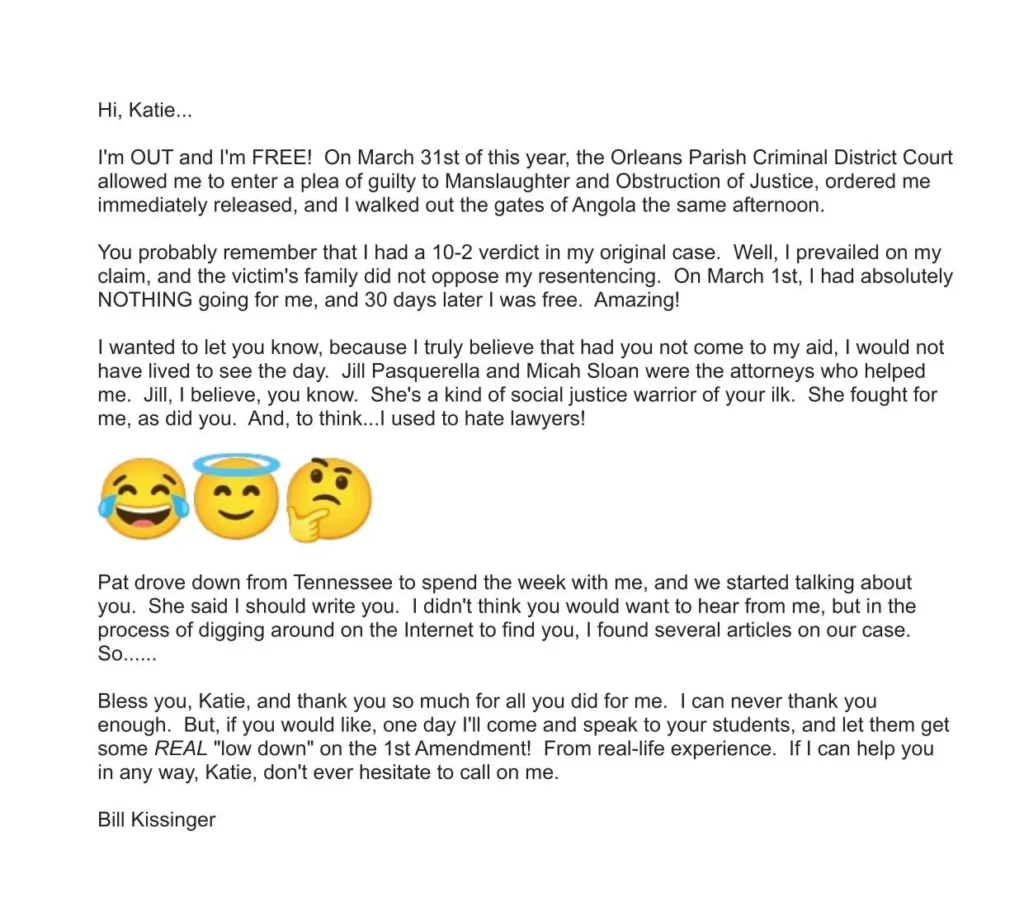
It took some time and a few prison disciplinary hearings, a few “DENIED” Administrative Remedy Proceedings and about 6 months in an extended lockdown cell, before Katie finally filed my lawsuit against Burl Cain and Jimmy LeBlanc (Secretary of Corrections at the time) and about 16 other named defendants. Katie knew from the outset that it would be a difficult case, but she stuck with me and we proved that, for the second time, Louisiana had tried to silence me. It took literally two years to climb that hill. We won hands down. The single most important goal I had was getting back to Angola, back to my same dormitory and job assignment, and getting my property back. The settlement we reached accomplished all of my goals. And, hey, I didn’t forget her. Several years later after my release, I reconnected with her.
eMail I Sent To Katie After I Was Released From Prison
Yes, prison is tough and danger lurks around every corner. There are traps and pitfalls everywhere one looks and every time one sets their foot down. Fellow prisoners, guards – anybody – can hate you for doing the right thing. Sometimes it is very hard to do it. Sometimes you suffer. And very seldom do people appreciate what you’ve done that ended up helping them. My takeaway, though, is that when you do the right thing, well, right things happen for you. I’m just glad there were people willing to stand in that gap beside me.