• Skip to primary navigation
  • Skip to main content

My Life After Prison

Resources for the incarcerated and their families.

  • Home
  • About
  • Contact Us
  • BREAKING NEWS !!
  • Florida
  • Louisiana
  • Show Search
Hide Search

Louisiana

KATRINA – When She Hit Angola – Part 1

William Kissinger · October 9, 2025 · Leave a Comment

A Year Of Hardship – And Shared Suffering

NOTE: Most people think of Hurricane Katrina and have images of people stranded on rooftops, crowds of people in the Superdome, helicopters flying overhead with lift-stretchers dangling below, or boats flying down city streets. Katrina upended a LOT of lives, but very few people stop to wonder what it was like in Angola State Prison or Orleans Parish Prison. In this short series of articles, I’ll tell you.


Things went south while we were asleep. Mother Nature was savagely angry with New Orleans and Angola and was showing her wrath, while we were still asleep. We woke to the shrill blaring of whistles, nightsticks banging on metal locker boxes and strident screams from correctional officers.

KATRINA Lay just offshore and grew to a MONSTER storm

Robert H. “Bubba” Butler, longtime Angola employee who had risen to command of Camp F and Death Row was standing at the head of the dorm, face red and usual cigar in his mouth. Camp F was the prison’s Trusty Camp, and we were about 430 prisoners of varying age, race, ability and temperament. Every one of us averaged 20-30 years served on LWOP (Life Without Parole) sentences. In other words, we were at home. “Here,” for me, was Camp F Dorm 3-Lower, a forty-man dorm, the first floor of a 2-story building that at one time served as a BOQ (Bachelor Officer Quarters) for free people. It was considered to be a plum assignment, even for trusties. Living there could only be approved by the warden.

“Allright! You’ve got about 30 minutes here!” Bubba’s booming voice, amplified with his raspy speech and cigar-laced depth, echoed out across the dormitory.

“Get up and get your shit together. You can carry ONE pillow case with you because we don’t know when you’ll get your property. Take anything you need and put it in that pillow case. Everything else, pack it up and put it in your locker boxes, and roll your mattresses up and put any loose stuff in that. We’ll have somebody come pick all that stuff up later and get it to you when we can. It’ll ALL be out of here by the night. Now, get moving!” And, he was gone just like that. The rest of the pushing and orders came from the sergeants

And THAT is how we learned that Hurricane Katrina was getting ready to devastate Louisiana and upend our – and thousands of others’ – lives for over a year. Angola was really no stanger to hurricanes or “massive storms,” as the media refers to them. We had heard the day before that Katrina was strengthening and growing but had no idea what was to come. It was to us an unreal concept that we could be completely uprooted from our lives, that we could lose our home, that virtually everything would change. I mean, we were in the penitentiary, for God’s sake! COs were always spouting out that they were there to “protect us” and to “protect the community from us.” Weren’t we supposed to be protected, and didn’t that include from Mother Nature and her wrath?

Evidently not. There were some serious failures on the part of correctional officers all around the state on that day and ensuing days, most notably in New Orleans which was much closer to the coast than Angola. We had some hours before the full fury of the storm hit us. In the meantime tragedy and disaster along with major failure was happening in New Orleans.

As Hurricane Katrina began pounding New Orleans, the sheriff’s department abandoned hundreds of inmates imprisoned in the city’s jail, Human Rights Watch said today.

“Of all the nightmares during Hurricane Katrina, this must be one of the worst,” said Corinne Carey, researcher from Human Rights Watch. “Prisoners were abandoned in their cells without food or water for days as floodwaters rose toward the ceiling.”

By (the scheduled) lunchtime, we found ourselves dropped off from the backs of flatbed trailers and buses and herded into the 75-year-old Gym, which once served as the Chow Hall for the entire Main Prison. The free people were in full-on panic mode; as for us, we were confused as hell, worried and somewhat panicked over the loss of all of our property, our goods, all our important memories and things we held dear. Our hobbycraft tools and materials – and this was very important. Many of us lived on what we produced in the hobby shops – in our spare time, we spent many hours in the shops producing arts and crafts that we sold at the semi-annual Rodeo. What about our tools and raw materials that we had spent the months since April working with? What would happen to this? How would we support ourselves in the future? Would there be a future? We had no idea – by this time, rumors were plentiful.

Along with the rumors, news from the outside started to filter in to us. As it is with rumors, some of the news confirmed what was circulating and some disproved it. Not everyone went to work for a day or so as new security procedures were planned and worked out. The first big job was getting bedding and toilets working and showers and figuring out how we were going to eat and just live. The only ones who went to work for the first full day were guys whose boss picked them up for an “emergency detail.”

The whole time we weren’t working we were learning more and more about just how dire the situation was for New Orleans and coastal cities. Within two days, 80% of New Orleans was completely submerged. At first, the death toll was horrible – first reports indicated dozens were dead. This fact alone caused worry and concern among the convicts. There were no phones and no way to contact family or friends on the outside to determine if they were safe.

Then when power was restored and TVs were brought back online and finally brought to us, the staggering truth was revealed. There were literally thousands dead and many, many more missing and unaccounted for. Horrifying images flickered across the television screen of poor, mostly Black faces in agony, struggling through chest-high brackish and toxic sewage-laden water, overflowing masses who had sought shelter in the iconic Superdome, only to find crime – reports of assaults, rape, suicide, even murder taking place inside. The bodies began to pile up. The more we learned, the more concerned we grew and the more our imaginations began to wander.


As KATRINA Hit The City, Infrastructure Began To Fail
The Critical Routes Were Failing, Stranding Many
The City Was Overwhelmed By KATRINA
Hundreds Of Locals Sought Shelter in The Superdome
The Superdome Became A Refuge

Ultimately, there have been several studies conducted which cast a doubtful light on many of the numbers, but THESE are confirmed:
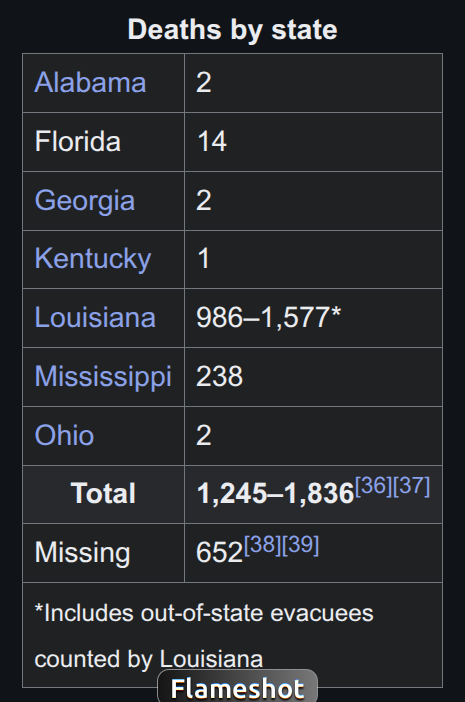
The first really impactful item that sent shivers down our spines was when word began to filter up to us of frightening events in New Orleans – prisoners were abandoned in their cells, left to the steadily rising waters when their guards abandoned them and fled their posts. Thereports were horrendous. Already off-balance with our own conditions, our only thought was “Could we be next?”

Conditions were in chaos in the gym….

Nothing happens to improve your lot in life immediately. Anywhere. In prison it takes an inordinate time longer.
So, our personal safety and provision of necessities obviously took the back seat on the bus. We had nothing and were packed 400 into the gym.

When we first arrived, bedlam reigned. There were no supplies, no bedding, no hygiene materials, no food arrangements, not even rolls of toilet paper. Not even the free people knew what was going on, what to do, who to get advice or instruction from. All of the Main Prison supervisors were stretched out trying to get a handle on the situation. Sometime in the early morning of the next day trucks arrived carrying old army-surplus styled folding green cots and we were all given one, so that at least we could get up off of the floor.

Prison being what it is, when we were told that we could only bring one pillowcase with us, most guys stuffed their bags with cigarettes/tobacco, instant Maruchan soups, cookies and a change of clothing and – hopefully – a bar of soap and shower shoes, maybe a roll of toilet paper.

The gym was split down the middle by a floor-to-ceiling chainlink fence. On the side where I was told to go, there was one toilet – an old ceramic relic that had to have been 50 years old. Stained, cracked and leaking, when flushed it spread a flood of sewage across the red tiled floor, so that when anyone used the toilet when they walked out, they spread the sewage across the gym floor. And cleaning supplies? Non-existent.

It took weeks before we could get anyone to install phones and set up mailboxes so that we could call or send letters out to our families and friends. In the meantime, all we could do was fret, worry, work or sleep from utter exhaustion. Just a few days after we came to the gym, the sprawling Rodeo grounds were taken over by dozens of officers for processing and intake of hundreds of prisoners from various parishes.

PDF Montage of Dan Bright – Exonerated from Angola Death Row And His Personal Experience With Katrina
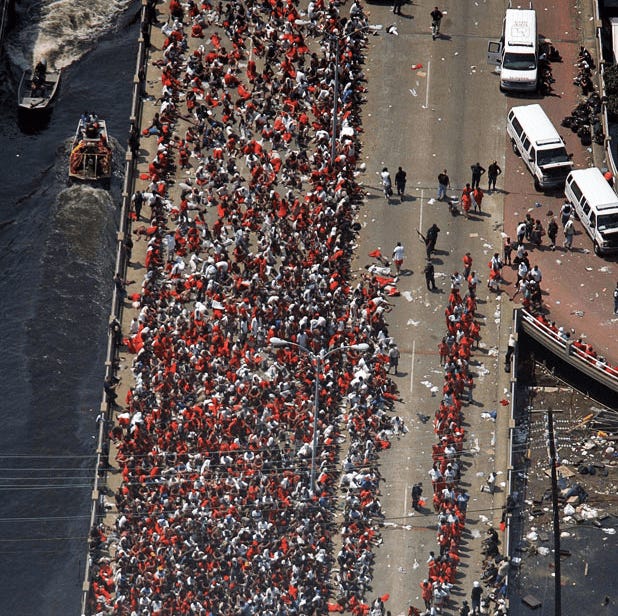
Thousands of OPP Prisoners were eventually herded onto a bridge/overpass where they would remain for several days without food or drink, in suffering heat. Finally, they would be rescued and lowered into boats that carried them to safety, and into another waiting mass for transfer to other prisons, other jails.
“It was complete chaos,” said a corrections officer with more than 30 years of service at Orleans Parish Prison. When asked what he thought happened to the inmates in Templeman III (A building within the OPP complex), he shook his head and said: “Ain’t no tellin’ what happened to those people.”

“At best, the inmates were left to fend for themselves,” said Carey. “At worst, some may have died.”

The stories of mass deaths of abandoned prisoners have not been verified, though a number of individuals and organizations have conducted their own studies and investigations have certainly pointed in that direction. If true, it would have called for a massive coverup.


In the gym, which was slowly beginning to become at least habitable, things became a bit more chaotic as we settled into a routine of work – both our regular jobs (plumbing, carpentry, electrical, etc.) and “emergency” cleanup work, repairs and preparing parts of the prison to house evacuated prisoners from parish jails. It was only the beginning.

While New Orleans received the most attention, smaller communities, particularly in coastal parishes east of the city and around Lake Pontchartrain, experienced massive damage from the storm surge.

  • Slidell: Located on the north shore of Lake Pontchartrain, more than 40% of the city was submerged by the storm surge, which topped 20 feet in some areas. More than 95% of homes and businesses were damaged.
  • St. Bernard Parish: The sparsely populated areas of this parish were hit unexpectedly hard by winds and floodwaters. The emergency center was submerged, and an estimated 40,000 homes were flooded.
  • Plaquemines Parish: Located south of New Orleans, this low-lying, rural parish was “devastated by high winds and floodwaters”.
  • Mandeville: Communities along the north shore of Lake Pontchartrain were significantly impacted by a storm surge of 12 to 16 feet.

Other even smaller towns simply disappeared. When evacuations finally began in earnest, people filtered out to Baton Rouge, Houston, Dallas, Atlanta and some even farther – Tennessee, Chicago, Arkansas and far-flung destinations.

After about 2 weeks, semi-trucks, pickups and even SUVs would begin arriving, packed to the gills with donations from churches, stores and organizations who had learned of Angola’s plight.

My own personal adventures would soon begin.

How ‘Bout A Slice o’ Dat’ Pie, Old Boy!

William Kissinger · August 17, 2025 · Leave a Comment

Cherry Pie We ALL Supposed To Get A Piece Of – ‘Dat’s De’ “Lagniappe“

I was reading over a post that a good friend had made earlier today about what happened in his life when he exposed corruption in the Louisiana State Penitentiary and the Louisiana Board of Pardons and Paroles…the corruption reached all the way up into the Governor’s office. Doing so reminded me that I needed to get back over here and finish this story.

It is, of course, the never-ending story in Louisiana. Corruption is endemic to Louisiana. It’s something that we grow up with, and we always heard ,”Oh, yeah, cher’! It’s a pie. But everybody gets a slice of the pie.” They even have a peculiarly cute name for it: “lagniappe”.

“We picked up one excellent word – a word worth travelling to New Orleans to get; a nice limber, expressive, handy word – ‘Lagniappe.’ They pronounce it lanny-yap … When a child or a servant buys something in a shop – or even the mayor or governor, for aught I know – he finishes the operation by saying, – ‘Give me something for lagniappe.’ The shopman always responds; gives the child a bit of liquorice-root; (nb…)”: Mark Twain, Life on the Mississippi(1883)

On a totally related note, the gentleman who once famously uttered that particular “pie”-phrase served some prison time himself, I suppose, for taking too large of a slice of that same pie

Edwin Edwards, the former governor of Louisiana, served eight years in prison. He was sentenced to ten years in federal prison in 2001 after being found guilty of racketeering, extortion, money laundering, mail fraud, and wire fraud. The charges stemmed from a scheme to manipulate riverboat casino licenses. Edwards began his sentence in October 2002 and was released from prison in January 2011 to a halfway house, before being released from the halfway house in January 2011, and starting three years of probation in July 2011. He was granted an early release from probation in February 2013.

“In 1986, my wife and I exposed the largest “pardons for sale” (as it was dubbed by the media) criminal scheme in Louisiana history. The federal and state investigations that ensued sent the pardon board chairman to a federal prison, got one of the state’s most powerful legislators indicted (later acquitted), forced three prison officials into bribery guilty pleas, led to the resignation of a prison warden and a number of lesser prison officials, and, as you can imagined, pissed off a whole lot of people inside and outside of the Louisiana prison system—including then Gov. Edwin Edwards who never met a bribe he did not like.” (Billy Sinclair, FaceBook post, 8/11/25)

Billy went on to tell about the devastating effect that the incident had on his present and on his future…it would be many more years before he would see his freedom. He was branded a “snitch” by all, and allegations that he had “tarnished the integrity of the prison newsmagazine (The ANGOLITE) and violated some kind of unwritten code of journalism ethics by cooperating with law enforcement.”

“Through the co-editor’s (at the time, Wilbert Rideau) insider influence with the editorial board of the New York Times, I became the only inmate in history to ever be rebuked in an editorial by this massive media conglomerate for exposing corruption over protecting the “integrity” of The Angolite.”

Now, you see, I know a little something about (1) lagniappe, (2) corruption, (3) prison and (4) the consequences of doing “the right thing,” particularly in Angola prison. First, because I served 47 calendar years in that hellhole and, second, because I personally witnessed corruption on a daily basis, and finally because I was on the receiving end of a media-spun retaliation effort by those who dealt in the corruption plague within.

Twice.

The first occasion occurred in 1995 not long after Cain’s appearance on the state scene with his involvement in a private-sector company, Louisiana Agri-Can. The owner, Charles Sullivan, Cain and others with “high-level access, including to the Governor’s office,” had opened a can relabeling plant in the old cannery building at Main Prison. The inmates who worked there labored for hours daily at a rate of between .04 and .20 cents per hour.

At the time, I was an Inmate Counsel on the Civil Litigation Team at Main Prison, and because of a few well-known court victories, was a favored counsel to prisoners seeking assistance. When a prisoner assigned to the plant came to me with his request for help and answers to his questions, I helped, having no idea that it was the beginning of a months-long adventure involving a trip to the dungeon, field work, threats on my life via a plan to “shoot me while attempting to escape,” an emergency removal by U.S. Marshalls, a stay in the East Baton Rouge Parish Prison, multiple hearings in federal court, secretive information provided to my attorneys by an Assistant Warden, and ultimately, a financial settlement with the Department of Corrections.

I, too, was labeled a snitch – but not by prisoners. By guards. A few days after I was released from the dungeon and reassigned to the West Yard field lines, a friend came to me and told me that there was talk circulating among the guards that I could be shot while trying to escape. Much later, after I was in federal protective custody, when I was on the witness stand I was being cross-examined by Burl Cain’s attorneys. They tried to get me to tell them who told me that the guards intended to shoot me. I risked everything by refusing and looking at the judge and asking, “Your Honor, look what has happened to me. If I tell them who told me, that person has a job and is trying to feed his family and is trying to protect me. If they’ll do this to me, what do you think they’ll do to him?”

The judge ruled that I did not have to answer the question and ordered the attorney to ask his next question.

“U.S. district judge Frank Polozola ruled that Louisiana Secretary of Corrections Richard Stalder and Angola Warden Burl Cain be held in contempt. He ordered them each to contribute $1,000 to a victim compensation fund. Stalder, Cain, other wardens, assistant wardens and assorted prisoncrats were all ordered by judge Polozola to take a “refresher course” on the U.S. Constitution, particularly the First Amendment right to free speech.

The contempt ruling resulted from LA state prison officials failing to produce documents the court requested and for violating an order not to harass a prisoner. The prisoner, William Kissinger, had been employed in a private prison industry job at an Angola prison relabeling plant. Kissinger wrote a letter to federal health officials that cans of evaporated milk and tomato paste with old expiration dates were being relabeled and shipped out of the prison. “The bottom line is that Kissinger, a two-time murderer, was taking actions to protect the public,” judge Polozola said. “The DOC was taking actions that would hurt the public and protect the contract of friends.”

After Kissinger wrote two letters to the U.S. Food and Drug Administration (FDA), in which he said the can relabeling operation was “shrouded in secrecy” and “stinks of impropriety,” he was retaliated against by prisoncrats. Kissinger was transferred to a farm laborer job in a distant corner of the 18,000 acre Angola prison complex. He had been serving in the main prison as a legal advisor to other prisoners. Prison officials seized the computer Kissinger had used to assist other prisoners and to write the letters to the FDA. “Clearly this was retaliation,” said Kissinger’s attorney. “The inmate was transferred because of bad words. There is not an iron curtain between inmates and the First Amendment.”

Polozola agreed that transferring the prisoner and seizing his computer amounted to harassment, in violation of an earlier order he had issued to prevent officials from retaliating against Kissinger.”

Source: Corrections Digest

To illustrate the dangers involved in “doing the right thing,” from both sides of the fence, a meeting had been held the day before this particular hearing at the Ranch House. Burl had put a dot in the middle of a chalkboard and said, “That’s you.” Then, a circle around the dot, and an X inside the circle. “The X is you. You’re good and you’re safe.” Now, an X outside the circle. He pointed at it and said, “If that’s you, your ass is grass, and I’m gonna’ be the lawn mower.”

The next day at this hearing, my attorneys brought this conversation up when examining a witness. Burl’s jaw dropped when the attorney asked, because he now knew that someone in his inner circle had given us the information – he didn’t know where to turn. And, there was nowhere left to turn. When he finally took the stand, he could only rant and finally admit that, yes, he had retaliated against me by locking me up and ordering my computer seized. Because – ya’ ready? ‘ I had used “bad words.” Words like “shrouded in secrecy” and “stinks of impropriety,” when it literally was.

The Second War

The second occasion was 20 years later when Burl was under an investigation by Maya Lau, an investigative reporter and her team for the Advocate in Baton Rouge. This time, also, was because of the written word. I have this terrible habit of doing the right thing. And granted, it doesn’t always work out in my favor. Maya reached out to me as a source for her current investigation after she unearthed data about my first encounter with Burl and the tangled web he wove.

(L) Katie Schwartzmann, Atty and (R) Maya Lau, Investigative Reporter, The Advocate

So, we began a correspondence that began with a letter from her requesting to be placed on my visiting list. Because of my previous confrontation with “The Boss,” as he liked to be referred to as, the letter actually shook me up a bit. I carried the letter to my Camp Security Supervisor (a Colonel) who also, incidentally, happened to be my Camp F VETS Club sponsor. I felt naturally that I could trust him if no one else to guide me through this swath of uncharted waters.

As it happened Burl Cain was scheduled to attend a party at the David Knapps Training Academy located right next door that very afternoon. So, armed with the letter and my request for direction, the Colonel went next door to seek blessings for me. It turned out that Burl didn’t show up, but his trusted Deputy Warden was there. So, the Colonel showed him the letter and explained the situation and my concerns. The response? “Man, tell Kissinger he doesn’t have to worry about that stuff. That’s all water under the bridge.”

Except, it wasn’t. Or if it was, the waters were awfully deep and swirling rapidly. We continued our correspondence and suddenly a few weeks later I found myself stripped, jumpsuited, beaten, shackled and in the back of a van to an entirely different prison far away where I languished in solitary for weeks.

Because there was a Major there who I had helped a couple of years earlier with a discrimination lawsuit against DOC, I was finally able to get a phone call. I dialed a friend and told him to immediately record our conversation so he could play it back to Maya. I had a lot of information to get out there and get out there fast. I gave him Maya’s name and stated the specifics of my situation, and stressed the urgency of it all.

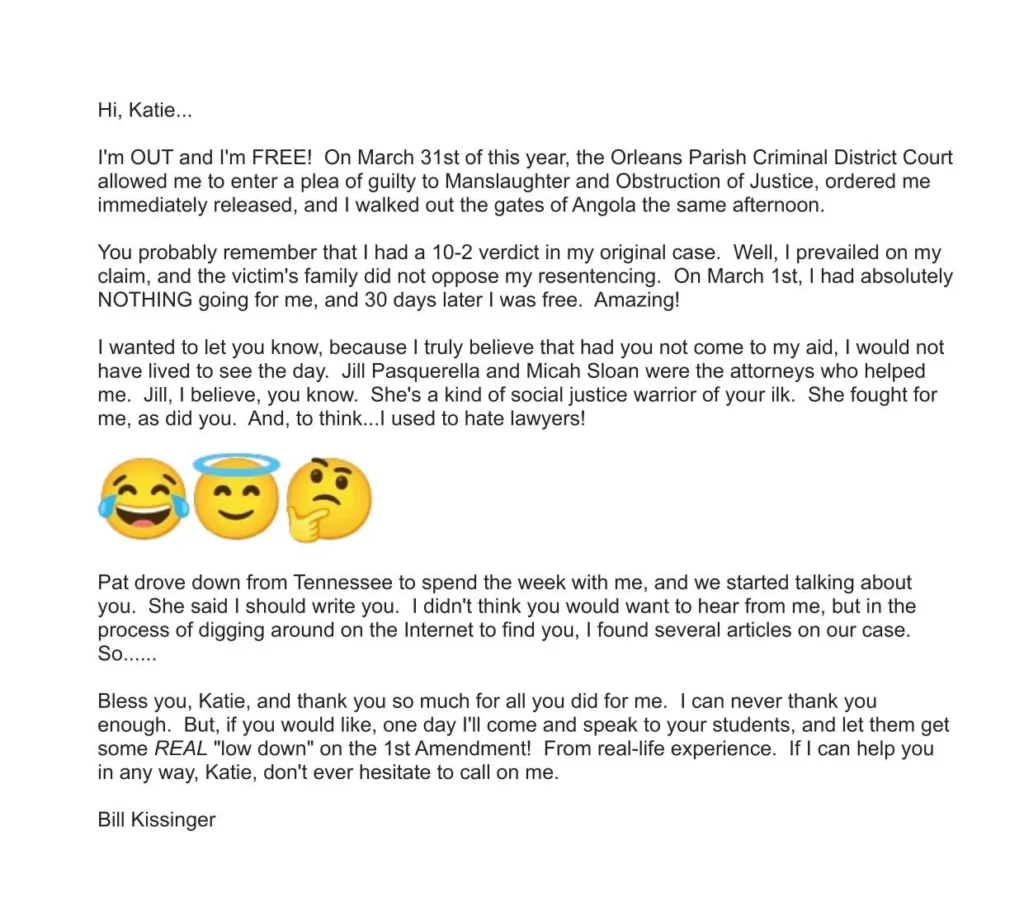
To her credit and the credit of the ADVOCATE, she immediately got the ball rolling. Now they weren’t so concerned about my 1st Amendment rights – they were concerned about their 1st Amendment right and access to information. In the end, though, they did the most important thing – they secured counsel for me. One day not long afterwards, a Sergeant came to my cell and flung the door open and said, “Lawyer visit…let’s go.” And that’s how I metKatie Schwartzmann,a tough and gritty bulldog of a lawyer and a staunch defender of the 1st Amendment. The Roderick and Solange MacArthur Justice Center took my case.

It took some time and a few prison disciplinary hearings, a few “DENIED” Administrative Remedy Proceedings and about 6 months in an extended lockdown cell, before Katie finally filed my lawsuit against Burl Cain and Jimmy LeBlanc (Secretary of Corrections at the time) and about 16 other named defendants. Katie knew from the outset that it would be a difficult case, but she stuck with me and we proved that, for the second time, Louisiana had tried to silence me. It took literally two years to climb that hill. We won hands down. The single most important goal I had was getting back to Angola, back to my same dormitory and job assignment, and getting my property back. The settlement we reached accomplished all of my goals. And, hey, I didn’t forget her. Several years later after my release, I reconnected with her.

eMail I Sent To Katie After I Was Released From Prison

Yes, prison is tough and danger lurks around every corner. There are traps and pitfalls everywhere one looks and every time one sets their foot down. Fellow prisoners, guards – anybody – can hate you for doing the right thing. Sometimes it is very hard to do it. Sometimes you suffer. And very seldom do people appreciate what you’ve done that ended up helping them. My takeaway, though, is that when you do the right thing, well, right things happen for you. I’m just glad there were people willing to stand in that gap beside me.

The Ditch-Side Homicide

William Kissinger · August 17, 2025 · Leave a Comment

Murder In Prison Beside A Ditch

When I first arrived at Angola, it was a truly lawless place, a landscape littered with broken hearts and dreams and shattered souls, a place full of anger and hatred, a place where people went to wait to die. As did I. I was sentenced to LWOP (Life Without Parole) for a senseless murder, the taking of a human life for dollars – chump change, really – in a drug robbery.

Well, now, I did have an excuse though no one wanted to hear it. I was an angry, Vietnam veteran with a humongous chip on my shoulder, mad at the whole world and at the government that didn’t support us and at the people stateside who rallied in the streets to oppose what we were sent to do, where four kids died at our own hands at Kent State University. I was angry at everybody and felt that they all owed me something for my self-inflicted misery.

I Was An Angry Young Veteran and An Addict When I Was Arrested

Angola was still in the throes of integration. Whites and Blacks living together! My God, imagine! And in the heart of the Deep South?! The East Yard was the West Yard and the whole world was crazy. Camp A, Camp F, Camp H, Camp I and Main Prison were the only living areas and they were all a mess. There was none of the Camp C and Camp D and Camp J, they were all lines on blueprints somewhere. DeQuincy was a dream in somebody’s mind because one could never get there. Wade and DCI didn’t exist yet, and the state’s prison population would swell to levels never before imagined. Louisiana has an incarceration rate of 1,067 per 100,000 people (including prisons, jails, immigration detention, and juvenile justice facilities), meaning that it locks up a higher percentage of its people than any independent democratic country on earth.

I spent my first few months at the old RC (Reception Center) building (which housed Death Row and CCR) because about 2 weeks after I got there, Butch Germain got me a job as a clerk in the print shop which was located in the back next to ID. I could pronounce multi-syllable words, could spell, do math and was White. I was a lock for virtually anything. Butch was a guy I met in the backseat of an NOPD cruiser that picked me up from the plane I was extradited from Texas to Louisiana on. Butch was locked up on a Felon in Possession of a Firearm charge, and had copped out for a 10-year sentence on a double-bill to avoid an HFC (Habitual Felony Conviction) sentence. He arrived at Angola about 3 weeks before me, but we had maintained our friendship all during the months of Parish Prison. This, of course, was long before Louisiana went stark raving mad and started issuing 198-year sentences for Armed Robbery and 35-year sentences for Simple Burglary. Much simpler times.

They had gotten rid of khaki-back guards (inmate guards with shotguns) a couple years earlier, though they still utilized them as what we called “Turnkeys.” The only task the Turnkey had was to guard a locked gate and open and close it using a big old heavy brass key. Secretly, they would do a bit of head-thumping for ranking security and always got away with it. The older ones they put in private little rooms on the second floor of RC, and they were protected. I mean, how long would they last in population with guys who just a couple years earlier they had wielded a shotgun over in boiling sun and doing backbreaking labor? Not long, and they knew it. I had an experience with one of those Turnkeys that was pretty entertaining but I’ll save that tale for another time.

About 9 months after I got to Angola, they reopened Camp A following a renovation and 50 of us were the first ones to occupy the Big Stripe side of the Camp. I was the second one through the gate (right behind Chester “Cheeky” Lawrence) and found a choice bunk in the corner and settled in. This was my new home and would be for a couple of years.

For several months we lived in the Camp and rarely went anywhere, rarely saw anything or anyone, and lived an isolated life where simple fights were the norm, “aggravated fights” (with any type of weapon) slightly less common. We didn’t have locker boxes, no way to secure our meager possessions and many fights were over stolen goods, many were over homosexual “lovers” spats, and some were racially motivated. Integration was slow in taking over and becoming the standard. Southern White boys being what they are and Blacks being what they are it kind of took a while for things to settle down.

We kept our possessions in cardboard boxes shoved under our beds, and we had to hustle the boxes from the kitchen or wherever we could find them. The camp was overrun with roaches and silverfish bugs. Radios and 8-track tape players would be infested quickly as the roaches loved the glue on circuit boards. To have a radio – GE Super Radios and Panasonics with a tape player were considered the top of the line – was both a status symbol and an invitation to host a brawl.

We used to gamble – a LOT – because of all the slack time on our hands and no way to burn energy off. For a while we even had a 24-7 poker game on a bunk pushed up next to the bathroom wall so we could see the “table” and count our “money” and pots after the lights were out. There were “big games” and little games. Big games were played with cigarettes, cash, watches, rings, new jeans – whatever one had of value and were worth whatever the “house man” placed on it. Little games were played with cookies, candy bars, and cigarettes.

There had to be guards available to allow us yard time on the tiny patch of land the Big Stripe side afforded. We were fortunate, as the Trusty side didn’t even have a yard – their building looked out on a cattle pen for the dairy which was the main industry of Camp A, but for Trusty prisoners only as they had to be up and at ‘em for 2:00 in the morning. Our back yard was actually big enough to play a raggedy game of touch football and had an old basketball backboard up on a post – sans net, naturally.

Willie White was in our dorm, and was one of the most fun and bubbly guys you could hope to be around in a maximum security prison. It was almost as if he didn’t deserve to be here, like he had jumped off the bus by accident and never caught a ride back. He and “Big O” were best friends, and Big O liked to put down one of the little poker games because Willie loved cookies and this way they always had a steady supply of duplex cookies for Willie to munch on. Big O was a fat older Black guy and Willie was a short but stocky Black – neither one of them had a racist bone in their body, so some of the White guys would join in their game, myself included.

James Love* was a younger Black guy from New Orleans, a hipster who embodied hip the way Irma Thomas embodied the French Quarter soul sounds she was so well-known for. He was also secretly in a homosexual relationship with “Georgie,” another New Orleans player with what was called “big hair,” an Afro that when fully picked out looked like a huge halo tarnished by time and prison.

This particular day started out just as any other – 65 men rushing to occupy one of 5 ceramic toilets, 4 sinks and a big mop sink. With toothbrushes in hand and clutching sour-smelling washcloths they made their way to the bathroom. Willie was as usual bantering lightly with someone when he encountered Love who said something no one could hear, and Willie turned around and told Love, “Bitch you the one over there making humps up underneath that blanket with Georgie!” Love said something about, “Yeah well, we’ll see about who be making humps!” and walked off.

By this time, Camp A had finally gotten an extra free man and he was assigned as a Line Pusher for our dorm’s field squad, Line 2. Because we were a small line (20 men max, as that was the most that a single guard was allowed) we usually worked very close to the camp and always within walking distance. Directly across the main road that ran from the Front Gate of the prison all the way around Angola was a large field where greens were growing. This huge field was surrounded by a ditch about two feet deep by 3 feet wide.

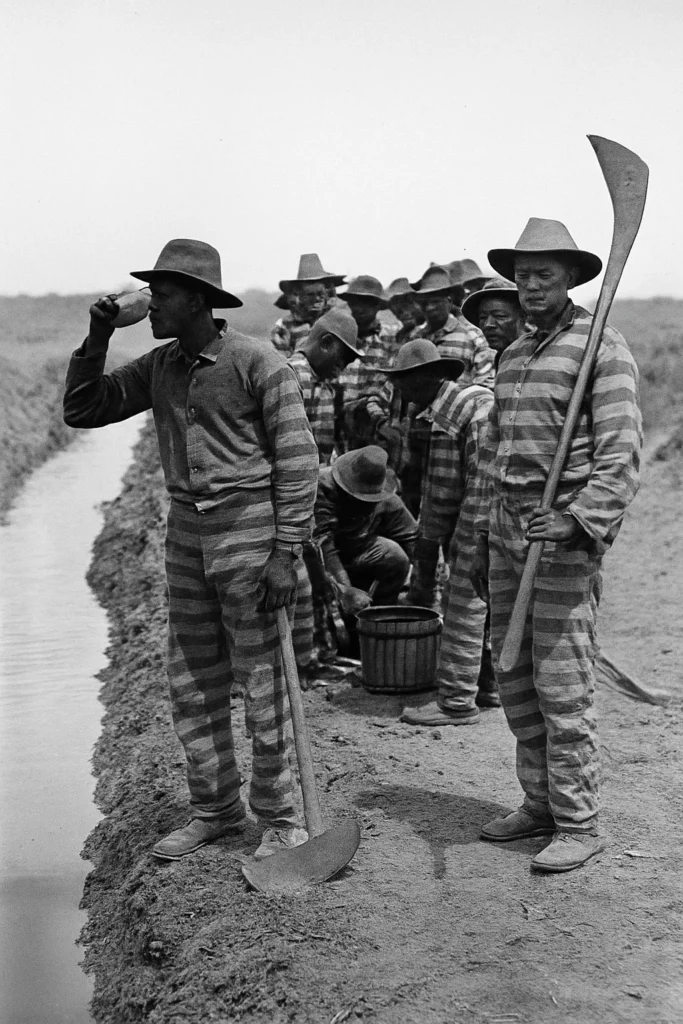
Convicts Working On Ditch – “3-Minute Waterbreak”

We were clearing the sides of the ditch and the bordering Johnson grass and weeds alongside the road, and using an assortment of tools such as ditchbank blades, a few hoes and a shovel. If you’ve never seen a ditchbank blade, they’re a long-handled tool with about a 14” curved blade about 4”wide. Normally, the Line Pusher would assign one man – a hard worker – to the short blade, which was a typical ditchbank blade but with a sawed off handle, usually used to cut and clear a guard line so the guard had a clear shot down the line.

TYPICAL DITCHBANK BLADE

I was blessed! This was my week to work the water bucket, and my partner was John Blanchard (a little rich White dude out of Lafayette whose daddy owned an oil well service company). The two-man team rotated on a weekly basis. All I had to do was pick the bucket up with John and carry it down to where the free man pointed and set it down. There was a collection of about 8-10 coke cans with holes drilled in the side and a wire hook to hang them from the bucket.

The water wagon would come around to all the lines early in the morning and fill our buckets up and this had to serve the whole line because he wouldn’t come back around until much later. At this time the lines worked for an hour and were given a 3-minute break. During that 3-minutes you had better do everything that needed doing: piss, roll a cigarette, talk, bullshit with your buddies or drink water. At the end of the 3 minutes you immediately went back to work.

When the pusher hollered “Break time! Drain ‘em, get ‘em and roll ‘em,” everybody scrambled, and we headed to the spot he pointed at, just far enough away from him and his horse. We set the bucket down and hung the cans on the lip and stepped back to clear the way for the thirsty workers. After a minute or two, Willie came to the bucket and stuck his blade in the ground and peeled his gloves off and folded them over the handle. He was laughing and joshing with someone as he leaned down and grabbed one of the cans and dipped it into the water.

He was mid-sip— cup to his lips, a casual tilt of his wrist and a laugh still on his lips when the blade came. I didn’t see it at first. Just the cup, slipping from his hand. Just the snap and grunt of his body folding in half like a broken toy. Then the thud. His head – attached only by a cartilage to the body – landed at my feet, eyes still open, mouth still curved in the soft shape of a swallow.

The blood came in a sudden burst—hot, blinding, metallic. It painted my shirt, my face, my mouth. I staggered back, gagging, hearing the distant echo of my own scream tangled with eighteen others. The Line Pusher was frozen with a look of horror on his face, and he drew his weapon and shouted and choked and put his pistol back in the holster, then drew it again and tried again to get his words out and failed.

Eighteen men—tough men, hard men—frozen mid-roll, mid-joke, mid-breath. Someone dropped a half-rolled cigarette. Another vomited instantly. No one moved toward the body. No one dared. It was as if time had cracked open and spilled something ancient and merciless into our midst. One moment: laughter, cool water, early morning weariness and sweat. The next: death, unfiltered and grotesque, as intimate as breath on skin.

No warning. No reasoning. Just the bright red of carotid arterial blood. Just silence. Just the sound of the cup tumbling slowly across the dirt, as if trying to pretend this was still just a normal working day.

Love stuck his short blade in the ground and walked to the ditch, away from our circle of shock and away from the Pusher. When he got to the ditch, he simply sat down. No drama, no excited yelling, just a weary sigh as if he had completed some long-burdensome task.

This was, of course, long before Angola had millions of dollars worth of 2-way radios and broadcast towers and computerized communications networks and ambulances. In those days, emergencies were broadcast from the fields by a succession of three quick gunshots that signaled what was known as a high-rider. Depending on his location, he would be either on horseback or riding what we called a “bronco,” which was akin to a Jeep.

We were still trying to gather our wits when the air was shattered by his three rapid shots. Moments later the high-rider screeched to a stop and he jumped out and asked the pusher what was happening and his eyes followed the pusher’s silent, shaky pointing finger. His eyes widening, he drew his weapon and screamed at everybody to move toward the middle of the field and away from the scene.

Within a half-hour there were a half-dozen or more broncos and personal vehicles gathered around us and they began pulling us off to the side and questioning us as to what we had seen or knew about what had happened. Love was handcuffed and hauled off to whatever fate awaited him, and after another hour or so we were lined up and counted and walked back to the camp. I don’t know what everybody else said, but I didn’t see anything.

The mood was subdued, somber. Everybody was quiet. We got to the gate and the shakedown was a lot more thorough than usual, and there were a lot of “mother fuckers” thrown around, Upstairs, we watched quietly as the guards came and packed up both Willie’s and Love’s property and left without another word.

The next day was a normal day.


I told this story because I was talking to my friend and extraordinary filmmaker and documentarian, Catherine Legge, on the phone yesterday about the violence in Angola and this story came to mind. It was my first witness of a murder in the prison and it had a lasting effect on me. From that point forward I kept a proverbial set of eyes in the back of my head.

For 47 years I held on to those eyes, as if they would be the only thing that would save me. They probably were.

This was the first murder I witnessed in Angola, but it wouldn’t be the last. Thank God it is a different world today.

STRETCHING THE LIMITS – Prison Jobs

William Kissinger · August 17, 2025 · Leave a Comment

During my 47 years in Angola (Louisiana’s State Penitentiary), I think I held something in the area of 8-10 different jobs. Doesn’t sound like a really good track record in the “free world,“ but trust me, it’s very good in prison.

I met the coolest of older dudes – they’d all been in the system for decades – when I finally made Trusty and moved to Camp F where the vast majority of trustys lived, worked, ate, slept and played. It was a world unto itself with a totally different caliber of men than found in the Main Prison or any of the other outcamps. They were older, more mature, stable. It was away from the hectic pace of the rat race that passed for the wider general population

I knew guys who had 30+ years in one job assignment, but they were trusty and hardly ever moved around the farm and usually had a “technical” or highly-skilled job. An example of this was my friend, Wayne…he worked in the Electric Shop, and had done everything from sweeping and mopping the floor, to working on the “pole truck,” and doing high-voltage line work, to working in the motor rewinding shop. He was finally released some time back and went directly into some well-paying job with all that experience. He’s currently living the good life in rural Louisiana.

Another of the guys, Earl, was a laundry worker – he had worked in every single assignment in the laundry, from orderly to washer to dryer, to presser and folder. He had been there for 27 years and loved his job and would often step in for someone who had a visit or was on callout or just didn’t go to work because he could operate any piece of equipment there.

Forget the fact that he had three cats he had raised from kittens that he cared for like a fussy and dotty old aunt. He died several years ago from a stroke, still working in the laundry.

Trusty workers always brought him special finds – wild onions, greens, garlic, peppers, tomatoes – from the various fields around the farm. He prepared a stack of good soul-food plates on weekends for sale for cigarettes and gave away half of what he made to poor and disabled convicts.

Tall cooked in various kitchens around the farm for over 40 years. He suffered from diabetes, and as a cook was on his feet for hours and hours every day. Finally, his legs were lost to age and his culinary skills lost to Angola.

Or, take Jerry…a sophisticated backwoods country boy who always proclaimed his innocence and bitterly cursed “the bastards in that damned parish who don’t want to see me free!” while passing out well-worn hoes, rakes and shovels along with the occasional weed eater or lawn mower from the Tool Shed. Every single tool had to be checked out and signed for by the borrower and accounted for upon its’ return. He was meticulous with records and inventories, especially of chemicals and flammable liquids.

Jerry had been at Angola for about 30 years when I was around him and had seen his share of interesting events. He had, at various times, worked in Tool Sheds around the farm, been an Inmate Counsel, been a cook, a club president, an orderly, an ACA compliance clerk, and a general pain-in-the-ass to virtually everybody.

Jerry was an ornery bastard but, at heart, was a good dude. He had tried several off-time activities, but eventually settled on one of the rarest of penitentiary hobbies – taxidermy. He combined his job with his hobby and his source of income. And it was a good choice – he maintained the support of the “old guard” crew of wardens and high-ranking security while he had the opportunity to build bonds (and customers) with the new guard. He gradually moved his taxidermy operation into a remodeled partitioned space in his Tool Shed and kept a pretty cluttered area that was highlighted by his own stove where he often had a big pot of jambalaya. He had a BBQ pit where on special occasions deer meat or pork steaks would be found for those fortunate enough to be invited.

When I left Angola, he was still busily handing out tools, checking levels in fluid containers, stitching animal hides and stirring up jambalaya, all the while proclaiming his innocence.

Or, “Ole Fox,” who never saw a pair of boots he didn’t want to lick. He had been down a little over 30 years when I was last around him. He was a middle-aged leaning in to older poor Black man who came from a bitter and impoverished background, and had had to work hard for everything he had ever had. When you first met him, he would come off as sort of gruff, with a deep and gravelly kind of voice. He had a habit of talking with his hands – like a lot of Italians do – and he made it a point of maintaining eye contact with you the whole time. If you looked away he wouldn’t hesitate to touch you on the arm or shoulder or back to return your attention to him.

He worked at the Mule Barn where the mules were there for the purpose not only of being working beasts of burden but for show as well. When they weren’t busy hauling fresh-picked produce from the field farm lines or delivering 500-gallon tanks of drinking water to the crews picking those crops, they were being groomed and made ready for TV. The Warden at the time, Burl Cain, loved to show off his mules and the Barn was a favored spot for taking escorted visitors on tours of “The Farm,” as Angola became famously known. Who decided to jump into the lurch and become the featured mule expert? Fox, of course. When not at work, he loved to talk about his job and the things that went on there, and would do so with anybody within earshot.

He called Burl Cain “his daddy,” and meant it. Once, Burl saved Fox in a disciplinary-type situation and the CO who was on Fox’s ass got chewed out pretty royally. Fox never let him or anyone else forget it.

“I’ll go to Burl on your ass in a minute!” became his standard reply when confronted with virtually any situation he didn’t like or was threatened by, Talk about stretching the limits!

These are just a few of the guys whom I was around while I was doing time. Angola was – if nothing else – a total hodge-podge of personalities that made up the unique environment that was Angola prison. I’m so glad I’m gone – they can keep it!

Murky Waters – Just Enough Light To See

William Kissinger · August 17, 2025 · Leave a Comment

When I set foot down in Angola (Louisiana State Penitentiary) in 1975, I had no clue what to expect, was scared out of my mind and never expected – by any means – to ever leave. My arrival was heralded by a pot-bellied, snuff-dipping, foul-mouthed redneck guard who told me to get my “fuckin’ sorry ass in that ditch and get to cuttin’ or I’m gonna’ show ya’ a new place for ya’ to sleep!”

So…THIS is Angola?

I found myself at 7:15 a.m. on my very first full day in Angola wading into greenish murky water that came up almost to my waist. My clothes were the same ones I had on at the time of my arrest a year earlier – bell-bottom Levi’s, a Polo shirt and Converse shoes. They were stylish when I last had them on; here, now, I felt like they were flashing a neon sign that said, “Scared as Hell!” Looking around me there were 19 other guys in various types and colors of clothing and every one of them had a different sign flashing: “Scared as You!”, “Defiant!”, “I’m Mad!”, or “I’m Lost!”.

The only one who didn’t have a sign flashing around him was the foul, pot-bellied guard sitting on the horse prancing around above us on the bank. He didn’t need a sign because every time the hack spurred the beast he would throw clods of mud into the water splashing on us, the guard cursing the horse and us simultaneously. It was not a pretty sight, and unsettling to say the least, especially on an empty stomach. How in the hell did I end up here, waist-deep in slimy green water, beating on a cypress tree with a dull ditchbank blade and a redneck hack screaming at me? I had only been here for about 9 hours!

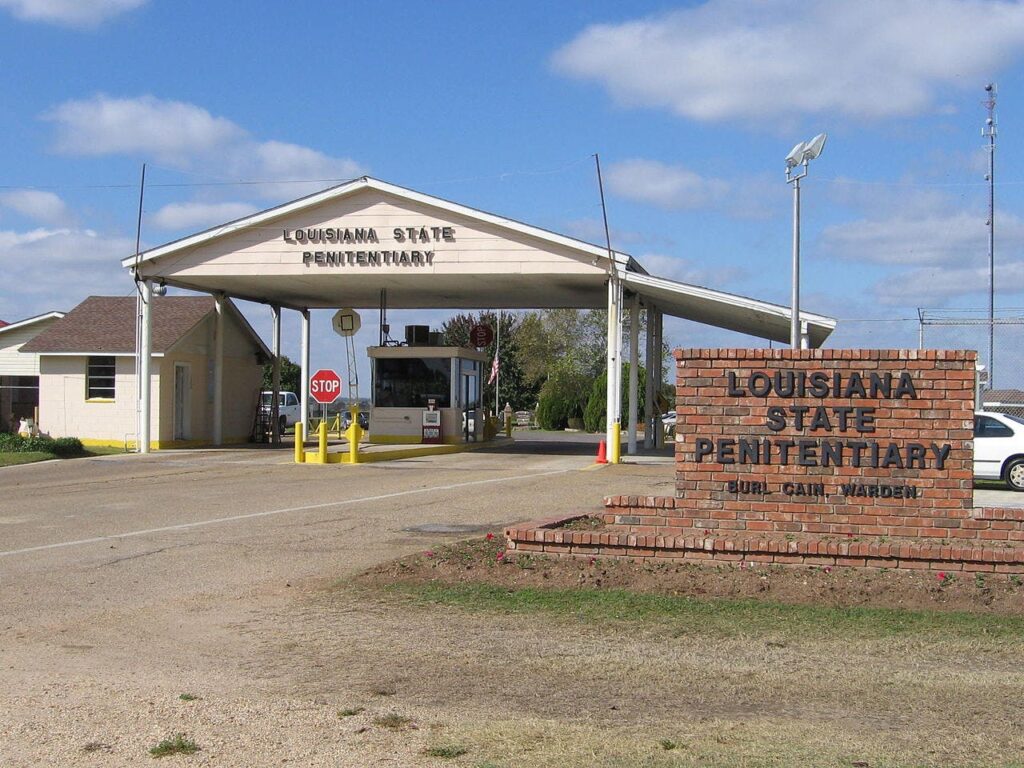
Front Gate – Angola State Penitentiary

The next 47 years would fly by or crawl by or stand stock-still; there would be good times and better times, and there would be bad times and horrible times and some absolutely bone-crushing frightening times. There would be times when I doubted the likelihood of waking the next day, or even of making the next meal. There would be times when I hated every single free man (employees of DOC) that I came into contact with, and I knew that they hated me. And believe it or not, there was actually a time when my heart ached when I stumbled upon a Captain trying to hide so he could cry because his phone rang and he found that his wife had just miscarried their second expected baby.

Prisons bring out the widest array of emotions that it is possible for any one human to display, and the timing of their surge to the surface is never quite optimal. At the most inopportune time one could be overwhelmed with a crushing sense of sadness that took all the breath out of you, or filled with a rage that blinded you with a fury burning so bright that you radiated with the anger and those around you felt the warmth.

So, we were prisoners not only of the rules and bars and fences and concrete, but of our own emotions as well. In effect, we became our own jailers bound by our angers and sadness and fears. This was our world.

I used to laugh – inwardly, of course, as outright mockery could earn you a quick and nasty ass-whipping – at the brazen stupidity of some of our keepers. Take the Compound Shakedown Lieutenant who found a 3.5” floppy disk (remember those ancient artifacts?) in my shirt pocket and when I explained that it contained “files” wanted to lock me up for an Attempted Escape.

Or the one who wrote me up for having a tiny flower plant in a clay pot. I used to take the pot outside early in the morning and let it get sun and air, and return it in the evening. Watching it steadily grow and begin to bloom and fold its petals at night as if sleeping gave me a sort of calming pleasure. The guard who wrote me up for it did so out of a sense of petty vengeance – he could do it, and there was nothing I could do about it. I get my pleasure now knowing that I can tell others about how petty he is, and there’s nothing he can do about it.

Tiny Flower In A Clay Pot

I suffer from COPD so a macing or tear gassing incident can deal me a lot of trauma. In all my years of incarceration, I was only personally gassed twice, but fell victim as a “collateral bystander” on several occasions. There is nothing more frightening than not being able to breathe. The unbearable weight of tons of stone pressing down upon your chest, the heart-rending agony of even a breath of the poison sending coughing spasms down into your lungs, wracking your entire body, tears streaming down your cheeks and making the burning in your eyes worse…

Both times that it was directed towards me personally were done by the same guard, and he did it because he could and because he didn’t like me and because I showed him just how stupid he was. So, yeah….my bad. I really should have left him in the dark. Would have saved me a lot of pain and suffering. But, he would still have been stupid.

One of the things I learned fairly early on was to pick my battles, and to pick ones that I thought I could win. The end goal, of course, was to win the war, but to do it one battle at a time. Just surviving was winning. The bastards wanted me to die there – I wanted to live. Just this morning I realized that I had in fact won the war, because I’m out here in Florida with a swimming pool not far from my front door, and he’s still right there in Angola.

By the time I was released, I had grown considerably older, a lot wiser, and much more tolerant of my fellow human beings. And, therein lies the rub – I now saw them as human beings instead of just blue-suit guards with hangovers and erectile dysfunction bent on making my life as miserable as they perceived theirs to be. But, this wasn’t a sudden thing that came about at the end of a long sentence. This was a gradual change that occurred over a long period of time, over a lot of emotional roller-coasters, and over a lot of personal triumphs and personal losses.

I can easily say now that by the time I walked out that Front Gate into the free world I could count among my friends at least 3 Deputy or Assistant Wardens, a Colonel, several Majors, a few Captains, a couple of Lieutenants, and a dozen or so Sergeants. Now, that doesn’t mean at all that I fell soft or forgot who I was and started mingling with the enemy. It just means that I now viewed them for what they were and they finally saw me for who I am – human beings.

And, I’m glad for that because it finally allowed me to win that final battle, which let me win the war: I saw myself as a human being. I was no longer an angry drug-addicted Vietnam veteran and a survivor of abuse. I’m human, and it’s so nice to be here with you.

  • « Go to Previous Page
  • Page 1
  • Page 2
  • Page 3
  • Page 4
  • Go to Next Page »

My Life After Prison

Copyright © 2026 · Website provided by Boomajoom